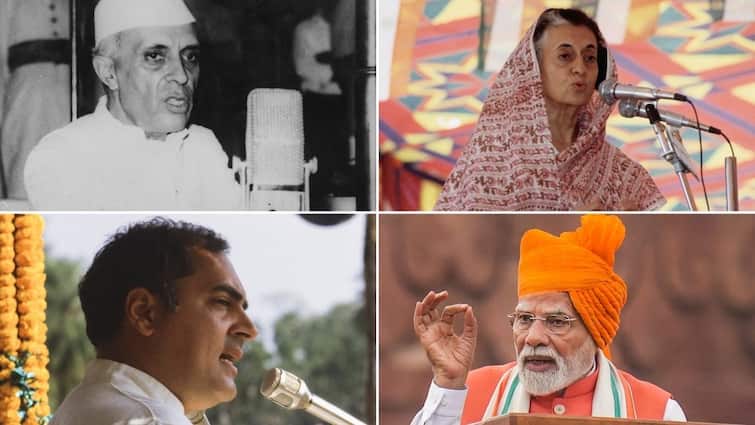

Since 1947, India’s Prime Ministers have addressed the nation from the Red Fort on Independence Day, using the moment to outline challenges, set priorities, and offer a vision for the future. A review of these speeches shows how each leader has approached issues ranging from governance and foreign relations to the economy and national security.
Shifts in Focus Over the Decades
In the early years after independence, Jawaharlal Nehru’s speeches often centred on poverty, agriculture, education, and foreign policy. Yet, despite the enormity of the issues before him, Nehru sometimes spoke for as little as 15 minutes on August 15. Indira Gandhi’s addresses, while longer, also reflected similar brevity compared with later leaders. Rajiv Gandhi gradually extended the scope, with speeches lasting over half an hour.
In contrast, Prime Minister Narendra Modi has consistently delivered lengthier addresses, often presenting detailed action plans, timelines, and year-on-year progress reports. His style marks a departure from earlier Prime Ministers, who were criticised for treating the Independence Day speech more as a formality than an agenda-setting exercise.
Business and the Economy
The relationship between government and business has been a recurring theme. Nehru often took a critical view of traders and industrialists, accusing them of profiteering and black-marketing. Indira Gandhi echoed similar concerns, warning against corruption and market manipulation. Rajiv Gandhi, while highlighting reforms such as bank nationalisation under his mother, also spoke about limiting the influence of capitalist forces.
Modi, however, has struck a different tone. In his 2019 address, he called wealth creators “nation builders” and urged respect for entrepreneurship, reflecting a broader policy shift towards encouraging start-ups and private investment.
Speaking to the People
The tone adopted towards citizens has also varied. Nehru frequently called on people to work harder, avoid waste, and support government initiatives, at times attributing shortages and inflation to public behaviour. Indira Gandhi stressed civic responsibility but also placed blame on consumer choices that encouraged black-market practices.
Rajiv Gandhi portrayed India’s progress as the outcome of decades of leadership, while Modi has consistently placed faith in ordinary citizens, praising their resilience and positioning them as central to national transformation.
National Security and Foreign Policy
Responses to external threats, particularly from China and Pakistan, have been a recurring element. Nehru’s 1962 and 1963 speeches adopted a cautious tone following the border conflict with China, but critics noted the absence of explicit tributes to soldiers’ sacrifices. Modi, by contrast, has highlighted military achievements, such as the response in Ladakh in 2020, and paid homage to fallen soldiers.
On Pakistan, earlier Prime Ministers, from Nehru to Manmohan Singh, often spoke of shared history and the need for peace. Modi’s approach has been more assertive, emphasising action against terrorism and acknowledging people in Pakistan-occupied territories.
Tackling Inflation and Governance
Inflation and food shortages have been a constant concern. Nehru and Indira Gandhi often referred to the problem but offered limited specifics. Indira at one point suggested citizens grow vegetables at home to ease shortages. Manmohan Singh argued for better prices for farmers but attributed inflation partly to global factors. Modi has highlighted welfare schemes such as free food grain distribution during the pandemic, while pointing to stronger macroeconomic fundamentals.
On governance and accountability, Nehru and Indira spoke of responsibility but were criticised for shifting the burden onto citizens. Modi, in his first Independence Day address in 2014, said governments should be judged by whether they “walk the talk,” stressing transparency and implementation.
Democracy and Leadership Styles
Indira Gandhi’s speeches during the Emergency in the mid-1970s described the suspension of democratic freedoms as necessary under the circumstances. Rajiv Gandhi defended democratic institutions but criticised what he saw as irresponsibility within them. Modi, by contrast, has repeatedly described democracy as India’s greatest strength, while calling for an end to corruption, nepotism, and appeasement.
A Continuum of Legacies
Different Prime Ministers have framed their predecessors in varied ways. Rajiv Gandhi credited India’s progress largely to his family’s leadership, while Modi has acknowledged the contributions of all governments since independence.
As India prepares to mark another Independence Day, the speeches from the Red Fort remain more than symbolic. They reflect not only the priorities of each era but also the evolving relationship between leaders and the people they address, raising the question of how future Prime Ministers will define their vision for the nation.