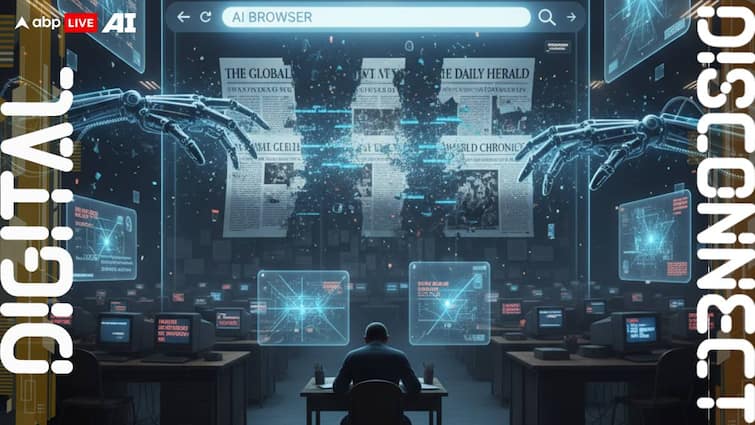

Digital Disconnect:Remember when browsers were simple? You typed, you searched, you clicked, you discovered. Now, the latest tech darlings, Perplexity’s Comet and OpenAI’s Atlas, want to turn that entire experience into a chat. Instead of opening a dozen tabs, you’ll just ask your browser, “Hey, what’s happening in Bihar ahead of the elections?” and et voilà, it’ll summarise the internet for you, complete with a confident tone, a sprinkle of bias, and zero need to actually visit a news site.
Sounds futuristic, right? Sure. Until you realise those “summaries” are stitched together from the hard work of journalists and editors who now get none of the traffic, none of the credit, and none of the ad money. The bots may be summarising the world, but they’re also starving the very industry that documents it.
The Silent Extinction Of The Click
We’ve already seen what Google’s AI Overviews can do, a cheerful one-box answer that crushed referral traffic faster than you can say “algorithmic oversight.” Now imagine that power baked right into your browser.
Every question you ask becomes a self-contained conversation, every source blurred into digital mush.
ALSO READ: Google’s AI Overview Is Eating The News Industry Alive, One Search At A Time
If you think this traffic meltdown is just media melodrama, the numbers tell a different story. In April 2025, only 36.5 per cent of The New York Times’ desktop and mobile visits came from organic search, according to Similarweb, down from 44 per cent three years ago. Translation: people are still Googling, they’re just not landing where they used to.
And yet, Google swears everything’s peachy. At its May developer conference, the company proudly claimed that AI Overviews have boosted overall search engagement.
For whom, exactly? Hard to say. But judging by the publishers watching their analytics crash like a bad IPO, it’s safe to assume the “boost” isn’t trickling down to the newsroom.
For newsrooms already watching their numbers nosedive, AI browsers are the next tidal wave. No clicks means no revenue, and no revenue means fewer reporters doing actual journalism. Publishers will have to either strike deals with AI firms, licensing their content for scraps, or fade into the abyss of invisible sourcing.
The Great Filter Bubble: Coming To An AI Browser Near You
Here’s where it gets darker. These AI browsers don’t just summarise your news; they personalise it. Based on your history, your mood, your midnight doomscrolls, they decide what “you’ll like.” It’s like living inside your own ideological terrarium. We’ve already been seeing its effects on social media users over the years, so it’s not exactly hard to imagine a similar future with AI browsers.
Sure, AI can save you time by clustering stories or “highlighting diverse perspectives,” but let’s be honest: personalisation often ends up being a polite term for confirmation bias as a service. You get headlines that agree with you, opinions that validate you, and an increasingly narrow version of reality.
And it’s not just paranoia. A study by the Budapest University of Technology & Economics found that in its early stages, generative AI actually makes deceptive or misleading content more attractive to readers. Because it looks cleaner, sharper, and eerily confident. Translation? The more polished your fake news looks, the more likely you are to believe it.
Add to that the flood of deepfakes and synthetic voices now populating social media feeds, and we’re one bad algorithm tweak away from a full-blown credibility crisis.
Journalism’s Existential Lag
The media industry has always adapted, from print to pixels, from social to search. But AI-native browsing represents something more existential: a future where the internet doesn’t link anymore, it thinks for you. And when that happens, truth becomes optional, nuance becomes inconvenient, and journalism becomes background noise.
AI browsers are not just another platform shift. They’re a redefinition of how information is accessed, filtered, and believed. And if publishers don’t figure out how to reclaim visibility in this new paradigm, they won’t just lose readers, they’ll lose relevance.
Because when your browser decides what’s worth knowing, journalism’s biggest challenge won’t be fake news. It’ll be invisible news.
Digital Disconnect is an ABP Live-exclusive column, where we explore the many admirable advancements the world of tech is seeing each day, and how they lead to a certain disconnect among users. Is the modern world an easier place to live in, thanks to tech? Definitely. Does that mean we don’t long for things to go back to the good-ol’ days? Well, look out for our next column to find out.