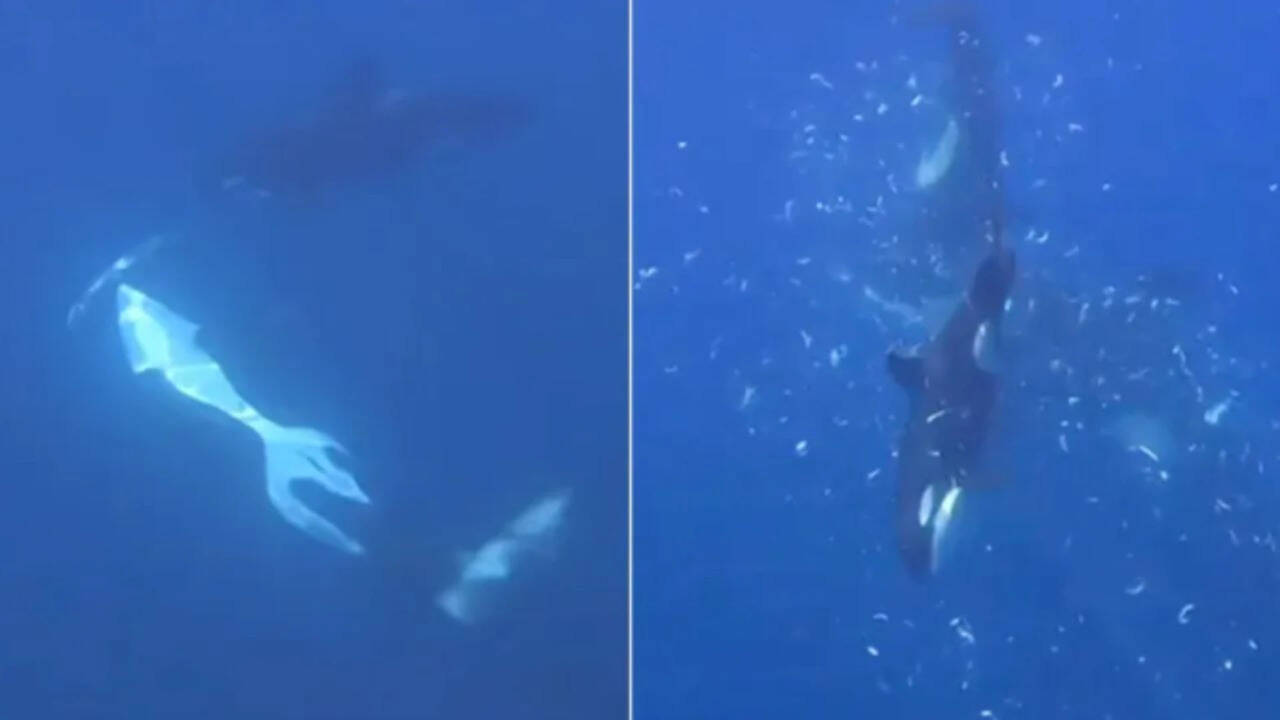

The animals worked together to hold and ram giant sharp-tail sunfish. (Picture: Live Science)
Orcas have been filmed using a hunting technique that scientists say has not been recorded before. Researchers observed the marine predators working together to hold and ram a giant sunfish so forcefully that its body broke into thousands of small pieces.The behaviour was seen twice in the Gulf of California, more than a year apart. The researchers believe the technique may help younger orcas feed more easily. They also say it is possible the animals were playing with their food, something orcas are already known to do. The findings have been published in the journal Frontiers in Ethology.Sunfish are among the heaviest bony fish in the world. They can grow to more than 3 metres in length and weigh up to 2,000 kilograms. They often come to the surface of the sea to rest, regulate their body temperature or allow other animals to remove parasites from their skin. At the surface, they become easier targets for predators such as orcas.
Processing the prey
The researchers studied two separate hunting events involving sharp-tail sunfish. During the first event, in July 2024, scientist Dr Kathryn Ayres observed a group of orcas that included a young animal. The group had already killed a sharp-tail sunfish.A female orca gripped the dead fish by its large tail fin while a male orca swam towards it at high speed. Just before the male reached the fish, the female let go. The impact tore the sunfish’s body into thousands of small pieces that spread through the water.The young orca then fed on the smaller fragments, while the adult orcas ate the larger parts of the carcass.In September 2025, wildlife photographer Hector Franz filmed another group of orcas showing the same behaviour. The researchers said the two events followed the same pattern of one orca holding the fish while another rammed it.
Why orcas do this?
The researchers said the sunfish were already dead before they were rammed. This suggests the behaviour was not used to kill the fish but to break it into smaller pieces.”We document how one orca holds the sunfish and lets go just before another orca hits it at high speed, causing the tissue to break apart into thousands of pieces,” said Dr Ayres, as quoted by Science X.”We think this may help younger orcas feed more easily or it could also just be for fun. Orcas are known for playing with their food.”The researchers said the behaviour appeared to be carefully coordinated. One orca kept the carcass steady while the other struck it with enough force to tear it apart.They also noted that orcas have previously been seen sharing food with calves and younger members of their group. “Orcas often tear apart prey and share it with other members of the group, including calves and juveniles,” Ayres said.
Scientists say more research is needed
The team also pointed to another possible effect of breaking the fish apart.Sunfish have a jelly-like outer layer and skin that contains many microorganisms. When the tissue is shattered, these microorganisms spread into the surrounding water. The researchers said this could allow the microbes from the sunfish and the orcas to come into contact, although the possible benefits of this are not yet clear.So far, the behaviour has only been observed with sharp-tail sunfish. The researchers said it is not known whether other species of sunfish would break apart in the same way.It is also unclear whether the same orcas were involved in both events. The team said more high-quality photographs and videos will help identify individual animals and determine how common this behaviour is.”Collecting good identification photographs whenever possible is key. We are still seeing new techniques of how orcas hunt and process their prey,” Ayres said.”They’re one of the most iconic marine predators in the world, yet they continue to surprise us,” she added.