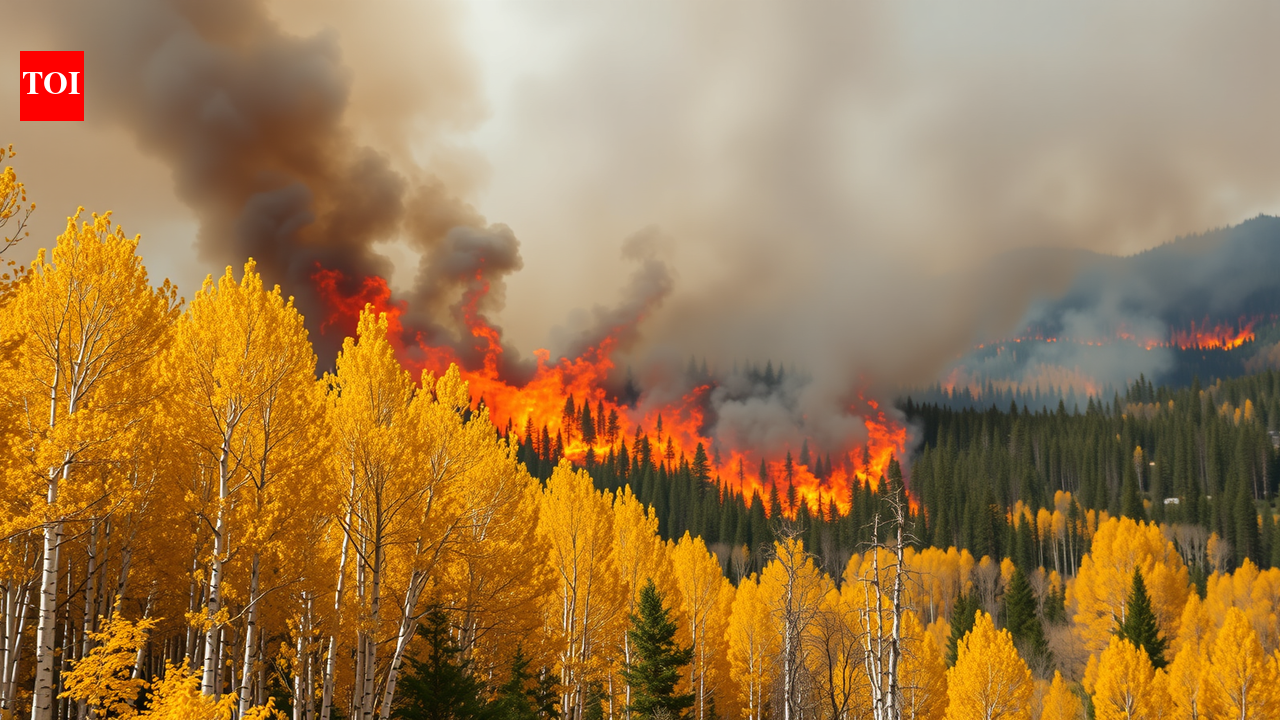

When a wildfire is tearing through a conifer forest, the assumption is usually that trees are simply fuel, more vegetation means a bigger, faster moving fire. Two recent studies, one covering the southwestern United States and another examining Canada’s entire boreal forest, suggest that assumption does not hold for every tree species. Aspen, a fast growing deciduous tree found across much of North America, appears to genuinely slow fires down and sometimes stop them altogether, a pattern researchers have now confirmed using large scale satellite and fire behaviour data rather than relying on scattered anecdotal reports from land managers.
How scientists discovered that aspen forests can slow wildfires
According to a study published in the journal Ecological Applications led by researchers at Western Colorado University, Colorado State University and the US Forest Service, the team examined 314 wildfires that burned across the southwestern United States between 2001 and 2020, analysing how aspen cover affected daily fire spread rates. The study found that where aspen cover on the landscape was below ten percent, fires grew by an average of 1,112 hectares a day with a maximum spread rate of 2.1 kilometres a day, but where aspen cover exceeded twenty five percent, those same figures dropped sharply to 368 hectares a day and 1.3 kilometres a day. According to Colorado State University’s own summary of the research, aspen was also found to be more abundant along the very edges of burned areas than within the interior of burn zones, indicating that fires do not just slow down when they reach aspen stands, they sometimes stop or change direction entirely.
Why aspen behaves so differently to conifer trees in a fire
The reasons aspen resists fire so much better than pine, spruce or fir come down to some fairly straightforward physical differences between the species. According to Colorado State University’s account of the study, aspen has long been understood to be more resistant to burning because of the higher moisture content found in its foliage and understory, along with high branches and chemical differences in the tree itself that reduce overall flammability. Unlike densely packed conifer stands, where resinous needles and continuous canopy fuel can carry fire quickly from tree to tree, aspen forests tend to hold more moisture in both their leaves and the vegetation growing beneath them, making it considerably harder for flames to establish and spread through an aspen dominated stand in the first place.
What the Canadian study confirmed at a national scale
A separate and more recent study looked at the same basic question across a far larger area. According to McGill University’s official account of the research, lead author Flavie Pelletier and colleagues at McGill University and the Canadian Forest Service examined dominant tree species maps against wildfire occurrence data across four major Canadian forested ecozones during three recent active fire years, finding that aspen trees were far more common along fire perimeters than within the interior of burned areas, the first time this pattern had been demonstrated at a genuinely national scale. According to the study published in the journal Forest Ecology and Management, the proportion of aspen recorded at fire perimeters ran more than twice as high as the proportion found within burned interiors, while spruce showed no comparable edge effect and pine showed only a slightly negative one.
Why season did not change the pattern as expected
One particularly notable finding from the Canadian research involved timing. The research team had initially expected aspen stands to burn more severely during spring, when the trees are naturally drier due to having lost their leaves over winter, yet according to McGill’s account of the study, researchers found no significant link between the season and either fire severity or the proportion of aspen recorded along fire perimeters. Pelletier described this consistency across seasons as the strongest indicator that aspen genuinely functions as a fire barrier, rather than its apparent fire resistant reputation simply being an artefact of when most wildfires happen to occur.
What this could mean for how forests are managed
Both research teams have suggested these findings carry real practical implications for how forests are managed going forward, particularly around communities and critical infrastructure. According to Colorado State University, study co author Camille Stevens-Rumann noted that where land managers can encourage aspen over conifer species, doing so may represent a more desirable fuel treatment in some forest types than traditional thinning or shaded firebreaks, given the additional aesthetic and wildlife habitat value aspen provides. Pelletier raised a similar point specifically about forestry practice in Canada, noting that some forestry companies actively remove aspen to promote more commercially valuable conifer species, and arguing there is genuine value in retaining aspen not just for biodiversity but because mixed stands that include aspen may be less likely to be entirely lost in a fire.
Why aspen is not a complete solution on its own
Neither research team has suggested that aspen offers anything close to guaranteed protection against wildfire. Pelletier was explicit on this point, noting that aspen is not a hundred percent effective fire deterrent, but that compared with other species, it represents a genuinely better choice to plant around communities or important infrastructure. Individual aspen trees can still burn relatively easily due to traits such as thin bark, and the protective effect documented in both studies applies specifically to larger, well established aspen stands rather than scattered individual trees. Even with these caveats, the consistency of the pattern across two entirely separate studies, one covering the American southwest and the other spanning Canada’s vast boreal forest, offers land managers a genuinely evidence backed reason to think of aspen as more than simply another species growing among the pines, but as an active, natural tool for slowing the spread of increasingly severe wildfires. Go to Source