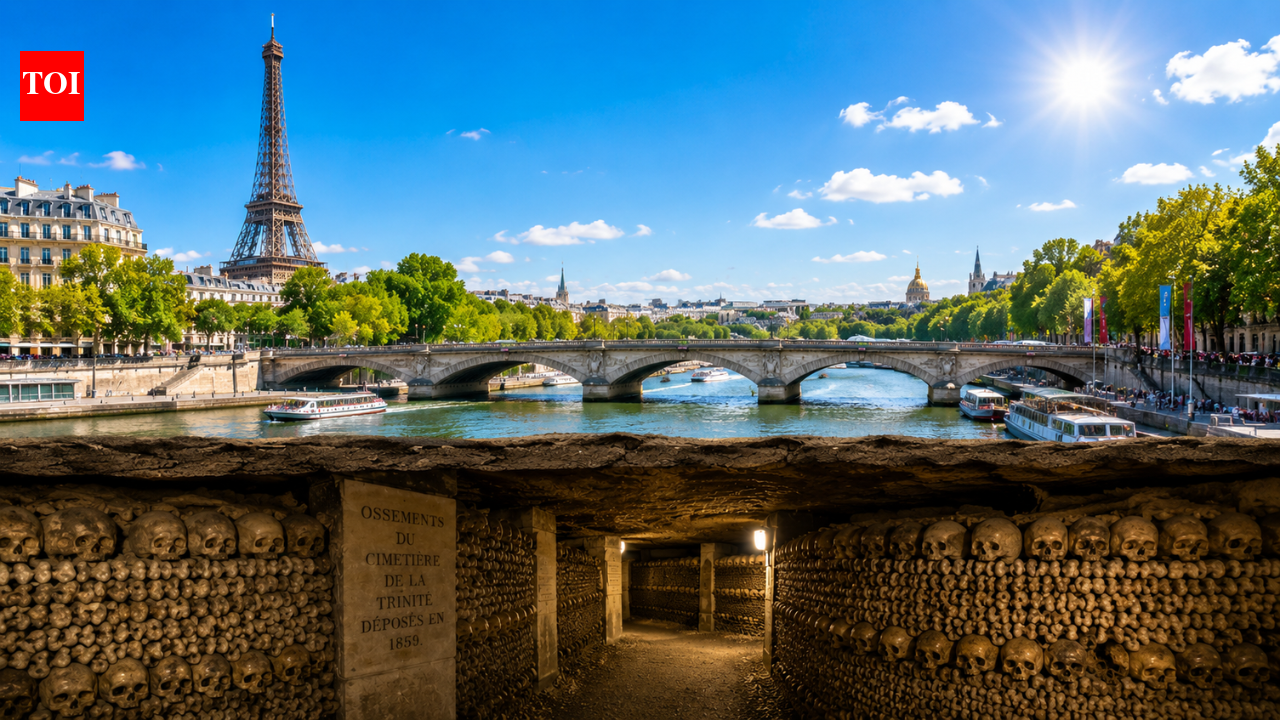

Image: AI Generated
Paris is celebrated for its grand boulevards, elegant cafés and iconic landmarks. Yet beneath the pavements, far below the tourists and traffic, lies a second city that most people never see.The Paris Catacombs form an immense underground network of former limestone quarries stretching for hundreds of kilometres beneath the French capital. Hidden entrances, flooded passages, forgotten chambers and walls built from human bones have long fuelled stories of mystery and adventure. While the public ossuary attracts millions of visitors each year, much of the labyrinth remains closed, accessible only through concealed entry points known to experienced explorers.Venturing into these restricted sections reveals a very different side of Paris. Here, traces of ancient quarry workers, wartime bunkers, underground artists and modern-day cataphiles coexist in a maze where history seems to accumulate layer upon layer. The deeper one travels, the easier it becomes to understand why the catacombs continue to fascinate explorers, and why they remain capable of swallowing the unwary.
How the Paris catacombs grew beneath the city
The story begins with stone. Much of historic Paris was built from limestone quarried beneath the city itself. Extraction began during the Roman period and expanded steadily as Paris grew. Over centuries, miners carved out vast underground galleries, leaving behind an increasingly complex network of tunnels beneath neighbourhoods that would later become densely populated.According to Les Catacombes de Paris, by the eighteenth century, the situation had become serious enough to alarm authorities. Entire sections of ground were at risk of collapse as abandoned quarries weakened the foundations of streets and buildings. In response, the French crown established the Inspection Générale des Carrières in 1777 to survey, reinforce and document the underground passages.The catacombs took on their most recognisable form a few years later. Overcrowded cemeteries in Paris had become a major public health concern, prompting officials to transfer human remains into disused quarry galleries. Between 1786 and 1814, the bones of millions of Parisians were carefully relocated underground.Today, the official ossuary contains the remains of an estimated six million people. The result is both unsettling and strangely moving: a place where centuries of Parisian history are arranged in corridors of skulls and bones.As the official Catacombs website states:”As the years passed, the ossuary became the resting place of many illustrious individuals. These Catacombs are the largest ossuary in the world.”
Beyond the tourist route lies a hidden underground culture
Most visitors encounter only a carefully curated section of the catacombs. Beyond those illuminated pathways lies a much larger and largely inaccessible world.Among those who know it best are the cataphiles, urban explorers who have spent decades navigating the hidden reaches of the network. Their presence has helped create a unique underground culture, one that exists almost entirely out of public view.Researchers documenting these communities have recorded secret meeting spaces, improvised art galleries, carved sculptures and even underground cinemas concealed deep within the tunnels. Some chambers appear almost surreal, as though they belong to a forgotten city frozen beneath modern Paris.History has also left its mark underground. During the Second World War, sections of the quarry network were used by members of the French Resistance, while German forces established bunkers beneath parts of the capital. Elsewhere, quarry inscriptions, engineering records and centuries-old markings survive on tunnel walls, preserving details of everyday lives long since forgotten above ground.In places, the silence is so complete that it becomes difficult to believe a city of more than two million people is bustling overhead.
Why the catacombs remain genuinely dangerous
The catacombs are often romanticised as a destination for adventurous explorers. The reality is less forgiving.This is not a simple network of tunnels but a sprawling maze filled with intersections, dead ends, flooded galleries and narrow crawl spaces. Many passages look remarkably similar, making orientation surprisingly difficult even for people familiar with the system.Perhaps the most famous cautionary tale as per Atlas Obscura, involves Philibert Aspairt, a hospital doorkeeper who entered the quarry network in 1793 and failed to return. His remains were discovered years later, reportedly only a short distance from an exit he never managed to find.The story endures because it captures a truth that experienced explorers know well: underground, distance can be deceptive and direction can quickly lose meaning.French authorities continue to restrict access to unauthorised sections of the network. The Paris police maintain a specialist unit, the Brigade des Réseaux Ferrés, tasked with monitoring parts of the underground system and enforcing access regulations.Experts from the Inspection Générale des Carrières have repeatedly warned of hazards including flooding, unstable ground, oxygen depletion and disorientation. Unlike the carefully maintained public route, many off-limits sections remain unpredictable environments where small mistakes can escalate quickly.
The enduring appeal of Paris beneath Paris
Part archaeological archive, part engineering achievement and part urban legend, the Paris Catacombs occupy a place unlike almost anywhere else in Europe.Few locations bring together geology, architecture, military history, funerary heritage and contemporary exploration culture in quite the same way. Every tunnel reflects a different chapter of the city’s past, from Roman quarrying and eighteenth-century public health crises to wartime occupation and modern underground communities.For explorers, the attraction extends beyond the skull-lined walls that have made the catacombs famous. What draws people underground is the sense of stepping outside ordinary Paris and into a landscape shaped by centuries of human activity, largely hidden from view.Above ground, Paris is a city of light. Beneath it lies a city of stone, silence and stories still waiting to be discovered. Go to Source