
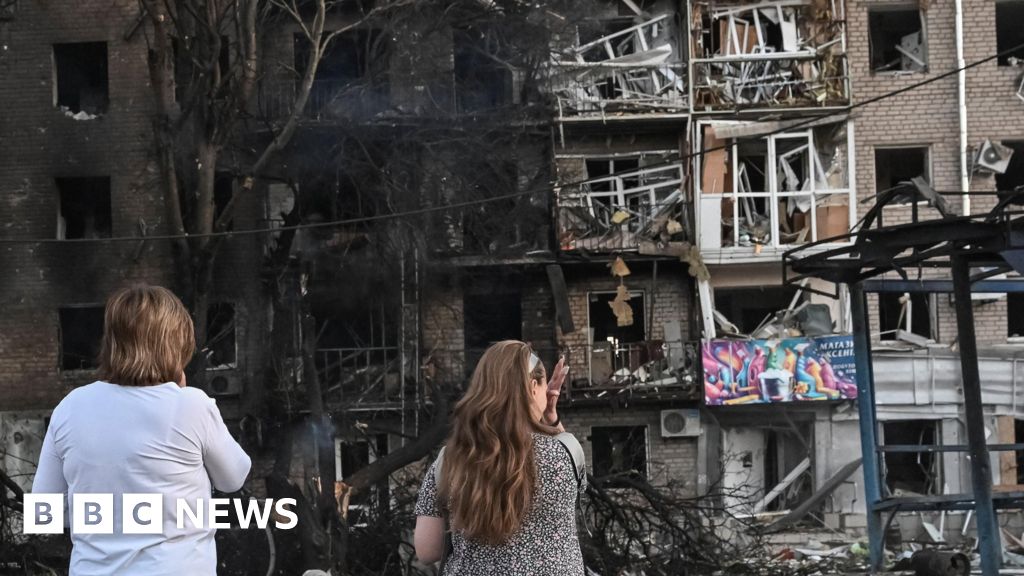

Sometimes it’s not what’s said that makes the biggest impression.
It’s the reaction.
In the Russian Far East, Vladimir Putin delivered a warning to the West: don’t even think about sending soldiers – and that includes peacekeepers – to Ukraine.
“If some troops appear there,” the Russian president said, “especially now while the fighting’s going on, we proceed from the premise that these will be legitimate targets for destruction.”
Then the reaction.
The audience at the economic forum in Vladivostok burst into applause, with Russian officials and business leaders apparently welcoming the threat to “destroy” Western troops.
Observing the scene in the hall, I found the applause quite chilling.
And this came just a day after Kyiv’s allies, the so-called Coalition of the Willing, had pledged a post-war “reassurance force” for Ukraine.
The audience applauded again when the Kremlin leader suggested that he would be prepared to meet Ukraine’s President Volodymyr Zelensky – but only on home soil.
“The best place for this is the Russian capital, in Hero City Moscow,” said Putin.
Outside Russia, Putin’s proposal has been dismissed as unserious, a complete non-starter. A case of political trolling.
But in many ways it encapsulates the Kremlin’s current position on the war in Ukraine: “Yes, we want peace, but only on our terms. You reject our terms? No peace then.”
This uncompromising stance is being fuelled by a combination of factors.
First, by the Kremlin’s belief that, in Ukraine, Russian forces have the initiative on the battlefield.
Second, by diplomatic success. In China this week, Putin shook hands and shared smiles with a string of world leaders. The optics were all about demonstrating that Russia has powerful friends, such as China, India and North Korea.
And then there’s America. Last month US President Donald Trump invited Putin to Alaska for a summit meeting. Back home pro-Kremlin commentators hailed the event as evidence that Western efforts to isolate Russia over the war in Ukraine had failed.
To convince the Kremlin to end the fighting Trump has previously set ultimatums and deadlines; he’s threatened further sanctions if Russia won’t make peace.
But Trump hasn’t followed through on his threats – and that’s another reason for Russia’s confidence.
Putin publicly praises Trump’s peace efforts. And yet he has rejected Trump’s ceasefire proposals and shown no desire to make concessions over the war in Ukraine.
So where does that leave prospects for peace?
Putin said recently that he could see “light at the end of the tunnel”.
It seems to me that right now Russia on the one hand, and Ukraine and Europe (and to some extent America) on the other are in different tunnels, on different roads, with different destinations.
Ukraine and Europe are focused on ending the fighting, shaping security guarantees for Kyiv and making sure that the Ukrainian army is strong enough post-war to prevent another invasion.
When Putin talks about “light at the end of the tunnel”, I believe he imagines a path that leads to a Russian victory in Ukraine, and more widely, to the construction of a new global order that benefits Russia.
In terms of peace, it’s hard to see where and when these two very different highways will converge.
 "Pakistan: Eggs thrown at Imran Khan’s sister outside jail, she waves it off with ‘koi baat nahi’ | WATCH")
 "Why world No 2 Hikaru Nakamura has kicked off a rating controversy in qualification for Candidates 2026")
