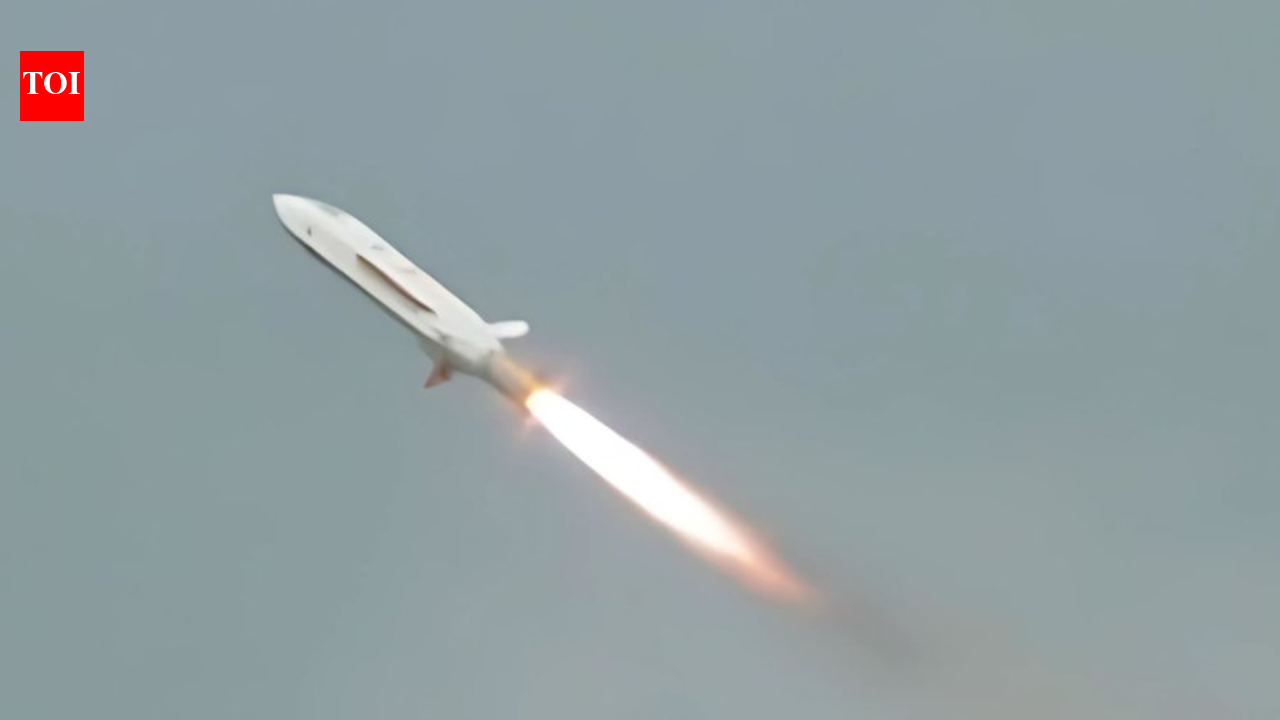

Japan has deployed its domestically produced Type-12 long-range surface-to-ship missiles near the East China Sea, a move analysts say could be interpreted by Beijing as crossing a “strategic threshold.” The deployment is expected to have major implications for regional deterrence and China’s operational planning in the East China Sea and around Taiwan.Chief cabinet secretary Minoru Kihara confirmed on Monday that the upgraded missiles would be deployed at Camp Kengun in Kumamoto prefecture by the end of March. Army vehicles carrying the first batch of missile launchers were reportedly spotted arriving at the base past midnight, according to SGMP.This follows a decision by the Japanese ministry of defence in 2024 to advance the missile deployment schedule by one year. Growing military tensions with Beijing in the East China Sea, near Taiwan, have driven Tokyo to accelerate its defence capabilities.The Type-12 missile, developed and produced by Mitsubishi Heavy Industries, has an extended range of about 1,000 km (up from 200 km), allowing Japan to cover almost all of the East China Sea from Kyushu and reach coastal cities in mainland China. The missile is intended to deter Chinese naval vessels in a potential conflict scenario.China has sharply criticised the deployment. Jiang Bin, spokesperson for the Chinese defence ministry, said that “right-wing forces” in Japan had been “accelerating moves towards remilitarisation,” as quoted by SGMP.He added that Tokyo’s deployment of long-range offensive weapons with ranges far exceeding Japanese territory “completely strips away the disguises of an exclusively defence-oriented policy and self-defence.” Jiang further said: “This fully demonstrates that Japan’s ‘new militarism’ is no longer just a dangerous tendency but a blatant and real threat, constituting a serious disruption to regional peace and security.”Experts note the strategic impact of the deployment. John Bradford, executive director of the Yokosuka Council on Asia-Pacific Studies and former US Navy officer, said Japan’s deployment of the Type-12 anti-ship missile in Kumamoto is a “new upgrade” ensuring it can threaten Chinese naval ships throughout the East China Sea. He explained: “This effort mirrors China’s long-standing deployment of so-called aerial denial weapons that can target foreign ships entering the East China Sea. This will strengthen deterrence because any navy ship entering the East China Sea knows it can be targeted by either China or Japan. The ‘mutual sea denial’ will make both sides hesitant to use force, as they know they will be challenged to gain sea control over that strategic buffer area.”Ray Powell, director of the SeaLight maritime transparency programme and retired US Air Force colonel, said the deployment “slots” into a growing allied missile network along the “first island chain.” He added that this complicates Beijing’s military calculations and enhances Japan’s role in alliance burden-sharing. “On the burden-sharing front, it substantially upgrades Japan’s value to the alliance. By moving from a heavy reliance on the US for long-range strike operations to wielding a credible deterrent of its own,” Powell said. “Tokyo is taking on the kind of operational risk and responsibility that Washington has been hoping to see.”The missile deployment also comes amid an ongoing dispute with Beijing. Tensions flared after Japanese prime minister Sanae Takaichi suggested in November that Japan could take military action in the event of an attack on Taiwan, prompting strong protests and economic retaliation from Beijing. Takaichi has pledged to accelerate Japan’s military build-up. The defence budget has reached 2 per cent of GDP, two months ahead of schedule, and the cabinet is pushing to revise major security and defence policies to strengthen autonomous defence against China, North Korea, and Russia.Last month, Japanese defence minister Shinjiro Koizumi said Japan would deploy Type-03 medium-range surface-to-air missiles on the westernmost island of Yonaguni, just east of Taiwan, by 2031.Liselotte Odgaard, senior fellow at the Hudson Institute, described the Type-12 deployment as “one of the most consequential shifts in Japan’s post-war defence posture.” She said: “The Type-12’s deployment would raise the cost of an attack on Japanese territory and complicate the PLA’s planning. Beijing must now plan for potential Japanese retaliation before launching operations in the East China Sea or around Taiwan, unlike before when Tokyo lacked long-range missiles capable of reaching PLA bases or coastal staging areas. China is likely to interpret the Type-12 deployment as a direct military threat, given the missile’s ability to strike the Chinese mainland. China will see it as a dramatic expansion of Japan’s ability to hold Chinese military bases and logistical hubs at risk. It weakens China’s confidence in its own anti-access/area-denial posture … In China’s view, Japan has crossed a strategic threshold.”Odgaard added that Beijing would likely interpret the deployment as preparation for a potential conflict over Taiwan, reinforcing suspicions about Japan’s intentions and efforts to constrain China’s freedom of action. “This may strengthen China’s narrative that Japan is acting provocatively and without transparency, increasing the risk of miscalculation, escalating an arms race in northeast Asia and undermining regional stability, militarising the East China Sea,” she said.
What are Japan’s Type-12 missiles?
Long-range anti-ship missile designed for stand-off strikesThe Upgraded Type-12 anti-ship missile is a domestically developed weapon by Mitsubishi Heavy Industries designed to give Japan the ability to strike hostile naval targets at significantly longer distances. Unlike the original Type-12 system used by Japan’s Ground Self-Defense Force, which had a range of about 200 km, the upgraded version is expected to reach around 900 km or more, although the exact range has not been officially disclosed. The new missile also features a low-observable design, aimed at reducing the chances of detection by enemy radar, according to IISS.
Multi-platform deployment for wider strike reach
The upgraded Type-12 is intended to be deployed across multiple launch platforms, including ground-based launchers, ships and aircraft, significantly expanding the operational flexibility of the Japan Self‑Defense Forces (JSDF). Once operational, the missile will allow Japanese forces to conduct long-range maritime strike operations, targeting adversary ships from a safer distance. This would substantially extend Japan’s maritime strike capabilities beyond those of its current anti-ship missiles such as the ASM-2 (Type-93).
Part of Japan’s evolving counterstrike strategy
The upgraded missile forms part of Japan’s broader “stand-off” counterstrike capability, which aims to deter adversaries by enabling strikes on enemy forces before they reach Japanese territory. According to analysis by the International Institute for Strategic Studies (IISS), the system is part of a wider missile modernisation effort that includes hypersonic weapons and long-range cruise missiles. These capabilities are being developed alongside expanded space-based intelligence, surveillance and reconnaissance (ISR) systems to help locate and track targets at long range. Go to Source