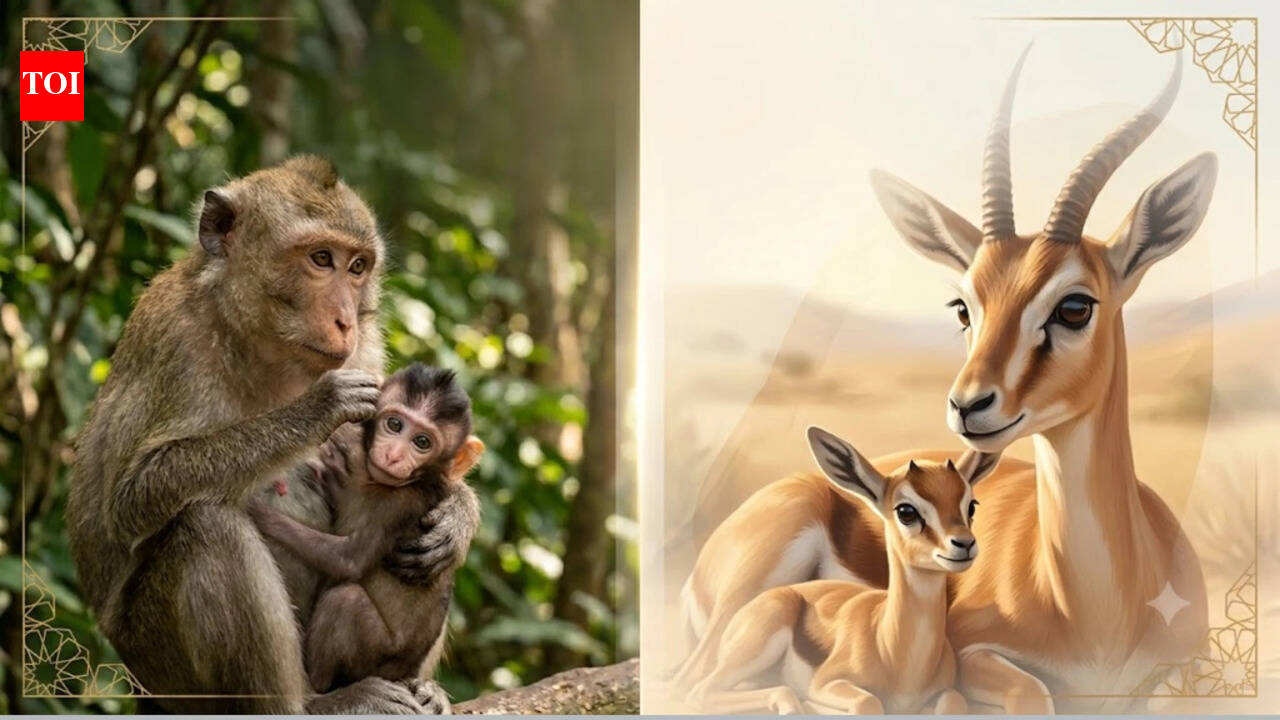


‘The monkey is a gazelle in its mother’s eyes’
At first glance, the proverb sounds almost humorous. How can a monkey possibly resemble a graceful gazelle?Yet for centuries, Arabic speakers have repeated the saying “القرد بعين أمه غزال” (Al-qird bi-‘ayn ummihi ghazal) to express one of the most universal truths about human relationships: affection often changes perception. To a mother, her child remains beautiful, admirable and worthy of love, regardless of what others see.Few proverbs capture parental devotion with such vivid imagery. While the monkey traditionally symbolizes awkwardness or unattractiveness in many cultures, the gazelle has long represented elegance, beauty and grace across Arabic literature. The contrast makes the lesson unforgettable.
What the proverb means
Literally translated, the proverb means “The monkey is a gazelle in its mother’s eyes.”Its figurative meaning is straightforward: people—especially parents—often view those they love through the lens of affection rather than objective judgment. A parent’s pride, admiration or emotional attachment can overshadow flaws that outsiders notice immediately.Although the saying specifically mentions a mother and her child, its meaning extends beyond family. It also applies to anyone who overestimates the qualities of someone they are emotionally attached to—a friend, a partner, an employee or even one’s own work. In many situations, the proverb serves as a gentle reminder that love can influence perception.
Where did the saying come from?
Like many traditional Arabic proverbs, the precise historical origin of this saying cannot be traced to a single author or documented moment in history. It belongs to the rich oral tradition through which proverbs were passed from one generation to another across the Arab world.A popular folk explanation links the proverb to one of Aesop‘s fables, in which a monkey proudly presents her child in a beauty contest despite the laughter of other animals. Different versions of the story place the contest before Jupiter, the king of the Roman gods. However, historians have not established that this tale is the definitive source of the Arabic proverb. Instead, it is best understood as one traditional explanation that became associated with the saying over time.What is certain is that the proverb has become deeply embedded in everyday Arabic speech and appears in several regional forms across countries such as Egypt, Jordan, Lebanon, Syria and Morocco.
Why a monkey and a gazelle?
The imagery works because both animals carry strong symbolic meanings in Arabic culture.For centuries, the gazelle (ghazal) has been celebrated in Arabic poetry as the ideal of beauty. Classical poets frequently compared graceful movement, expressive eyes and elegance to those of a gazelle. Calling someone a gazelle has traditionally been considered a compliment.The monkey, by contrast, has rarely symbolized physical beauty in Arabic folk expression. By placing these two animals at opposite ends of the beauty spectrum, the proverb creates an immediate and memorable contrast.The message is not about the animals themselves. It is about the power of emotional attachment to transform perception.
A lesson supported by psychology
Modern psychology offers an interesting perspective on why this proverb continues to resonate.Researchers have long studied the halo effect, a cognitive bias in which positive feelings toward a person influence our judgment of their other qualities. Someone we love may seem more capable, kinder or more attractive simply because our emotional connection shapes our evaluation.Similarly, studies of parenting have consistently shown that parents often display positive bias when assessing their children’s abilities, personalities or achievements. This tendency is not necessarily harmful. In many cases, it strengthens emotional bonds and encourages children through support and confidence.However, excessive bias can also prevent constructive criticism or realistic assessment. The proverb therefore carries both warmth and caution: love is valuable, but it should not blind us completely.
How the proverb is used today
The saying remains common in everyday conversations throughout the Arabic-speaking world.Someone may quote it when:
- A parent insists their child is the most talented despite average performance.
- A business owner believes their product is exceptional while customers disagree.
- A football fan refuses to acknowledge the weaknesses of their favourite team.
- An artist becomes convinced that every creation is a masterpiece simply because they made it.
In these situations, the proverb is usually delivered with humour rather than hostility. It reminds people that personal attachment naturally influences judgment.Its relevance has arguably increased in the age of social media, where people constantly present idealised versions of themselves, their families and their achievements. Emotional investment often makes it difficult to separate affection from objective evaluation.
A universal idea across cultures
Although the wording is uniquely Arabic, the underlying idea appears in many cultures.English speakers often say, “Love is blind,” suggesting that affection can obscure faults.Another familiar English expression, “Beauty is in the eye of the beholder,” emphasises that beauty depends on personal perception rather than universal standards. While not identical in meaning, it reflects a similar understanding that individual feelings shape judgment.The Arabic proverb stands out because it places maternal love at the centre of the message, making the idea more vivid and emotionally relatable.
Why the proverb has endured
Many proverbs disappear as societies change. This one has survived because it describes a timeless aspect of human nature.Parents still celebrate their children with unmatched pride. Friends still defend one another despite obvious mistakes. People still become emotionally attached to ideas, possessions and achievements they have created.The proverb does not mock love. Instead, it acknowledges its remarkable power.In just six Arabic words, it captures an enduring truth: affection changes how we see the world. Sometimes that makes us kinder, more patient and more compassionate. At other times, it reminds us to balance love with honesty.Perhaps that is why “The monkey is a gazelle in its mother’s eyes” continues to be quoted centuries after it first entered everyday speech. Human nature has changed very little, and neither has the tendency to see our loved ones in the best possible light. Go to Source