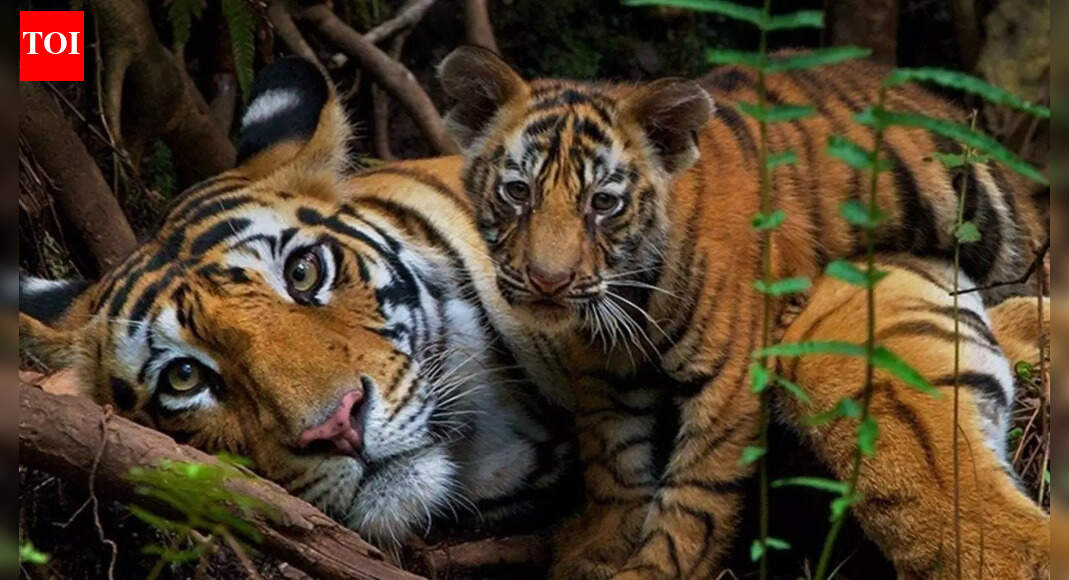


A tigress with her cub
In early 2025, a motion-sensor camera high on the hills of Purulia district, West Bengal, blinked to life. The image it captured was unremarkable in isolation: the grainy silhouette of a tiger crossing scrubland. But for residents and forest officials, it was extraordinary. Purulia had never yielded a tiger sighting before. No camera traps, no spoor, no local memory of the big cat. The photograph was more than a record; it was a signal – that the landscape had begun to shift in ways people were only beginning to comprehend. Within weeks, researchers traced the animal’s path through a series of camera traps: March 2024 in Chhattisgarh’s Balrampur forest division; summer sightings in Jharkhand’s Palamau Tiger Reserve; and by January 2025, in Bengal’s Purulia and Jhargram. The tiger had wandered roughly 500 km through human-dominated terrain, crossing administrative and ecological boundaries in search of space. The tiger’s journey is not an anomaly. It is part of a pattern. India’s wild tiger population, once on the brink of collapse, has surged from 1,411 in 2006 to approximately 3,682 in the latest estimate – almost 75% of the world’s wild tiger population. This rebound, often hailed as a conservation landmark, is the centrepiece of Project Tiger’s story. Conservationists and forest staff took pride in the numbers, even as they now grapple with the consequences of unprecedented success. Scientists at the Wildlife Institute of India (WII) estimate that nearly 30% of these 3,682 tigers – more than 1,100 animals – now roam outside notified tiger reserves, sharpening the challenge of coexistence. WII director GS Bhardwaj told TOI that a dedicated Tiger Outside Tiger Reserves (TOTR) project has already been initiated from 2025, with the focus on conserving both tigers and people. The project targets forest divisions that host dispersing tigers, aims to mitigate human-tiger conflict linked to TOTR, and envisages strengthening protection regimes beyond reserve boundaries.

Testing human tolerance
But there is a paradox embedded in that success: Project Tiger became “a little too successful”, as an expert said. As core reserves fill, tigers disperse farther – into buffers, across states and into human landscapes, fuelled by instinct, not intention. Tigers are inherently territorial; adults typically range across tens to hundreds of square km depending on prey and habitat. Studies in Indian landscapes have shown female home ranges between 30 and 64 sq km, with males sometimes exceeding 170 sq km. The average, even in prey-rich forests, often approaches 90 sq km. Bhardwaj said WII has advised all states to strengthen wildlife protection outside tiger reserves and carry out intensive monitoring of tigers moving beyond them, so that encounters do not escalate into human casualties or retaliatory killings. In the central Indian landscape – the broad swath of forests, hills and plateaus that includes Madhya Pradesh, Chhattisgarh and surrounding states – pressure is particularly acute. Bandhavgarh Tiger Reserve, for instance, has one of the highest tiger densities in the country. A state-level review found territorial fights to be a major cause of death among tigers there between 2021 and 2023, reflecting intense competition for space and mates. With older males holding core territories, younger animals are pushed into buffer zones and near villages, raising the frequency of conflict. Bandhavgarh registers more than 2,000 cattle kills annually – a stark indicator of how tigers are pressed against the edges of ecological and social boundaries. Not all reserves exhibit the same degree of crowding though. In Uttarakhand, Corbett and Rajaji tiger reserves are approaching saturation, but nearly half of India’s reserves remain below what scientists describe as their ecological capacity. Forest officials in the state have reported that Corbett can support about 20 tigers per 100 sq km, while eastern Rajaji’s capacity is around 14 per 100 sq km – figures that help explain why animals increasingly stray outside protected areas. As tigers move beyond core forests, their presence ripples through local communities in palpable ways. In early 2025, in several villages in Uttar Pradesh’s Pilibhit region, a prowling tiger caused schools to be closed. Children stayed home. “Exams are coming,” said a Class 5 student from Khalispur had then said, “but we haven’t even completed the syllabus.” Teachers refused to hold evening sessions. Parents stopped letting children walk alone. Tigers in Pilibhit often establish temporary bases in sugarcane fields, drawn by wild boars that feed on the sweet crop. Boars attract tigers. Sugarcane draws both. And between them lies the village. Elsewhere, the consequences have turned fatal. In Gadchiroli district of eastern Maharashtra, tiger numbers grew from zero to nearly 30 in five years – a startling shift in a landscape long considered tiger-scarce. With 12,000 sq km of forest, it appears generous on paper. But in practice, only about 7,000 sq km in two forest divisions is occupied. Human settlements, encroachments, and patchy prey base have constrained the actual carrying capacity. In 2024, 25 villagers died in tiger attacks across the Wadsa and Gadchiroli divisions. Two problem tigers were captured. A tigress was spared because she had cubs. Though technically capable of holding far more – by some estimates, up to 300 tigers – Gadchiroli cannot even accommodate 25 without triggering conflict. In one forest-fringe home in Jharkhand, a tiger entered a family’s hut, settled on a wooden cot, and waited. The family, stunned, watched in silence from a corner of the room. The tiger had wandered far from mapped territory. Its entry was a mistake. Its departure, hours later, was quiet. Nobody was hurt. The event became a story of awe and fear. These tigers are no longer sentinels of wilderness. They are migrants. Monarchs in exile. Each one a ghost of ecological success, walking into fields, hamlets and homes – not out of aggression, but because the forests behind them are full. In some landscapes, officials speak of “social carrying capacity” – not how many tigers the habitat can sustain, but how many human communities are willing to tolerate. In parts of Uttarakhand, tiger-inflicted fatalities have surpassed leopard attacks for the first time in years. In response, village volunteers called Bagh Mitras have been trained to monitor tiger movement and alert forest departments. Some report sightings through mobile apps. Others simply listen for silence – the kind that descends before a tiger appears. Translocation – moving tigers from dense parks to underpopulated reserves – has been tried. Odisha attempted it in 2018, without success. Intra-state efforts show more promise, but officials now lean toward corridor consolidation. Movement is safer when it’s natural. But for that, corridors must exist – not just on policy maps, but on the ground. In the Terai Arc, at least 10 critical corridors are under threat from habitat loss and development. In central India, linear infrastructure – railways, highways, power lines – cuts across migration routes. And yet, some reserves offer hope. In Tadoba, tiger density rose 30% over a decade, with buffer populations expanding as prey base improved. In Sundarbans, the reserve is being expanded by more than 1,000 sq km to create space for 101 tigers now crowding its mangrove heartland. India now has more than 50 tiger reserves. Some are full. Others still hold ecological potential, if prey can be restored. The key lies not just in creating new habitat, but in connecting the old – allowing dispersing tigers to move without triggering conflict. Perhaps the tiger today is not just an emblem of wilderness, but a kind of refugee of success – displaced by recovery. The Purulia tiger’s trek is both a biometric trail and a metaphor. It is the story of a tiger with nowhere to go, walking east until the land gave way to politics and fear. In the empty classrooms of Pilibhit, in the living room of a Jharkhand family, in the cattle sheds of Bandhavgarh, and in the forests of Gadchiroli now marked by claw and memory, India’s national animal is no longer confined to the forest. The tiger has returned. The question is – where can it stay? Go to Source