


.
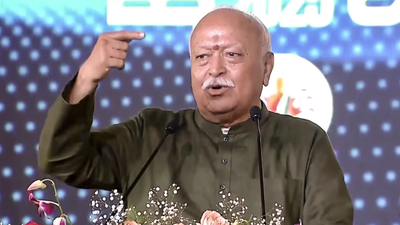
NEW DELHI: RSS chief Mohan Bhagwat on Tuesday said India’s rise on the global stage is “certain”, but stressed that the country’s development must be guided by a larger responsibility to offer a meaningful and humane model to the world, not merely pursue national advancement or material dominance.Speaking at the seventh edition of the Bharatiya Vigyan Sammelan 2025 organised by Vigyan Bharati, Bhagwat argued that modern development paradigms — particularly in the West — had delivered material prosperity but also produced deep social and ecological distress. “When we look at developed countries today, we see that development has come with destruction,” he said, noting that many societies were now rethinking growth models that prioritised consumption over balance.Bhagwat underlined that the core purpose of development was sukh (well-being), and that the direction of progress depended on how happiness itself was understood. “All development is for happiness. Human beings want happiness; everyone in creation wants happiness,” he said. Questioning purely utilitarian approaches to knowledge, Bhagwat added: “Why do we want to know how far the sun is? Because human beings have a thirst to know, and on the basis of that knowledge they want to make their lives happy. ”Critiquing dominant global thinking over the past two millennia, the RSS chief said happiness had largely been reduced to material satisfaction. “For the last 2,000 years, systems influencing the world assumed happiness to be only material,” he observed, drawing parallels with animal instincts of food, sleep, fear and survival — benchmarks he said were inadequate for measuring human progress.Contrasting this with India’s civilisational outlook, Bhagwat said Indian thought recognised both material needs and inner well-being. “Food, clothing, housing, health and education are necessary, and suffering must be reduced. But we should not stop there,” he said, arguing that happiness ultimately resides within and cannot be sustained in isolation from society and nature.He also cautioned against development models that create sharp social divides. “Development should not produce two classes — the happy and the unhappy, the haves and the have-nots. That is wrong development,” Bhagwat said, adding that inequality driven by unequal access and opportunity inevitably breeds conflict and instability.Bhagwat further said India’s growth must be anchored in ethical restraint and balance, which he described as dharma. “Dharma is not ritual or religion; it is that which sustains. It ensures harmony between individual progress, social welfare and nature,” he said.The conference, attended by scientists, academics and policymakers from across the country, focused on aligning scientific inquiry with sustainability, ethics and Indian knowledge traditions, with organisers describing it as an effort to shape a distinctly Indian vision of science-led development.


