
Nearly five years after reclaiming power, the Taliban has introduced a sweeping 90-page penal code that is drawing intense criticism from rights advocates worldwide. Signed by the group’s supreme leader, Hibatullah Akhundzada, the new law formalises several of the regime’s most restrictive policies, particularly those affecting women and children.
At the centre of the controversy is a provision permitting husbands to physically discipline their wives and children, provided it does not result in “broken bones or open wounds.” The move has raised urgent questions about legal protection, equality before the law, and the future of women’s rights in Afghanistan.
ALSO READ: MAGA Leader’s ‘3rd World Aliens’ Remark On Texas Hanuman Statue Triggers Backlash
What The New Penal Code Says

The newly issued code outlines that physical punishment within the family is permissible so long as it does not leave visible fractures or serious injuries. If a husband uses what the law terms “obscene force,” such as causing visible fractures, the maximum penalty is 15 days in prison.
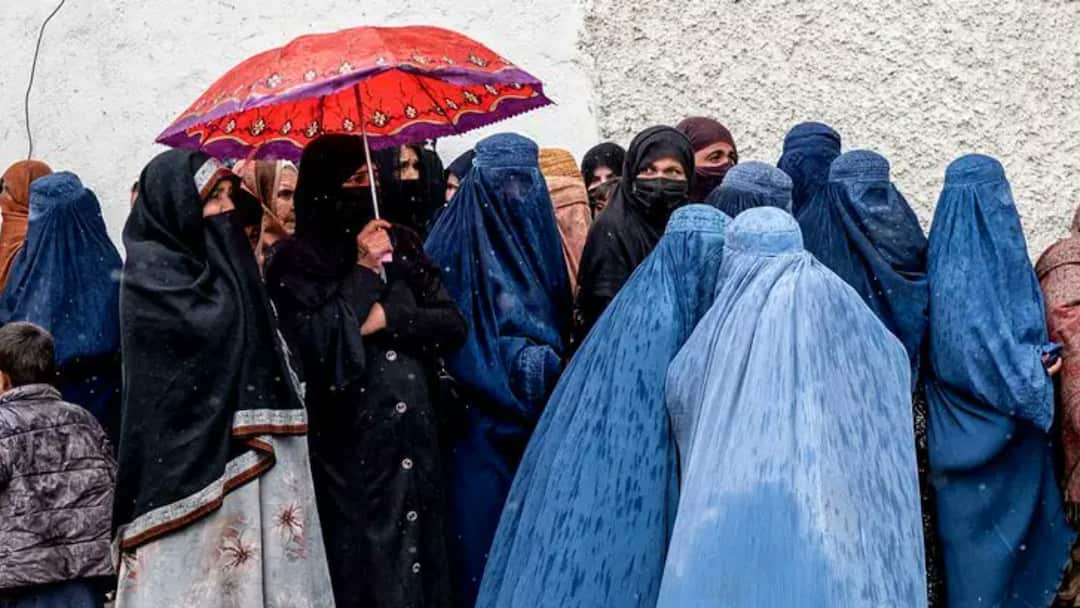
Even then, accountability hinges on proof. A wife must present her injuries before a judge, a process complicated by strict social and legal constraints. Women are required to appear fully covered in public and must be accompanied in court by a husband or male guardian, even when the husband is the alleged abuser.
The code does not explicitly criminalise psychological or sexual violence, leaving significant legal gaps in protection.
A Justice System Based On Social Status
The penal code introduces a stratified system of justice. Punishments vary depending on whether an offender is considered “free” or “a slave,” formalising inequality within the legal framework.
Article 9 divides Afghan society into four categories: religious scholars (ulama), the elite (ashraf), the middle class, and the lower class. The same offence may carry dramatically different consequences depending on the accused’s social standing.
If an Islamic scholar commits a crime, the response is limited to advice. Members of the elite may receive a summons and advice. Those classified as middle class face imprisonment for the same offence. Individuals placed in the lower class may face both imprisonment and corporal punishment.
Corporal penalties for serious crimes will be administered by Islamic clerics rather than correctional services.
Abolition Of The EVAW Law
The new penal code effectively repeals the 2009 Elimination of Violence Against Women (EVAW) law introduced under the former US-backed government. That legislation had criminalised forced marriage, rape, and various forms of gender-based abuse.
With its removal, earlier legal protections for women have been dismantled. Campaigners argue that the new code legitimises what they describe as systemic abuse.
Rawadari, an Afghan human rights organisation operating in exile, has urged the United Nations and international bodies to intervene. The group called for an “immediate halt of the implementation of the criminal procedure code” and asked global institutions to “utilise all legal instruments” to prevent it from taking effect.
Broader Restrictions On Women’s Lives
The penal code emerges against the backdrop of sweeping decrees issued since the Taliban’s return to power. Girls remain barred from secondary schools and universities, effectively ending formal education beyond grade six for most.
Women are prohibited from many forms of employment and public life. Parks, gyms, sports clubs, civil service roles, NGOs, and beauty salons have largely been closed off to them. Healthcare access has also become increasingly strained due to mobility restrictions and a shortage of female health workers.
Reem Alsalem, the United Nations Special Rapporteur on violence against women and girls, responded on X, writing: “The implications of this latest code for women and girls is simply terrifying. The Taliban however have understood, and understood correctly, that no one will stop them. Will the international community prove them wrong? And if so when?”
Global Scrutiny Intensifies
According to reports, even discussing the penal code may carry consequences under a new Taliban ruling. Rights groups say fear has silenced public debate.
As international scrutiny grows, the question remains: will global institutions intervene, or will the new legal framework reshape Afghan society without resistance?
For now, the penal code stands as one of the most consequential legal changes since the Taliban’s return to power, one that critics say fundamentally alters the protections available to women and children in Afghanistan.