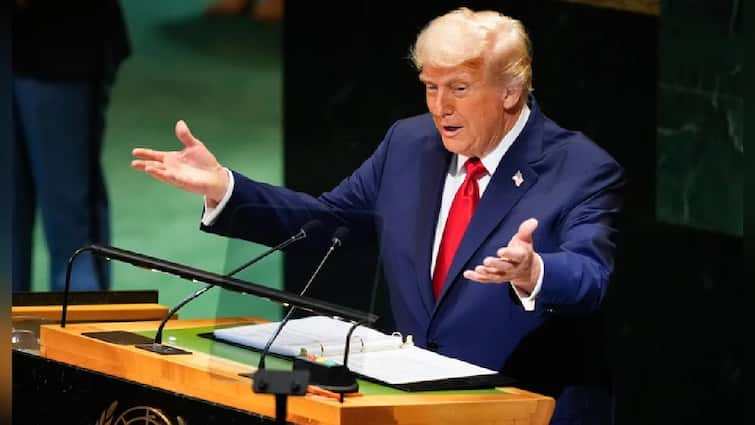

US President Donald Trump’s speech at the United Nations on Tuesday was a memorable moment in world politics, to say the least. From criticizing the UN for being ineffective in “solving any problems” to claiming that European nations are “going to hell” due to their stance on green energy and immigration, the President did not mince his words during his address.
The UN General Assembly has not historically been a platform for a head of state to scold other world leaders or to denigrate one’s predecessors for their domestic policies. However, based on Trump’s first eight months back in office, it is not surprising that he pulled this off.
A Speech for the Home Audience?
Analysts have claimed that the hour-long address seemed less like a foreign policy speech and more like Trump speaking to his political base at home. Boasting about his administration’s crackdown on immigrants by stopping a “colossal invasion,” the US being “the hottest country anywhere in the world,” and his own economic policies, the speech could very well have been one made during a campaign stop.
It wasn’t unlike JD Vance’s address at the Munich Security Conference in February, where he made a scorching attack on European leaders over the “fall of Europe.”
Trump and the Reordering of World Politics
It is undeniable that the Trump administration has played a major role in the reordering of world politics, expedited by the tariffs imposed on several US allies and partners. The souring of the India-US bilateral relationship was also a direct result of Washington’s new characteristic of unpredictable foreign policy decisions. India has traditionally been an important friend of the US, especially in its bid to counterbalance the growing dominance of China in the Indo-Pacific.
However, Trump’s recent punitive tariffs on India for continuing to buy Russian oil have damaged decades of cultivated friendship and goodwill between the two countries.
India, China, and the Russia-Ukraine War
India and China both found mention in Trump’s UN speech as “primary funders” of the Russia-Ukraine war, although he did also lay the blame on NATO countries for “funding the war against themselves.”
Now more than ever, Trump’s way of interacting with the world raises the question of whether diplomacy as we know it is still alive and kicking, or whether the way states conduct diplomacy is being fundamentally altered.
At its core, Trump’s foreign policy still largely reflects his thinking as a businessman, and his way of conducting diplomacy seems like a page straight out of his Art of the Deal. His lack of faith in multilateral institutions such as the United Nations is very telling of his view of the world order.
The only time he did not criticize NATO during the speech was when he praised members for committing to increased defense spending, another bid towards making the international order “fairer” for America.
A Fractured World and India’s Strategic Hedging
The decline of US hegemony is leading to a fractured world with multiple poles of power emerging. India now, like many others, has more reason than ever to stay true to its policy of strategic hedging.
PM Modi’s visit to China for the Shanghai Cooperation Organisation (SCO) summit at the end of August served as a platform for India to display its autonomy. While the ‘RIC’ or Russia-India-China trilateral remains an interest-based alignment rather than an alternative to the US-led Western order, it is an opportune moment for India to exercise strategic realignment.
Ultimately, India has more in common with the US than it may with the Trump administration, and momentary strain might be tricky to navigate, but the path ahead is as full of potential as it is precarious.
The Era of Transactional Diplomacy
If there is one thing predictable about Donald Trump, it is his unpredictability. The new-age diplomacy he is laying the foundation for seems to be transaction-based and heavily reliant on narratives and posturing.
Cautious navigation in the midst of reordering, as well as maintaining interest-based alignments without alienating partnerships, is likely the course of action that could ensure survival in a world of poly-crises.
Saniya Kulkarni is a programme manager at LSE IDEAS, The London School of Economics and Political Science.
 "Triple the crowd, half the security: Cops reveal lapses behind Vijay’s Karur rally deaths")