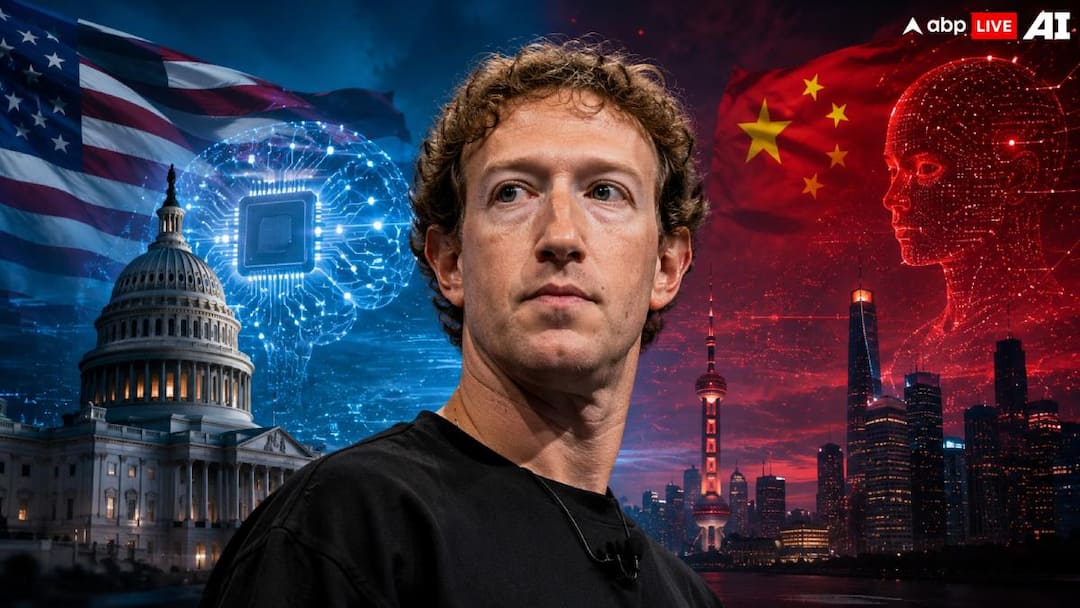

- Meta CEO Mark Zuckerberg opposes banning Chinese AI models.
- He advocates US strengthen its AI ecosystem through openness.
- Zuckerberg promotes open AI, believing it fosters innovation and security.
Meta CEO Mark Zuckerberg has entered one of the biggest policy debates shaping the future of artificial intelligence, arguing that the United States should focus on strengthening its own AI ecosystem instead of banning Chinese AI models. His comments come at a time when Washington is weighing tighter oversight of advanced AI systems while also increasing scrutiny of Chinese developers over allegations of intellectual property theft.
Rather than calling for restrictions, Zuckerberg is making the case that America’s long-term advantage in artificial intelligence will come from openness, competition and innovation. His remarks also reflect Meta’s broader strategy of promoting open AI models, putting it at odds with rivals such as OpenAI and Antohropic, which have largely relied on closed systems.
ALSO READ: Centre Unhappy With Meta’s Explanation Over PM Modi Facebook Post Removal, Says Issue ‘Not Closed’
Why Zuckerberg Opposes Ban on Chinese AI
Speaking in separate interviews to The New York Times and Financial Times, Zuckerberg argued that preventing Chinese AI models from operating in the US would not solve the country’s competitive challenges. Instead, he said policymakers should focus on identifying obstacles that slow American innovation and remove those barriers.
His intervention comes as concerns grow over China’s rapid AI progress. Beijing-based Moonshot AI recently unveiled its Kimi K3 model, which has drawn attention for approaching the capabilities of leading American AI systems. US officials have accused the company of using a technique known as distillation to train its models on rival American technologies, with senior Trump administration officials indicating that sanctions against Chinese AI labs remain under consideration.
Despite these developments, Zuckerberg maintained that a ban would not be “an effective solution”. He instead advocated for a stronger domestic AI ecosystem capable of competing globally.
Open AI Versus Closed AI Becomes Silicon Valley’s Biggest Battle
Much of the Meta chief’s message centred on what he calls “AI for everyone”, reinforcing Meta’s belief that open AI models should remain widely available for developers and businesses. According to Zuckerberg, concentrating powerful AI technology in the hands of only a few companies could hurt innovation.
He also cautioned against allowing major AI companies to shape regulations governing the industry.
“There’s always this question of regulatory capture if you have a set of businesses that have their own interests that are doing peer review,” Zuckerberg said. “Are the frontier labs… going to want an open-source model to succeed? I think that there have kind of been some mixed signals on that.”
Although he did not directly name competitors in those remarks, Zuckerberg separately criticised what he described as an increasingly pessimistic narrative surrounding AI development.
“So much of the discourse from a lot of the other labs that are developing this is overwhelmingly filled with doom,” Zuckerberg said. “There needs to be a voice or several voices that are bringing realism to this debate.”
Debate Intensifies Over AI Regulation & Safety
The timing of Zuckerberg’s comments is significant, with the Trump administration expected to introduce a voluntary framework allowing AI developers to submit new models for testing before public release.
Several industry leaders have backed stronger oversight. Anthropic CEO Dario Amodei has advocated stricter AI regulation, while Google DeepMind chief Demis Hassabis has proposed creating an industry self-regulatory body to establish standards for advanced AI systems.
Zuckerberg, however, argued that limiting access to the most advanced AI models is not necessarily the best approach to improving cybersecurity. He said powerful AI tools can also help organisations identify and fix vulnerabilities more quickly.
Referring to a recent cybersecurity incident, Zuckerberg said, “We’ve seen some breaches from big models [where] basically the company that got breached didn’t have access to the closed frontier models because it was restricted… so they turn to open-source models to go patch the issues.”
Meta’s Vision For Next Phase Of AI
Beyond the policy debate, Zuckerberg’s comments underline Meta’s long-term strategy. The company has invested billions of dollars in developing what he describes as “personal superintelligence”, built around AI systems that individuals can customise for their own needs.
Rejecting the idea that a single AI system could fairly represent everyone’s interests, Zuckerberg said, “I think a lot of people have this notion that if you build some kind of singular AI you can, through some idealized form of alignment, make sure it is benevolent to humanity. I’m personally skeptical of that path.”
He added, “I think it is literally impossible to have a single benevolent superintelligence that is simultaneously aligned with everyone at once.”
Summing up his broader philosophy, Zuckerberg argued that technological progress has consistently favoured wider access rather than greater concentration.
“I believe the general arc of the industry has been toward more openness and putting the power of tech into more people’s hands, not fewer,” he said.