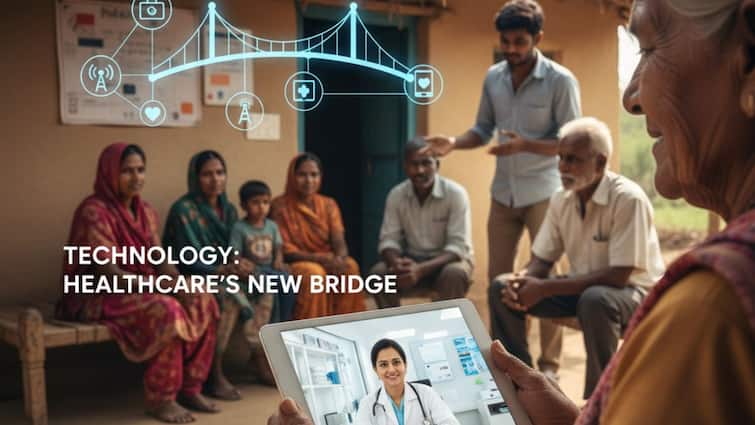

In many parts of the world (especially in the remote regions, impoverished communities, and underserved rural areas), access to healthcare remains a persistent challenge. Barriers such as distance, cost, and absence of specialist doctors, weak infrastructure, and sometimes lack of trust keep families from receiving timely medical care.
But now, technology is increasingly acting as a bridge, bringing doctors, diagnostics, and care much closer to those who were earlier cut off.
As Bipasa Giri, a Health Educator with Lotus Petal Foundation (a charitable organisation that runs programs in Education, Nutrition and Livelihood for underprivileged children), puts it, “Technology is now a vital bridge between doctors and underserved families. It is changing healthcare access in powerful ways. Tools like telemedicine, AI-based diagnostics, and mobile health apps bring medical advice and treatment to families in remote areas.”
In Rajasthan, India, a qualitative study of providers and patients in remote parts (Balotra district) found that telemedicine was being increasingly accepted. This study by the National Institute for Implementation Research on Non-Communicable Diseases, Jodhpur (Rajasthan), found that patients appreciated not having to travel long distances; providers noted enhanced efficiency. But problems included poor connectivity, low digital literacy, and a need for training.
“Digital tools make healthcare easier to use. More importantly, they create fairness and human connection for families once cut off from essential services. With telemedicine, people in isolated places can consult specialists. Mobile apps let individuals track their health and ask for advice any time,” says Bipasa Giri.
Telemedicine & Remote Consultations
A systematic review, Telemedicine for Patient Management in Remote Areas and Underserved Populations, summarised 20 studies (until May 2021 – collated by the University of Tehran) that focused on telemedicine in geographically remote settings (mountainous, forested). Benefits included reduced travel time and cost, increased patient satisfaction, earlier access to care, and better disease management. Challenges were things like unreliable internet, weather, and difficult logistics.
Another example is how the Indian national portal e-Sanjeevani, used during and after the COVID-19 pandemic, has helped make teleconsultations more available, as highlighted by a report by the Department of Community and Family Medicine, All India Institute of Medical Sciences, Rajkot, Gujarat.
Studies show good satisfaction among users, especially when the infrastructure (internet, devices) is adequate.
“For many children and their parents I work with at Lotus Petal Foundation, this feels like having a doctor finally within reach. Technology breaks barriers of distance, cost, and weak infrastructure. In skilled hands, it brings wider and timely patient care to people everywhere,” adds Bipasa Giri
AI-Driven Diagnostics & Decision Support
A recent study titled “Artificial Intelligence in Rural Healthcare Delivery: Bridging Gaps and Enhancing Equity through Innovation” published in August 2025, reviewed 109 studies from 2019-2024, finding strong promise in AI for tasks like predictive analytics, diagnostic imaging, and telemedicine platforms etc. These tools improve access, speed, and quality, but also raise problems of data quality, regulation, infrastructure, and ethics.
A study carried out by Cornell University and published in September 2025 showcases how, in India, AI screening tools for diseases such as diabetic retinopathy are under development in tele-ophthalmology applications. This study presents PerceptronCARE, a teleophthalmology application based on deep learning (designed for automated diabetic retinopathy detection using retinal images) is helping tackle and treat diabetic retinopathy – a leading cause of vision loss among adults and a major global health challenge, particularly in underserved regions. It claims that the app-based programme is able to classify the severity of diabetic retinopathy with ~85.4% accuracy, enabling earlier detection even in remote settings.
Early warning tools and diagnostic aids are also making headway. In many places, public health systems are piloting AI-cancer screening, AI-based stethoscopes, and diagnostic tools that require less specialist input but can alert or refer when needed. A Times of India report states that to strengthen preventive healthcare, Punjab government has launched a first-of-its-kind artificial intelligence (AI)-enabled screening devices for early detection of breast cancer, cervical cancer, and refractive errors.
Mobile Health Apps & Monitoring
Mobile apps and remote monitoring are playing a bigger role: tracking chronic conditions, mental health, post-operative care, and more. For example, “Mobile App-Based Remote Patient Monitoring in Acute Medical Conditions”, a collaborative study by two health research organisations from the United Kingdom, showed the feasibility of apps for monitoring discharged COVID-19 patients, helping reduce clinician burden while keeping patients under watch.
Also, there is the heart-warming and encouraging study by the George Institute of Global Health (UK, & Australia) of how the SMART Mental Health project in rural India used mobile/tele-technology to deliver mental health services in remote communities, helping reduce barriers such as stigma, travel, lack of specialists, and increasing use of services.
Conclusion
Technology is steadily bridging gaps in healthcare, especially for underserved communities. At Lotus Petal Foundation, Bipasa Giri notes that tools like telemedicine, AI diagnostics, and mobile apps “make healthcare easier, fairer, and finally within reach.” Evidence supports her vision: teleconsultations cut costs and travel, AI enables earlier disease detection, and mobile health tools create continuous connections with doctors. For many families, this shift feels like having a doctor nearby for the first time.
Yet barriers and challenges remain. Unstable internet, limited digital literacy, and the need for sustainable models still challenge widespread adoption. Regulatory oversight and hybrid approaches blending digital with in-person care are essential. Indian case studies, from tele-ophthalmology in Tamil Nadu to AI screening pilots in Punjab, show how solutions can scale. Ultimately, technology is not just transforming medical delivery; it is enabling human progress, making healthcare more equitable and accessible for families once left behind.
(Kirti Pandey is a senior independent journalist)
Check out below Health Tools-
Calculate The Age Through Age Calculator