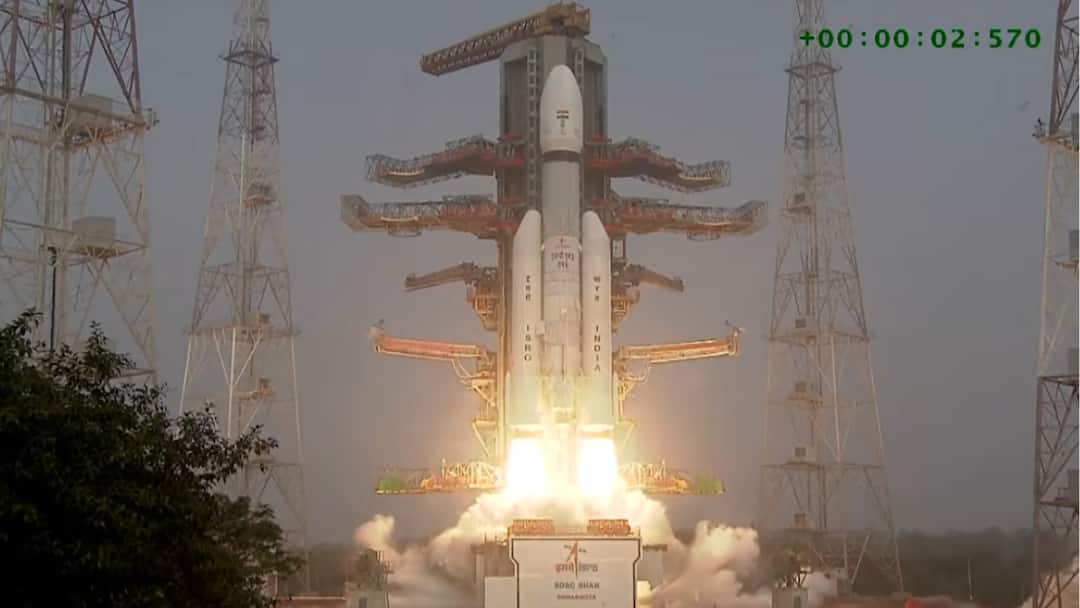

India’s Launch Vehicle Mark-3 (LVM3), ISRO’s most powerful rocket to date, stands at the core of the country’s ambitions in heavy-lift launches and commercial space missions. Designed as a three-stage launch vehicle, LVM3 has steadily evolved into a dependable platform capable of handling some of the most demanding payloads India has ever sent to space.
Towering at 43.5 metres and weighing about 640 tonnes at liftoff, the rocket is crowned with a 5-metre-wide payload fairing that protects spacecraft during the intense early phase of flight. Its modular yet robust architecture reflects years of indigenous development aimed at mastering complex propulsion technologies.
LVM3: A Three-Stage Design Built For Power & Precision
The LVM3’s configuration combines brute force with precision engineering. The first stage consists of two S200 solid strap-on boosters, among the largest solid rocket motors operational anywhere in the world. Each booster carries 204 tonnes of solid propellant and ignites at liftoff, providing the massive thrust needed to lift the rocket off the launch pad.
The second stage, known as L110, forms the liquid-fuelled core of the vehicle. Powered by two Vikas engines, it uses a mix of N₂O₄ and UH25, carrying a total of 115 tonnes of propellant. The third and final stage, C25, is the technological crown jewel of the rocket, equipped with ISRO’s indigenous CE-20 cryogenic engine. This stage runs on liquid hydrogen and liquid oxygen, with a propellant load of 28 tonnes, delivering the final push to orbit.
How Stage Separation Sequence Unfolds
The mission begins with the simultaneous ignition of both S200 boosters at liftoff. They burn for roughly 134 seconds before separating at an altitude of around 70–71 kilometres and falling into the sea. Even before their burnout, the L110 core stage ignites at about T+113 seconds, ensuring smooth thrust continuity.
The L110 stage continues firing until approximately T+313 seconds, reaching an altitude of nearly 126 kilometres before separation. The cryogenic C25 stage then takes over, guiding the payload to its intended orbit. During ascent, the payload fairing separates at around 115 kilometres altitude, once atmospheric drag is no longer a concern. Spacecraft deployment typically occurs close to 974 seconds into flight for GTO missions, while LEO missions follow a shorter trajectory.
Proven Capability In LEO, GTO Missions
LVM3 has demonstrated the ability to carry 8–10 tonnes into Low Earth Orbit and up to 4,000 kilograms into Geosynchronous Transfer Orbit. Its reliability has been underscored by a flawless success record across all missions so far. A standout example of its LEO capability was the LVM3-M2 mission, which deployed 36 OneWeb satellites into a 601-kilometre orbit through a complex, 75-minute sequence of orbital manoeuvres.
For LEO flights, ISRO often deorbits the cryogenic stage after payload separation to limit space debris, highlighting a growing focus on sustainable space operations.
With its consistent performance and growing commercial relevance, LVM3 has firmly established itself as the backbone of India’s heavy-lift launch programme and a serious contender in the global launch market.