
Saturday, April 25, 2026
39.1 C
New Delhi

You can read Epstein’s emails like you are inside his inbox

You can read Epstein’s emails like you are inside his inbox

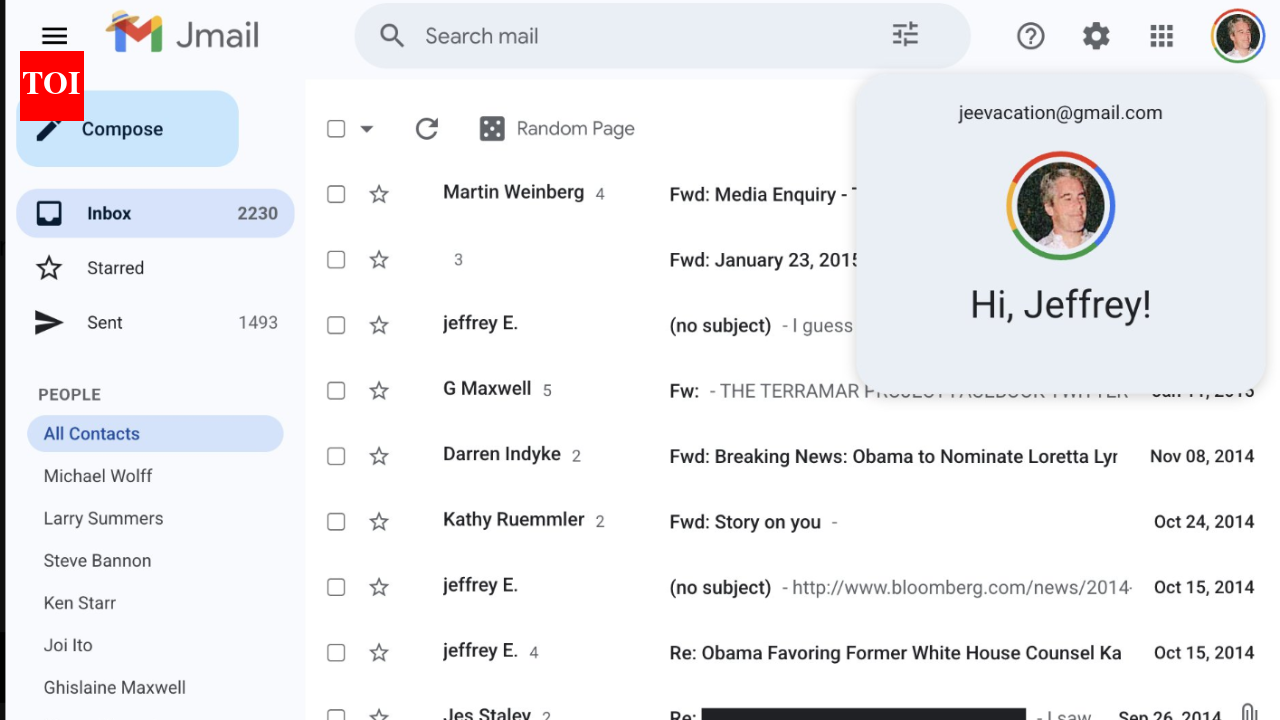
Sifting through large document dumps is usually a tedious exercise, even when the material is of major public interest. That has been the case with emails linked to Jeffrey Epstein, which have circulated in the public domain as scanned PDFs, plain text files, and images released through court cases and official disclosures. A recent web project changes that experience entirely. Instead of forcing readers to jump between files, it presents the emails inside a familiar, Gmail-style interface, making the archive feel like a real inbox and turning a messy collection of documents into something far easier to explore, search, and understand.The project, known as Jmail, recreates the look and behaviour of Google’s email service while relying only on material that is already public. There is no new data and no private access involved. The aim is usability rather than revelation: to make existing records readable without specialist tools or hours of manual sorting.

Who built Jmail and what they were trying to prove

Jmail was created by Riley Walz, described by Wired as a prankster and internet artist, working alongside web developer Luke Igel. Rather than treating the Epstein emails as raw evidence to be mined for new revelations, the pair approached them as both a technical challenge and a cultural problem. Their central question was not what the emails contained, but how the way information is presented shapes who engages with it and who does not.The creators have framed Jmail as an experiment in accessibility. Public records, they argue, are often technically available but practically unusable, buried in fragmented files that discourage close reading. By rebuilding the archive in a familiar format, they sought to expose the gap between transparency in principle and transparency in practice.

How the inbox changes the reading experience

The interface mirrors the conventions of a standard email client. Messages are clearly divided between sent and received folders, conversations are grouped into threads, and a search bar allows users to look up names, dates, and keywords instantly. These small design decisions dramatically alter how the material can be navigated. Instead of skimming isolated documents, users can follow patterns of correspondence and timelines with minimal friction.For journalists and researchers, this reduces the time spent on basic organisation and increases the time available for analysis. For general readers, the familiar layout removes the intimidation factor that often accompanies large document dumps, making engagement more likely.Although the presentation can feel provocative, Jmail functions primarily as a research aid rather than a stunt. It does not introduce new information or private data, nor does it claim to reveal hidden material. Its significance lies in how it demonstrates that interface design can influence whether public records are ignored, misunderstood, or meaningfully examined. Go to Source
Hot this week

US Navy begins mine clearance operations to restore transit in the Strait of Hormuz

President Donald Trump has directed the US Navy to intensify mine-clearing operations in the Strait of Hormuz, a critical maritime chokepoint currently paralysed by the ongoing conflict with Iran. Read More

UK scrambles Typhoon jets in Romania over Russian drone incursion near Nato airspace

Report says RAF jets did not enter Ukrainian airspace, contradicting claims of Russian drones being shot down and averting a potential escalation with Nato Go to Source Read More

AI To Take Over 50% Of UAE Government Services By 2028; What It Means For People

At the centre of the plan is ‘Agentic AI’, a more advanced form of artificial intelligence that goes beyond assisting humans. Read More

US-Iran Negotiations: Tehran Toughens Stance As IRGC Chief Drives Pakistan Talks | Exclusive

General Ahmad Vahidi and his hardline military council have effectively sidelined civilian diplomats, introducing a series of aggressive new preconditions Go to Source Read More

Topics

US Navy begins mine clearance operations to restore transit in the Strait of Hormuz

President Donald Trump has directed the US Navy to intensify mine-clearing operations in the Strait of Hormuz, a critical maritime chokepoint currently paralysed by the ongoing conflict with Iran. Read More

UK scrambles Typhoon jets in Romania over Russian drone incursion near Nato airspace

Report says RAF jets did not enter Ukrainian airspace, contradicting claims of Russian drones being shot down and averting a potential escalation with Nato Go to Source Read More

AI To Take Over 50% Of UAE Government Services By 2028; What It Means For People

At the centre of the plan is ‘Agentic AI’, a more advanced form of artificial intelligence that goes beyond assisting humans. Read More

US-Iran Negotiations: Tehran Toughens Stance As IRGC Chief Drives Pakistan Talks | Exclusive

General Ahmad Vahidi and his hardline military council have effectively sidelined civilian diplomats, introducing a series of aggressive new preconditions Go to Source Read More

‘Our Office Is Open’: Dubai’s War-Triggered WFH Comes To End

UAE companies, including law firms like Jones Day and Cleary Gottlieb Steen & Hamilton, are rolling back remote work as tensions ease, pushing staff back to offices. Read More

‘We Are Not A Giant Hotel’: This Country’s Capital Is Restricting Tourism Completely. Here’s Why

As visitor numbers surge to record levels, Athens is weighing restrictions on tourism growth, with the mayor cautioning that the city’s historic centre is under strain. Read More

Shanoo Sharma gets married, keeps husband’s identity under wraps

Popular casting director Shanoo Sharma is one of the most well known names in the industry as she’s known for launching actors like Arjun Kapoor, Ranveer Singh, Parineeti Chopra, Bhumi Pednekar among others. Read More

Related Articles