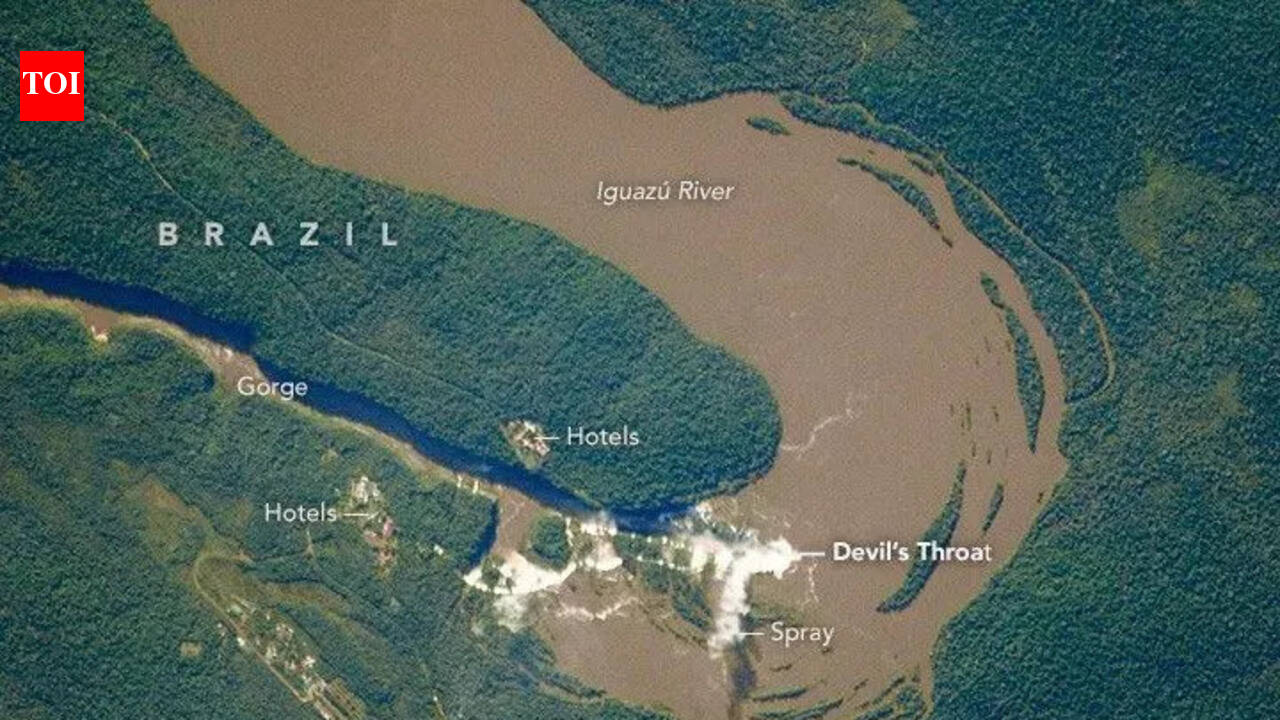

World’s largest waterfall system by width lies between Brazil and Argentina — stretching 2.7 kilometres (Image Source – NASA)
Along the border of Brazil and Argentina, the Iguazu River widens, slows, and then drops. The land simply falls away. Iguazu Falls stretches roughly 2.7 kilometres across a basalt plateau, forming what is generally described as the largest waterfall system in the world. Around 275 individual cascades make up the site. Heights vary between 60 and 90 metres, depending on the section and the season. At its centre sits a broad semicircle known as Devil’s Throat, where water funnels into a narrow gorge and rises again as spray. The plume is often visible from aircraft and satellite images. On both sides of the river, national parks protect the surrounding subtropical forest. The falls have held UNESCO World Heritage status since 1984.
Iguazu Falls is the world’s largest waterfall system by width
Iguazu Falls lies on a volcanic rock formation that shaped the border between Argentina and Brazil. Over time, river flow has cut through layers of hardened lava, creating steps, islands and separate curtains of water rather than one continuous drop. The Iguazu River bends sharply before reaching the edge, which explains the wide, curved shape of the falls.Sections differ in character. Some cascades fall in thin strands. Others plunge heavily into shadowed channels below. The scale becomes clearer from above, where the white arcs contrast sharply with deep green forest. The gorge beneath Devil’s Throat is narrow and steep, gradually lengthening as erosion continues upstream.
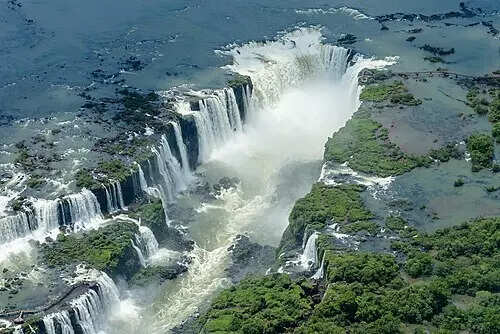
Iguazu Falls is the world’s largest waterfall system by width (Image Source – Wikipedia)
Subtropical forest supports rare wildlife
The surrounding rainforest forms part of a protected ecosystem shared by both countries. More than 2,000 species of vascular plants grow here. The humidity remains high for most of the year, sustained by constant spray.Wildlife typical of this region includes tapirs, giant anteaters, howler monkeys, ocelots, jaguars and caymans. Birdlife is especially active near the water. Among them is the great dusky swift, a dark, fast-flying species known for nesting behind the waterfalls. The birds fly directly through the falling water to reach ledges hidden from predators. The behaviour appears risky but offers protection from many threats found deeper in the forest.
Tourism infrastructure surrounds the falls on both banks
Both Argentina and Brazil maintain viewing areas within their respective national parks. Wooden walkways extend over sections of the river, allowing visitors to approach several cascades closely. On the Argentine side, a one-kilometre walkway crosses calm water before reaching the edge of Devil’s Throat.Hotels operate near the park entrances on both banks. Access routes are regulated, though visitor numbers remain high throughout the year. Early morning light often reveals the scale of the spray column rising from the gorge. From certain angles, the mist casts a faint shadow across the river surface before thinning into the forest air. Go to Source