
Source: Forbes
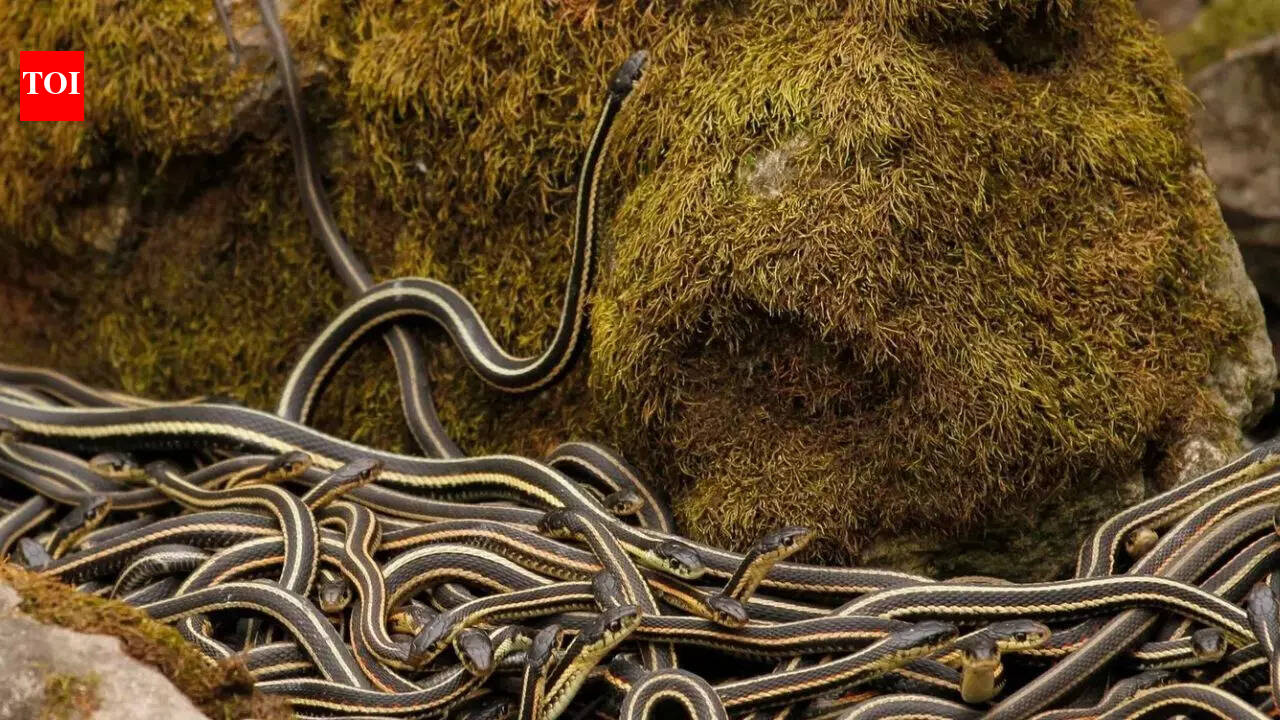
In the Canadian province of Manitoba, the Narcisse Snake Dens is the provincial wildlife management area, which is located in the Rural Municipality of Armstrong. These dens are the winter home of approximately 100,000 red-sided garter snakes. These sinkholes are believed to contain the largest gathering of this species anywhere on the planet. Their winter shelters lie deep within caverns carved out of water-smoothed limestone beneath the surface. When spring arrives, the snakes emerge from these underground dens and gather in the pits to mate. Once the breeding season ends, they gradually disperse into the surrounding marshlands, where they spend the summer months feeding and roaming.
Narcisse Snake Dens: Where 100,000 snakes spend freezing winter
According to BBC Wildlife, the Narcisse Snake Dens sit in the Rural Municipality of Armstrong, where grassland meets patches of forest, and beneath the soil lies porous limestone. Several metres down, these crevices dip below the frost line but stay above the water table. That detail matters. Winter temperatures above ground can plunge to -30°C. Yet inside the caverns, it never quite drops below freezing. For red-sided garter snakes, known scientifically as Thamnophis sirtalis parietalis, it’s the perfect winter refuge. They begin arriving in late September or early October. Slipping underground and settling into tight clusters, and then they wait, five to six months.
Why snakes depend on external warmth
Snakes rely on external warmth to power their metabolism. So when winter locks the landscape in ice, they simply shut down. Experts say that, together, they may help reduce moisture loss and stabilise body temperature. The males reportedly emerge first, often while snow still clings to the ground. They gather near the den entrances. Female garter snakes release pheromones, which are chemical signals that males detect using their vomeronasal organ, a scent-sensitive structure in the roof of the mouth. It guides them unerringly toward the source. One female can attract dozens and sometimes hundreds.What follows is known as a mating ball. A writhing knot of snakes, all competing for position. It looks like a single, pulsing organism. Tourists stand back. Cameras out. Some fascinated. Some are clearly reconsidering their life choices. Males rub their chins along the female’s back, trying to align their bodies. When one succeeds, he uses one of his two hooked reproductive organs, called hemipenes, to transfer sperm. A gelatinous mating plug is left behind, which appears to reduce the chances of rivals mating with the same female.
Red-sided garter snakes’ facts
- Venom: The red-sided garter snake is non-venomous and generally harmless to people, though it can be surprisingly bold when cornered.
- Size: Adults usually grow to around three or four feet, with a sturdy build and an olive-brown to almost black body.
- Colour: Most have a clear yellow stripe running down the back, while the side stripes can look sharp or faint depending on the individual. A yellowish belly often shows dark edging along the scutes. The well-known red bars along the sides may appear between the scales or spread across them, giving each snake a slightly different look.
- Scales: Their scales are keeled in 19 rows, and they are ovoviviparous, meaning females give birth to live young rather than laying eggs. Newborns resemble smaller, equally variable versions of the adults.
- Habitat: Find them near ponds, marshes, canals or slow-moving water, where they feed mostly on amphibians, along with worms and the occasional small rodent.