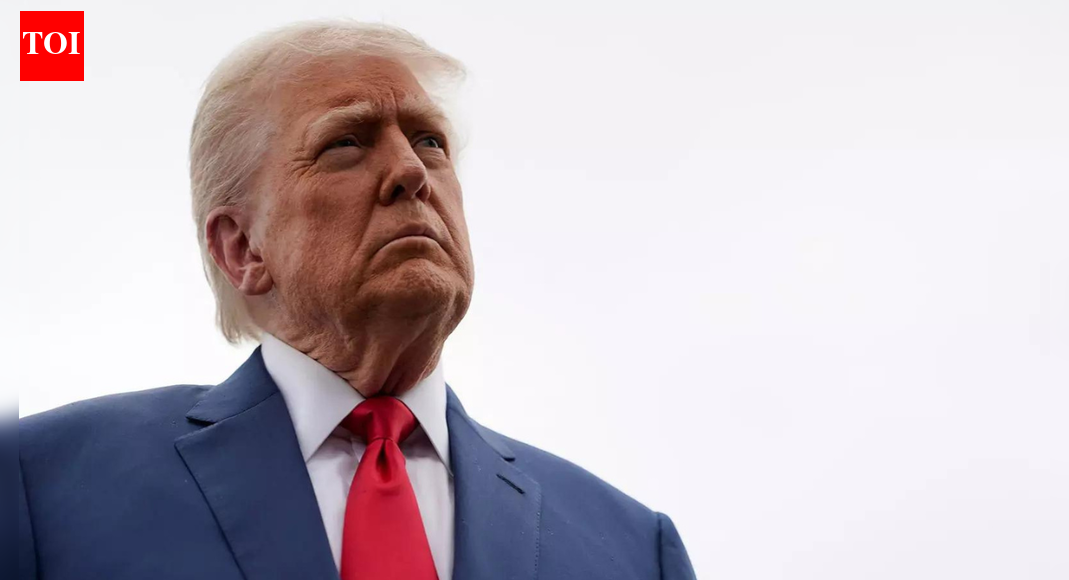

Photo credit: ANI
Transatlantic relations have suffered since Donald Trump took office again. The publication of the National Security Strategy on December 4 was seen by many European politicians as an open affront.In the document, which each new administration submits to Congress, Europe is described as a continent in decline where there is a risk of “civilizational erasure” because of migration policies. There is mention of “censorship of free speech and suppression of political opposition.”
However, a longer, unpublished draft of the document was circulated prior to the official, public strategy. It reportedly goes into more detail about the plans the US has for Europe in future. According to the Washington-based digital media platform Defense One, which claims to have seen the draft, it lists Italy, Austria, Poland and Hungary as countries that the US should “work more with … with the goal of pulling them away” from the European Union.The White House has denied the existence of any such draft.But the question remains: Is the US trying to divide the European Union? And why are these four countries of particular interest?
Italy, Austria, Poland and Hungary
Hungary’s name on the list is probably the least surprising, as Hungarian Prime Minister Viktor Orban and US President Trump remain close allies. The former supported the latter during his 2016 presidential campaign — the only ruling EU leader to do so at the time. Both stand to mutually benefit from the other’s political stance. Orban is widely seen as a maverick and a destabilizing force for the EU — an institution that Trump appears to deeply distrust. And Trump has refered to Orban as his “great friend” and is even alleged to have offered Hungary a “financial shield” of $20 billion (€17 billion), similar to the one he recently offered Argentina. Hungary’s economy is in a weak state, and significant EU funds due to the country are frozen over persistent concerns about democratic backsliding. Trump told the media outlet Politico earlier this month that he had not promised Hungary a financial lifeline but said that Orban had asked for one.The US president also appears enthusiastic about Italian Prime Minister Giorgia Meloni and her Brothers of Italy, a right-wing party with neo-fascist roots. But Daniel Hegedüs, regional director for Central Europe at the German Marshall Fund of the United States, believes that the US government is under a “misapprehension” that Meloni would oppose the EU. Though she shares certain ideological views with Orban, she has not played an obstructionist role in the bloc. Indeed, she is very pragmatic, Hegedüs told DW, adding that few had understood as well as she had what a stable EU could do for their country.While neither Poland nor Austria are currently led by right-wing populist governments, this was the case until recently, and right-wing and euroskeptic parties remain extremely influential in both countries. In the last elections, the far-right Freedom Party of Austria (FPÖ) was the strongest force. It is currently leading the polls. In Poland last summer, Karol Nawrocki, the candidate backed by the national conservative Law and Justice party (PiS), won the presidential election.It is perhaps not surprising that the Trump administration might hope to soon be able to exert more influence in both countries.
Why not the Czech Republic and Slovakia?
What is surprising, at least to some, is that two EU states do not appear on the list: the Czech Republic and Slovakia.In the first, the parliamentary elections were won by the billionaire Andrej Babis and his populist ANO party in October. Babis formed a coalition government with the right-wing Motorists for Themselves party and the far-right Freedom and Direct Democracy party.Meanwhile, Slovakia has been experiencing a shift to the right since Robert Fico came to power as prime minister in 2023. His nominally social democratic, but in fact nationalist and increasingly right-wing Smer-SD party was recently expelled from the EU-level Party of European Socialists.Both Babis and Fico are outspoken EU skeptics, and both have the potential to cause chaos in EU decisionmaking and to undermine the bloc’s authority on strategic issues, especially with regard to Russia and Ukraine — qualities that the current Trump administration is likely to appreciate.Hegedüs believes the fact that they did not end up being mentioned in the final strategy document lies with the roots of their parties. For a long time, ANO could not be classified on the traditional left-right spectrum, while Smer-SD saw itself as left-wing. “You can clearly see how ideological the US approach is,” says Hegedüs. “Because Smer and ANO do not have a traditional right-populist background, they are not considered to be like-minded, even though they possibly pursue policies that are useful to the Trump administration.”
Gradual disintegration of the European Union
Initial attempts by the US government to interfere in democratic processes in Europe at the beginning of the year, such as Vice President JD Vance’s controversial speech at the Munich Security Conference, were initially dismissed by observers of transatlantic relations. Many argued that the new administration in Washington still had to find its feet in its new role. But ever since, the US government has interfered again and again — in the Romanian, Polish and German election campaigns, for instance. The pattern is always the same: support is given to those whom the Trump administration sees as an ally in ideological terms, and to those who can weaken Brussels.Experts such as Hegedüs doubt that the US’ goal is to promote the departure of one of these four nations from the bloc stylized as a “Huxit,” “Italexit,” “Auxit” or “Polexit” respectively, but rather to push a gradual disintegration of European integration, through diplomatic, political, and perhaps even financial support.The first signs of this are already visible. For example, although the EU has agreed to gradually phase out its dependence on Russian energy and the bloc will ban imports of liquefied natural gas by the end of 2026 and pipeline gas by the fall of 2027, Hungary has announced it will refuse to comply.In November, Prime Minister Orban secured a waiver from US sanctions on Russian oil and gas imports from Trump. He said that he did not accept the EU’s decision and would take the case to the European Court of Justice. In a recent joint press conference with Turkish President Recep Tayyip Erdogan , he announced that Turkey would continue to guarantee the route so that gas could be transported from Russia to Hungary via the TurkStream pipeline.Hegedüs predicts that in the coming years there will be more such cases, with member states failing tocomply with joint decisions, thereby increasingly calling into question the very essence of European integration. Go to Source