
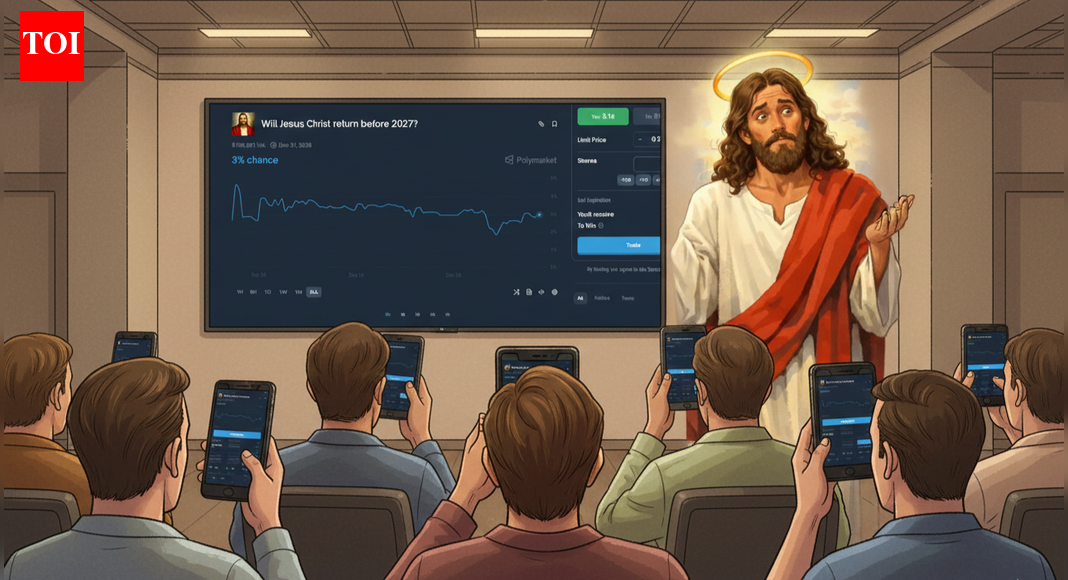


Polymarket traders currently give Jesus Christ’s return before the end of 2026 a roughly three percent chance/ AI Illustration
Christians have long awaited the Second Coming, a belief grounded in the Gospels themselves. Jesus speaks of his return, but he also issues a caution that has echoed through centuries of theology: “No one knows the day or the hour.” According to scripture, even he did not claim knowledge of when it would happen. The unknowability is part of the belief. What is new is the attempt to translate that uncertainty into a tradable probability and that such odds exist at all is what has drawn attention.The unusual wager is now playing out on a prediction market better known for pricing elections, court rulings and geopolitical flashpoints, where traders are placing money on a far older and more elusive question: whether Jesus Christ will return to Earth before the end of 2026.

The current wager strongly favors no, with traders assigning only a small chance to Jesus Christ’s return.
The contract sits on Polymarket, a platform where users buy and sell “Yes” or “No” shares tied to future outcomes. In this case, a “Yes” share pays out $1 if the Second Coming occurs by 11:59 PM ET on 31 December 2026; otherwise, it settles at zero. At present, the market prices that outcome at roughly 3%, implying a potential return of more than 5,700% for anyone backing it successfully.
A sequel to last year’s wager
This is not the first time Polymarket users have traded on the question. In 2025, a nearly identical contract asked whether Jesus Christ would return by the end of that year. Over the course of the market’s life, bettors committed close to $3.3 million, with the overwhelming majority backing “No”. During the spring of 2025, the implied probability briefly climbed to around 4%, before drifting lower as the year wore on. By December, support for a “Yes” outcome had fallen below 1%. When the calendar turned on 1 January 2026, the market was formally resolved against it. The contract’s terms offered little room for interpretation. “The resolution source for this market will be a consensus of credible sources,” Polymarket stated. Once the year elapsed without incident, the outcome was recorded accordingly. For traders who entered the “No” side during the brief period of heightened interest in April, the wager delivered an estimated annualised return of about 5.5%, before fees, a figure that quietly outperformed US Treasury bills over the same period, often treated as the baseline for low-risk returns.
Faith, probability and an old idea revisited
Applying odds to religious belief is not a modern provocation. In the 17th century, Blaise Pascal, a French mathematician and philosopher, proposed what later became known as Pascal’s Wager. His argument was pragmatic rather than theological: if God exists, belief offers infinite reward; if God does not, belief costs only finite earthly pleasures. Framed that way, belief represented the rational gamble. Pascal was not offering proof of God’s existence, nor suggesting belief could be priced or traded. He was describing belief as a life-defining bet made under uncertainty. The Polymarket contract does something narrower. It does not ask participants to believe or disbelieve. It asks them to assign a probability to a specific outcome within a defined time frame and to risk money on that assessment.
Why people still trade it
Polymarket hosts no shortage of unconventional contracts, including bets on alien disclosure, symbolic geopolitical events and unlikely catastrophes. What sets the Jesus wager apart is not its improbability but its subject. A belief held by billions, framed by scripture as unknowable, has been reduced to a price that ticks up and down in real time.Prediction markets such as Polymarket and Kalshi promote themselves as tools for aggregating information, with supporters arguing that financial stakes sharpen judgment. The Jesus contract, however, has drawn criticism even from those otherwise sympathetic to the model. “People buy lottery tickets despite astronomical odds,” John Holden, an associate professor of business law and ethics at Indiana University’s Kelley School of Business, told Bloomberg, noting that participation does not necessarily reflect belief in the outcome. Others are less charitable. Melinda Roth, an associate professor at Washington and Lee School of Law, described the wager as “distracting,” arguing that it “diminishes the value of actual prediction markets that provide insights and useful information.” Online, reactions have ranged from dismissal to discomfort, with users calling it absurd or questioning whether anything should be tradable.Among traders, however, the appeal is largely mechanical rather than theological. The contract offers a clearly defined resolution date, an overwhelmingly favoured outcome, and relatively low price volatility on the “No” side. That combination makes it attractive to participants seeking a place to park capital, hedge positions, or exploit small pricing inefficiencies rather than express belief.In that sense, the wager functions less as a statement of faith than as a financial instrument. The improbability is not a deterrent but an asset: the more unlikely the event, the more predictable the trade appears, and the more the market rewards those willing to bet against it.
Where the market now stands
Despite reports circulating on social media of heavy liquidity, including claims that millions of dollars have been committed across both sides of the trade, the market itself remains overwhelmingly one-sided, with roughly 97% of positions still sitting on “No”.The rules governing the contract have not changed, the deadline is clearly defined, and the outcome will be determined in the same way as last year’s wager, through the simple passage of time rather than any declaration, revelation or recognised authority.For now, traders continue to monitor small movements in the odds, watching prices shift by fractions of a percentage point as the contract counts down toward its expiry.(Disclaimer: Recommendations and views on the stock market, other asset classes or personal finance management tips given by experts are their own. These opinions do not represent the views of The Times of India) Go to Source