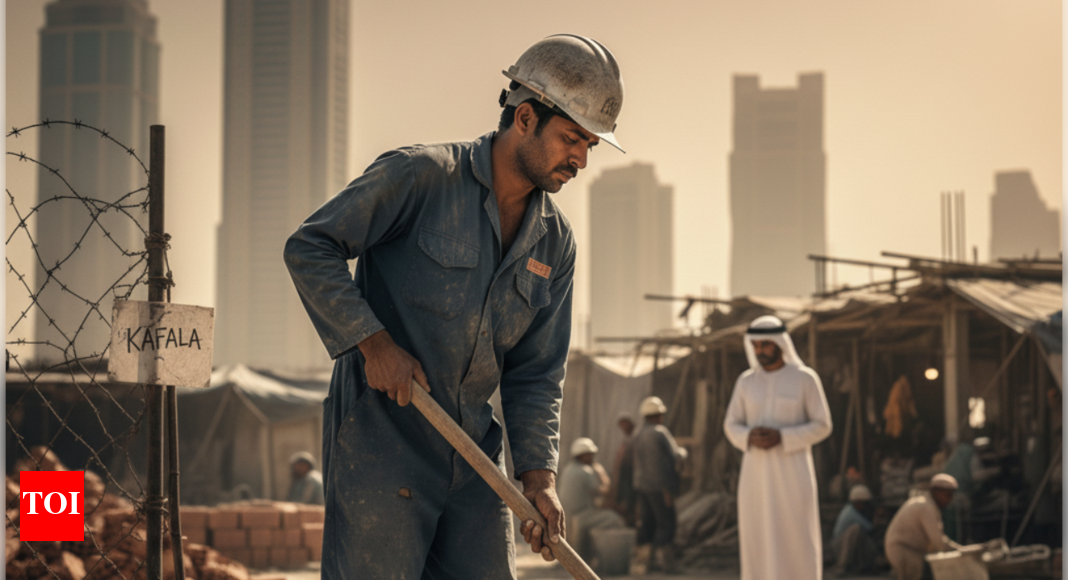

Saudi Arabia’s labour reforms mark a major shift, easing worker mobility and reducing Kafala dependency to promote fair employment rights / Illustration generated by AI
For over half a century, a single word defined the lives of millions of foreign workers in the Gulf: kafala, Arabic for “sponsorship.” It decided whether they could change jobs, whether they could leave the country, and whether they could fight back against abuse. It was a system critics compared to “modern-day slavery.”Now, for the first time in 50 years, that system has officially been abolished in Saudi Arabia, where roughly 13 million foreign workers make up the backbone of the economy. But what exactly was the kafala system? Why was it so controversial? And how much will life really change for those who lived under it?
What was the Kafala system?
The kafala system was a legal framework that governed the employment and residency of migrant workers across the Gulf Cooperation Council (GCC) states. It emerged in the 1950s, when oil-rich economies needed cheap labour to build cities and infrastructure but wanted to avoid granting permanent residency or citizenship.Under kafala, a foreign worker’s legal status was tied entirely to their employer, or kafeel. This sponsor controlled their visa, their right to live in the country, and often their ability to change jobs or even exit the country. Without the sponsor’s approval, workers could not:
- Change employers
- Leave the country (many needed an “exit visa”)
- Seek legal recourse if abused
The system was designed to minimise state bureaucracy and regulate labour through private sponsors. But in practice, it created an enormous power imbalance. Employers could confiscate passports, withhold wages, or threaten deportation, and workers had almost no way to challenge them.
Why was it so controversial?
Over the decades, kafala became one of the most criticised labour systems in the world. Human rights groups and the International Labour Organization (ILO) accused Gulf governments of enabling forced labour and human trafficking under the guise of sponsorship.Because workers risked arrest or deportation if they left their jobs without permission, many remained in exploitative or abusive situations — particularly in domestic work, construction, and agriculture. In extreme cases, NGOs documented conditions resembling indentured servitude.The scale was staggering:
- Around 13.4 million migrant workers live in Saudi Arabia, nearly 42% of the population.
- Millions come from South and Southeast Asia, including India, Bangladesh, and the Philippines.
- An estimated 4 million are domestic workers, often isolated and vulnerable to abuse.
Why is Saudi Arabia abolishing it now?
The decision to abolish kafala, announced in June 2025, is part of Vision 2030, Crown Prince Mohammed bin Salman’s sweeping plan to diversify the Saudi economy, attract foreign investment, and modernise its global image.The move also reflects mounting international pressure. Ahead of high-profile events and partnerships, Gulf states have faced criticism from global rights groups, Western governments, and even multinational companies over their labour records. Qatar, for instance, introduced partial reforms ahead of the 2022 FIFA World Cup.
What’s changed under the new system?
Saudi Arabia says it is replacing kafala with a contract-based employment system that aims to restore agency to workers. Key changes include:
- Freedom to change jobs: Workers can move to a new employer without needing approval from their current one.
- Freedom to exit: They can leave the country without an exit visa or sponsor consent.
- Legal protections: Workers will have improved access to labour courts and complaint mechanisms.
Officials say the reforms will boost productivity, reduce exploitation, and improve Saudi Arabia’s reputation among investors and the international community.
How much will life really change?
The announcement is a breakthrough but experts caution that legal reforms alone won’t end abuse overnight.Rights groups point out that:
- Implementation gaps remain: many employers still demand consent for job changes or control exit visas.
- Domestic workers among the most vulnerable may not benefit equally from new protections.
- Recruitment abuses in origin countries (like high fees and contract substitution) are still common and not addressed by Saudi law.
“Changing the law is the first step,” says Human Rights Watch. “Changing the reality on the ground will take much longer.”
Why this matters
For millions of migrant workers from India, Bangladesh, Nepal, the Philippines, and beyond, the end of kafala is more than just legal reform, it’s a restoration of basic rights long denied. The ability to walk away from an abusive employer, to leave the country freely, or to seek justice without fear marks a fundamental shift in how Gulf economies treat the workers who sustain them.For Saudi Arabia, it’s a signal to the world that the kingdom is serious about modernisation and understands that economic reform must go hand in hand with human rights reform. But as activists note, this is not the end of the kafala story — it’s the beginning of a new chapter. The true test will be whether Saudi Arabia enforces these rights in practice and whether other Gulf states follow its lead.The abolition of the kafala system is one of the most significant labour reforms in the Middle East in decades. It promises freedom, dignity, and legal protection to millions of migrant workers but the gap between law and lived reality remains a challenge that will define the next phase of the Gulf’s labour history. Go to Source