
Image: AI Generated
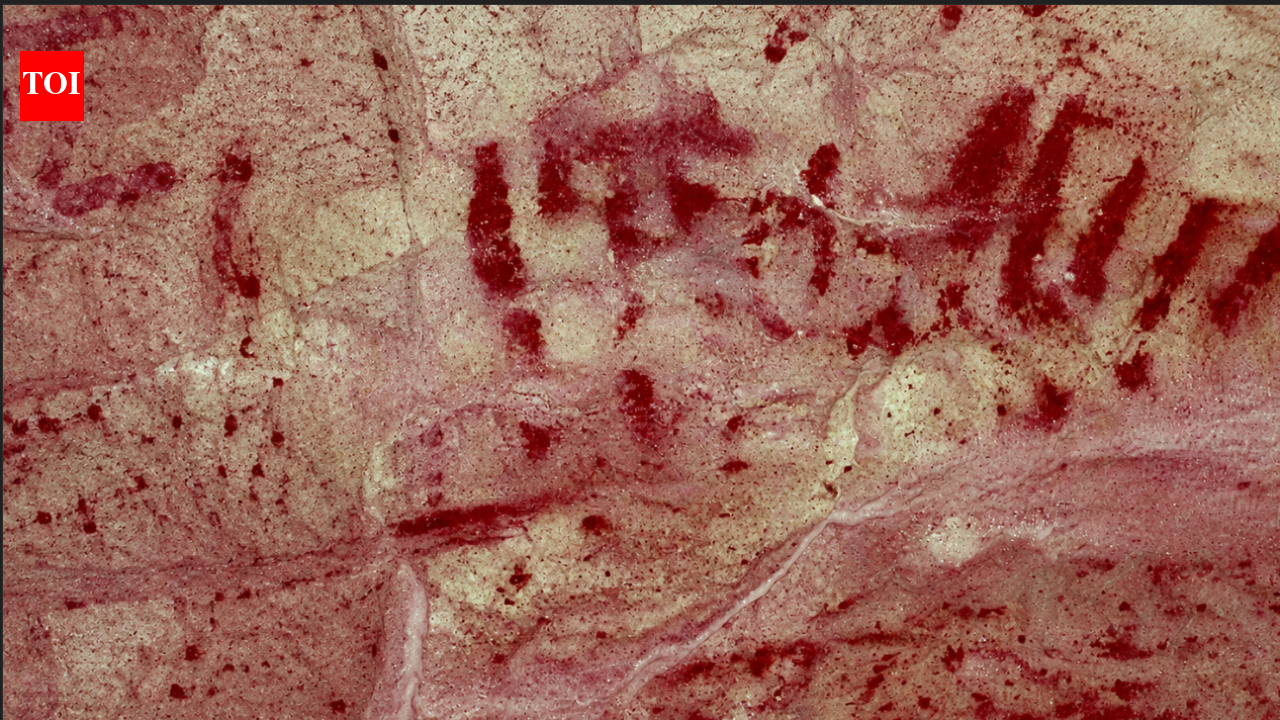
Inside a limestone cave on the Gower Peninsula in south Wales, eleven parallel horizontal lines of red pigment have been sitting on a cave wall for roughly 17,100 years. They were first noticed by scientists in 1912, declared a remarkable example of Palaeolithic cave art, then reclassified as a natural mineral seep sixteen years later, and subsequently forgotten by the academic community for nearly a century. A new study published in the journal Quaternary has now closed the debate decisively, confirming through uranium-thorium dating, geochemical analysis, and multispectral imaging that the marks are genuine prehistoric art made by human hands. The finding makes Bacon Hole cave home to the oldest known cave art in Britain and in north-western Europe, a title that had been sitting, unrecognised, on a cave wall near Mumbles all along.
How Britain’s oldest cave art was first discovered in 1912
Bacon Hole is a cave cut into the limestone cliffs of the south Gower coastline, overlooking the Bristol Channel, about 50 miles west of Cardiff. It was first excavated in 1850 and had been well known to local people for decades before that, including a fisherman named Jonny Bates from nearby Oystermouth, who visited in 1894 and left his name in painted graffiti on the cave wall. In 1912, geologist and anthropologist Professor William Sollas of Oxford and the French archaeologist and Catholic priest Henri Breuil entered the cave together and identified a series of horizontal bands in red pigment on the wall of an eastern side chamber. Breuil was already internationally recognised as the leading authority on Palaeolithic cave art in Europe. The two men were confident in what they saw, and their report, covered by The Guardian at the time, declared it the first known specimen of prehistoric cave painting ever discovered in Britain.
The discovery that was written off and forgotten for nearly a century
The consensus did not hold. By 1928, the painted panel had been reclassified as a natural phenomenon: red oxide mineral seeping through the rock and staining the surface in a pattern that superficially resembled human-made stripes. The Guardian, which had originally reported the discovery, appended a correction to its earlier account. The site was effectively closed as a subject of serious inquiry. As Dr George Nash, who led the new research, put it: “This invaluable panel became a footnote in history, forgotten by the academic community.”The dismissal made a certain kind of sense at the time. The early 20th century was shaped by what historians of science now describe as cognitive exceptionalism the assumption that truly symbolic or abstract thought was confined to anatomically modern humans in particular cultural contexts, and that the threshold separating art from accident required elaborate proof. The near-vertical regularity of the Bacon Hole stripes, combined with their abstract, non-figurative character, did not fit the dominant image of Palaeolithic art anchored by the animal paintings of Lascaux and Altamira. Red mineral staining was a plausible enough alternative, and once a senior voice proposed it, the site ceased to be a priority.
How a 2022 investigation proved the cave markings were made by humans
In September 2022, Nash and his international First Art research team revisited Bacon Hole with modern analytical tools. What they found under multispectral imaging immediately distinguished the panel from natural mineral deposits. Natural iron-oxide seeps in limestone caves follow gravity, producing irregular, vertical, or branching patterns determined by water flow and geological faults. The Bacon Hole markings are eleven parallel horizontal lines of consistent thickness and spacing, accompanied by finger dots and pigment splashes identified through D-Stretch image enhancement. The microscopic dispersion pattern of the pigment matches a deliberate spitting or blowing technique, not the gradual accumulation of mineral runoff.Geochemical fingerprinting went further still. The pigment contains clay minerals, aluminosilicates and highly crystalline haematite, a specific formulation absent from the natural limestone walls of the cave. This is not a mineral seep. It is a paint mixture prepared and applied by a human being.As the published paper in Quaternary confirms, uranium-thorium dating of calcite samples taken from flows overlying the painted surface in April 2023 placed the art at approximately 17,100 years old, corresponding to the later Upper Palaeolithic, the last phase of the Old Stone Age, when Wales was emerging from a severe cold episode of the Devensian glaciation. The paper’s conclusion is unequivocal: “It is evident that the pigmented lines were intentionally created by human agency, rather than resulting from natural processes.”
What Wales looked like when Britain’s oldest cave art was created
The date places the art firmly within the period when the Bristol Channel did not exist. The area now covered by that stretch of water was dry land, a broad, flat plain that would have served as a natural corridor for migratory megafauna grazing during summer months. The cave, situated on what would then have been an inland limestone ridge, offered shelter to hunter-fisher-gatherer groups moving through a landscape that was treeless and periglacial but increasingly habitable as the glaciers retreated. Nash noted that while we can never know with certainty what motivated the artists, the placement of the work deep in the side chamber of the cave suggests these were not casual marks; the location carried meaning beyond ordinary domestic use.The study team included academics from the Universities of Southampton, Swansea, Coimbra, and Ferrara, among others. The project received funding from National Trust Wales and the Bradshaw Foundation. Nash also noted that a rare example of Upper Palaeolithic rock art he discovered in 2010 at Cathole Cave, just two and a half miles from Bacon Hole, carries a minimum date of 14,500 to 12,500 years ago, making the Gower Peninsula an unexpectedly rich cluster of very early British rock art.
How modern science corrected a century-old archaeological mistake
The vindication of Sollas and Breuil’s original 1912 report is an unusual event in archaeology: a judgement made by two of the most respected scientists of their era, overturned by their successors, and then restored by a third generation armed with technology that neither could have imagined. Nash said that revisiting dismissed or overlooked sites across the region may now follow, given how definitively modern dating and imaging methods have proved their value here. Whether other panels in Bacon Hole or nearby caves are also waiting for reclassification remains an open question. For now, the eleven red lines in the eastern side chamber stand as the oldest confirmed act of human visual expression anywhere in Britain, patient, horizontal, and entirely unmistakable once you know what you are looking at. Go to Source