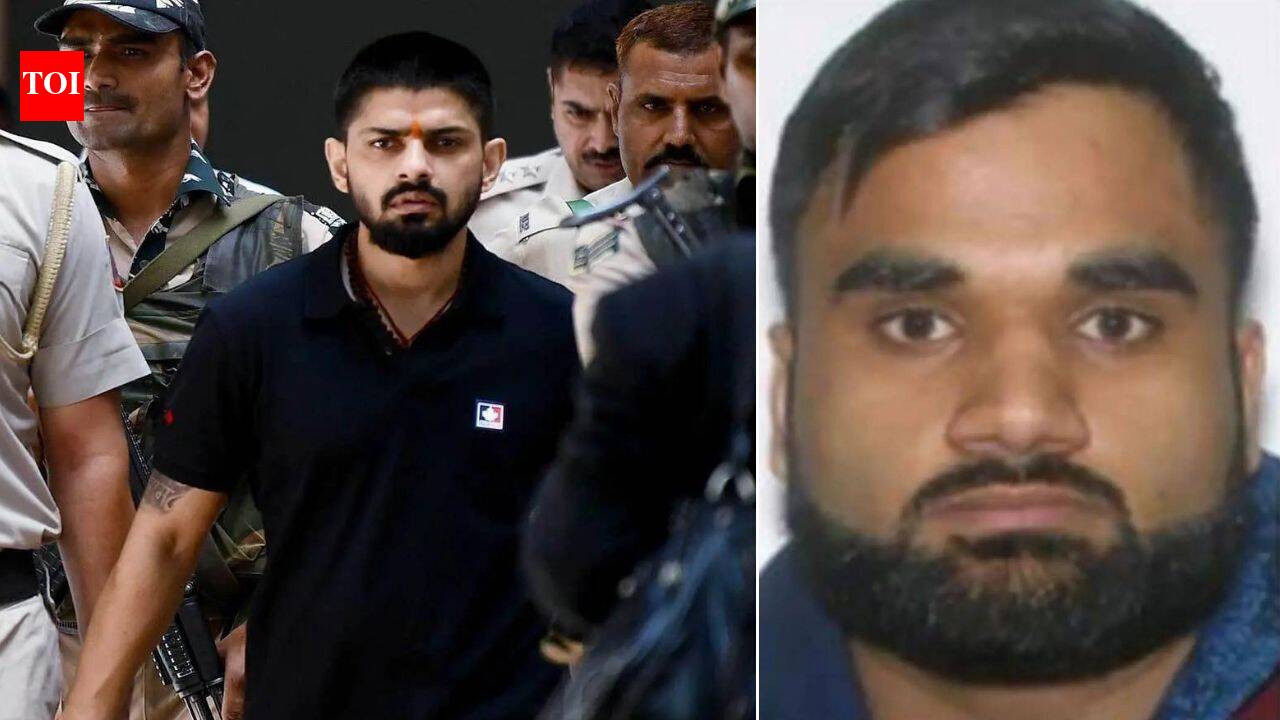

Lawrence Bishnoi, Goldy Brar charged in Hardeep Singh Nijjar murder, says US DOJ (Image/ANI)
TOI correspondent from Washington: US federal prosecutors have charged jailed Indian gangster Lawrence Bishnoi and his close associate Satinderjeet Singh, alias Goldy Brar, with ordering the assassination of Khalistan separatist Hardeep Singh Nijjar in Canada, but neither the indictment nor US officials accused the Government of India or any Indian official of directing, facilitating or participating in the killing like the Canadian government of Justin Trudeau did.The distinction is significant because Nijjar’s murder in June 2023 precipitated one of the worst diplomatic crises in India-Canada relations after then Canadian Prime Minister Trudeau told Parliament that Canadian security agencies were pursuing ‘credible allegations’ of a potential link between agents of the Indian government and the assassination. India strongly denied the allegations, calling them ‘absurd’ and politically motivated, suggesting he was pandering to his Khalistani supporters. The newly unsealed US indictment instead places organised crime figures at the centre of the killing.Nijjar, a Canadian citizen and a leading advocate of Khalistan, was shot dead outside the Guru Nanak Sikh Gurdwara in Surrey, British Columbia, on June 18, 2023. According to the federal indictment, Bishnoi and Brar ordered Nijjar’s assassination, provided his photograph and multiple addresses, and directed members of their criminal enterprise to carry out the killing. The charges were announced as part of ‘Operation Hard Ball,’ which the US Department of Justice described as the largest-ever action against India-based transnational organised crime networks. In all, 37 individuals have been charged in three federal indictments involving criminal organisations accused of murder, contract killings, extortion, narcotics trafficking, arms trafficking, kidnapping, money laundering and human trafficking across North America, Europe and Asia.The indictment portrays Bishnoi, 33, as the head of a sprawling criminal organisation that allegedly continued to operate globally despite his imprisonment in India. According to the Justice Department, Bishnoi cultivated an image as a ‘patriot,’ ‘nationalist’ and ‘deeply religious’ individual through social media and media interviews.”In private, Bishnoi presided over a sweeping criminal enterprise that spanned multiple continents,” the department said in a statement. Using contraband cellphones and internet-based communication devices allegedly smuggled into his prison cell, Bishnoi personally directed “political assassinations, murders, shootings, extortions, kidnappings, drug trafficking, human smuggling, and other crimes committed by members and associates of the Bishnoi enterprise worldwide,” prosecutors alleged.Brar, originally from Punjab and believed to be operating in North America, was described in the indictment as Bishnoi’s principal operational commander in the region. The FBI has issued a federal warrant for Brar and announced a reward of up to $50,000 for information leading to his arrest. Canadian police officials said the United States intends to seek Bishnoi’s extradition from India. “He is not in custody yet, but he will be shortly. We have charged him and we will extradite him to the US,” First Assistant US Attorney Bill Essayli told reporters.At the same press conference, US officials publicly questioned how some organised crime leaders were able to continue running international criminal enterprises while imprisoned. “Some of these criminals are in jail cells in India. Obviously that is not enough to restrain their activities. When they come to a federal prison in the US, they will not be exploiting anyone,” one official said. The comments stopped short of alleging complicity by Indian authorities but implied concern over the freedom with which some alleged gangsters are able to operate from prison.The US charges have generated sharply different interpretations among India partisans and Khalistan activists. Supporters of the Indian government’s position have argued that the indictment effectively vindicates New Delhi because US investigators, despite conducting an extensive international investigation involving the FBI, the Royal Canadian Mounted Police and other agencies, did not accuse India or Indian officials of involvement in Nijjar’s murder.Some India partisans have further argued that gangs such as the Bishnoi network operate independently and are often intertwined with criminal and political factions within sections of the Sikh diaspora abroad, including individuals and groups associated with the Khalistan movement. Others have suggested that the killing may have stemmed from organised crime rivalries, competition for influence in gurdwaras, or disputes linked to the Punjabi criminal underworld and transnational drug trafficking. The indictment itself does not specify a motive beyond alleging that Nijjar’s murder was ordered by the Bishnoi enterprise.Khalistan advocacy groups reject the suggestion that the indictment exonerates Indian authorities. Gurpatwant Singh Pannun, general counsel of the US-based group Sikhs For Justice (SFJ), argued that the charges against Bishnoi and Brar should be viewed together with a separate US prosecution involving former Indian intelligence officer Vikash Yadav, who has been charged in connection with an alleged murder-for-hire plot targeting Pannun in New York. “The Bishnoi indictment cannot be viewed in isolation. The trail of evidence leads directly to the highest echelons of the Indian government,” Pannun alleged. India has consistently denied such charges and has repeatedly rejected accusations by SFJ and other Khalistan activists.Beyond the Nijjar killing, Operation Hard Ball uncovered what US authorities described as extensive transnational criminal activity. Investigators seized approximately 1,000 kilograms of cocaine, one kilogram of heroin, cash and firearms. Prosecutors alleged that the criminal organisations generated millions of dollars through narcotics trafficking and extortion schemes targeting members of the Indian diaspora in North America.For India and Canada, however, the immediate significance of the US indictment lies less in the organised crime allegations than in its legal framing of Nijjar’s murder. Nearly three years after the assassination triggered a diplomatic crisis, the US case places alleged gangsters — not governments — in the dock, while leaving unresolved the broader political dispute over whether any state actors may also have played a role. Go to Source