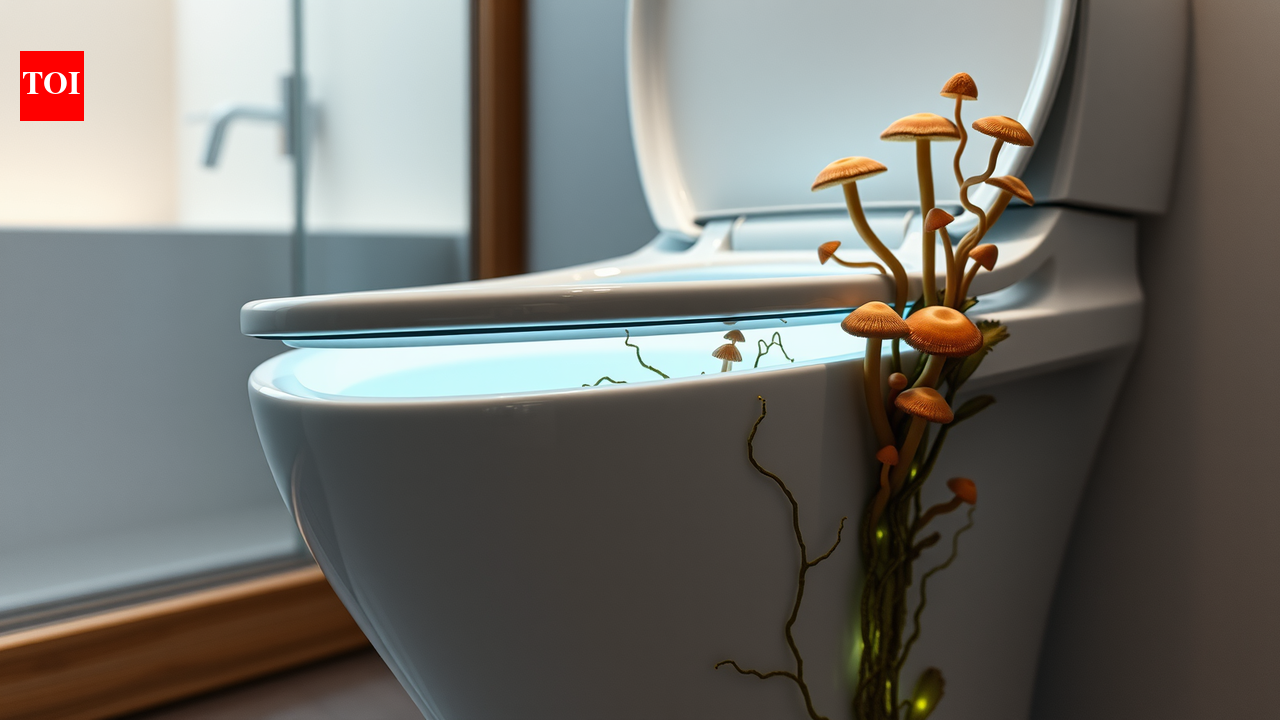

Somewhere between a botanical garden and a tree walk at the University of British Columbia, there is a cedar-clad timber structure with a green roof, a skylit interior, and a ramp for wheelchair access. It smells like a forest. It looks like a piece of considered architecture. And tucked inside its back wall is something no public toilet has ever used before: a compartment lined with living mushroom mycelium that absorbs odour, accelerates decomposition, and turns human waste into usable compost without a single drop of water, a gram of chemical input, or a connection to any plumbing system. The MycoToilet, developed by researchers at UBC’s School of Architecture and Landscape Architecture and the Department of Microbiology and Immunology, launched at UBC Botanical Garden in September 2025. It is the first of its kind anywhere in the world, and the problem it is trying to solve is considerably larger than any single campus installation.
The global sanitation crisis that makes mushroom-powered waterless technology so urgently needed
The scale of the sanitation problem that technologies like the MycoToilet are designed to address is genuinely staggering. A 2024 review published in The ISME Journal by Oxford Academic found that over two billion people do not have access to adequate sanitation, a figure the UBC Campus as a Living Lab project brief for the MycoToilet puts at 2.3 billion, with 450 million people restricted to open defecation entirely. Untreated human waste is a leading cause of preventable disease and child mortality across the developing world.The dominant solutions have their own serious limitations. Centralised sewage treatment is energy-intensive, water-hungry, and requires significant infrastructure investment that many municipalities and rural communities cannot afford. Chemical toilets, the portable units most commonly used in parks, construction sites, and event spaces, rely on formaldehyde and other toxic chemicals that require handling waste as a hazardous material at the disposal stage. Conventional composting toilets are a cleaner alternative in principle, but have historically suffered from odour problems, inconsistent decomposition, and an operational reputation that has made municipalities reluctant to adopt them at scale.
What is Mycelium and how do fungi break down human waste faster than standard composting
The MycoToilet’s core innovation is replacing the standard composting process with one driven by fungal mycelium, the dense, thread-like root network that forms the vegetative body of a mushroom, distinct from the fruiting body that appears above ground. According to a2023 review on mycoremediation published in Applied Sciences, fungi produce powerful extracellular enzymes capable of breaking down complex organic compounds, including lignocellulosic biomass, hydrocarbons, and biological waste, into simpler compounds that microbial communities can then process further. This enzymatic capacity is what makes mycelium particularly well-suited to decomposing human waste.”Fungi are very good at breaking down biomass, including human and animal waste,” said Dr Steven Hallam, professor in UBC’s Department of Microbiology and Immunology, in the official UBC announcement. “They produce enzymes that transform material into simpler compounds while supporting microbial communities that accelerate decomposition. No added water, electricity or chemicals are required.”The UBC Living Lab project summary notes that mycelium-based decomposition of harmful pathogens takes roughly half the time of traditional composting toilets a significant operational advantage for a system designed to be maintained on a minimal schedule. Laboratory tests of the mycelium liners showed they remove more than 90 per cent of odour-causing compounds, addressing the single biggest practical barrier to composting toilet adoption in public and community settings.
How the MycoToilet system separates waste, eliminates odour, and produces fertiliser and compost
The MycoToilet operates through a separation-first design. Liquid and solid waste are divided at the point of deposit, with solid waste channelled into the mycelium-lined composting compartment at the rear of the structure. The fungi and the thermophilic microbial communities they support then break down the solid material aerobically, meaning in the presence of oxygen, which prevents the anaerobic conditions responsible for the odours and methane production that plague poorly designed composting systems.A low-power fan maintains air circulation through the ventilated cedar structure, and the skylit design supports passive temperature regulation. The four maintenance visits per year the system requires are deliberately scheduled rather than reactive, a design choice that project lead Associate Professor Joseph Dahmen of UBC’s School of Architecture and Landscape Architecture described as intentional: “We’ve taken out the uncertainty that can scare municipalities away from composting toilets and solved it the schedule is set, the ventilation is integrated, everything works as it should.”When fully operational, the MycoToilet is projected to produce approximately 600 litres of nutrient-rich soil compost and 2,000 litres of liquid fertiliser annually. The nutrient recovery numbers are significant: a study published in The ISME Journal found that well-managed composting of human excrement can recover up to 91 per cent of the nitrogen, 83 per cent of the phosphorus, and 59 per cent of the potassium present in the waste nutrients that, if returned to agricultural soil, reduce dependency on synthetic chemical fertilisers.
The architecture and materials behind the MycoToilet’s design at UBC Botanical Garden
The physical structure of the MycoToilet is as deliberate as its biological system. Prefabricated timber panels form the primary structure, with a cedar exterior that is naturally rot-resistant and has been charred a traditional Japanese technique called shou sugi ban to give it additional antimicrobial properties. The green roof supports local plants and native wildlife habitat. The interior combines timber and stainless steel finishes with odour-absorbing mycelium compartments, designed by Dahmen to replace the look and smell typically associated with composting toilets with something closer to a forest shelter.”We wanted to turn a daily routine everyone knows into a pleasant experience that reminds us of our connection to ecological cycles,” Dahmen said. The structure blends into the botanical garden’s forest setting, is fully wheelchair accessible via a ramp, and was built to be modular and relocatable a design feature with direct implications for deployment in parks, remote communities, and regions without plumbing infrastructure.
What the six-week pilot test and future research will determine about scaling the MycoToilet
The six-week pilot that began at the end of September 2025 is testing the MycoToilet under real-world usage conditions, with researchers from both SALA and the Department of Microbiology and Immunology monitoring how the fungal and microbial communities interact as the system processes actual human waste at volume.If the pilot demonstrates consistent performance, the self-contained, chemically clean, and low-maintenance nature of the system positions it as a credible alternative to chemical toilets in parks and public spaces and potentially a meaningful sanitation option for the communities that need it most. A toilet that requires no water, no chemicals, no sewage connection, and only four maintenance visits a year, while converting its waste into agricultural inputs, is a fundamentally different proposition from anything currently deployed at scale. Whether it can reach that scale is what the research now has to answer. Go to Source