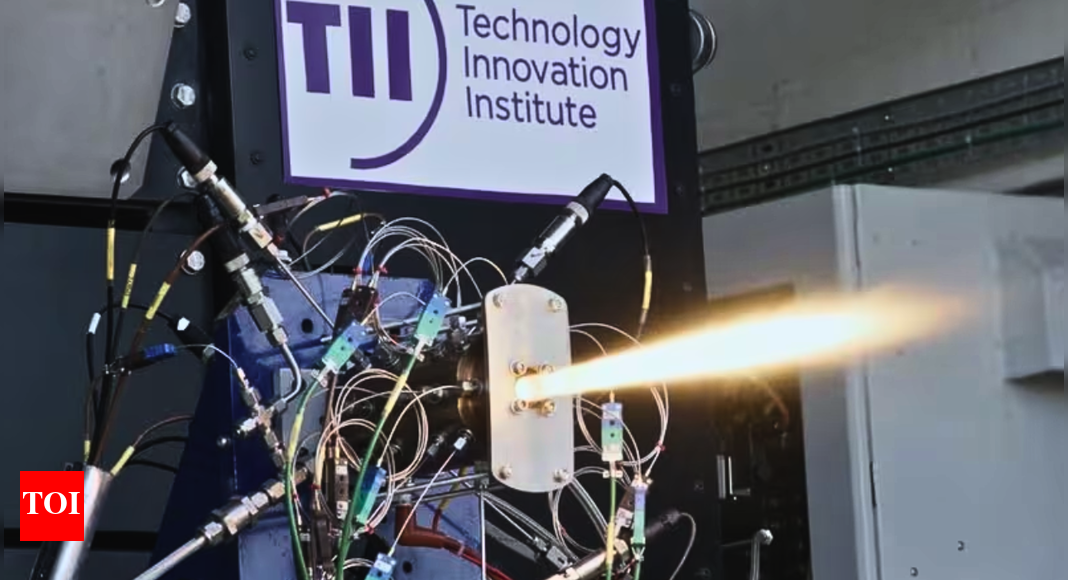

The UAE’s Technology Innovation Institute achieved 94% combustion efficiency in testing its 250-newton homegrown liquid rocket engine, marking a national milestone/ Image: Abu Dhabi’s Technology Innovation Institute
In a historic leap for its sovereign space ambitions, the UAE has successfully designed, built, and test-fired its first liquid-fuelled rocket engine. Developed entirely in Abu Dhabi by the Technology Innovation Institute (TII), this 250-newton-class engine marks a crucial step in building the country’s independent space propulsion capability and advancing its roadmap for orbital and deep-space missions.
UAE achieves first liquid rocket engine milestone
The Technology Innovation Institute (TII), the applied research arm of Abu Dhabi’s Advanced Technology Research Council, has announced the successful ignition of the UAE’s first liquid-fuelled rocket engine, a technical and strategic breakthrough in the nation’s expanding space programme.The engine, a 250-newton-class liquid rocket thruster, was completely designed and constructed in the UAE. It is capable of producing a thrust equivalent to lifting 25 kilograms on Earth. Thrusters in this category are primarily used for small satellite propulsion, orbital manoeuvres, and attitude control, all of which are critical for in-space mobility and stability.The engine was tested through over 50 hot-fire firings, reaching 94% combustion efficiency, a benchmark typically associated with well-established global space programmes. These performance metrics validated its design reliability, combustion precision, and consistency, key prerequisites for advanced space missions, including orbital operations, satellite station-keeping, and future lunar and Martian missions. Dr. Najwa Aaraj, CEO of TII, emphasised that the engine’s successful operation is not only a technological achievement but a platform for future capability. “This engine is the foundation for building the capability that will empower the UAE to design, test, and deploy propulsion systems supporting a wide range of future missions,” she said.
Building sovereign space capabilities in the UAE
The Liquid Rocket Engine Programme, spearheaded by TII in Abu Dhabi, was designed with a dual focus: to develop local propulsion technologies and to build a skilled Emirati-led space engineering workforce. Nearly half of the core engineering team behind the engine were Emirati nationals, responsible for critical tasks such as thermal and structural simulations, injector design, and test protocol development.“This is a moment of national pride,” said Dr. Elias Tsoutsanis, Chief Researcher at TII’s Propulsion and Space Research Centre. “It represents the starting point of a broader journey towards an ambitious space future led by the people of the UAE.”Despite the absence of permanent testing infrastructure in the country, the team overcame significant logistical and technical challenges. They custom-built cold-flow testing rigs in Abu Dhabi and collaborated with Airborne Engineering in the UK to conduct the live hot-fire tests.Dr. Tsoutsanis acknowledged the scale of the challenge: “The most significant hurdle was the absence of dedicated test infrastructure in the UAE. We solved this by developing deployable systems and performing the live firings abroad.”
Roadmap for UAE space propulsion: Infrastructure and innovation
Work is now underway to establish the UAE’s first static-fire rocket engine testing facility, which is expected to be operational by 2026 in Abu Dhabi. This facility will be capable of supporting engines up to five times more powerful than the current 250-newton model.The first 1-kilonewton-class engine firing on Emirati soil is also slated for 2026, signalling the UAE’s commitment to bringing space research infrastructure home.TII’s propulsion roadmap includes:
- Scaling to larger engines for heavier spacecraft and payload missions
- Development of regenerative cooling systems for sustained engine performance
- Transitioning to cryogenic propellants, a complex but vital technology for deep space operations
- Supporting scientific, commercial, and exploratory missions with fully sovereign launch and propulsion capabilities
“These plans reflect Abu Dhabi’s determination to play a meaningful role in global space exploration,” said Dr. Tsoutsanis. “Our aim is not just to build engines, but to enable the UAE to access space independently, repeatedly, and sustainably.”
UAE joins global league of liquid propulsion nations
With this successful milestone, the UAE enters an elite group of countries with verified liquid propulsion design capabilities — including the United States, China, Russia, India, Japan, and members of the European Space Agency.The UAE’s progress showcases not only its technical capability but also its strategic vision to cultivate local expertise, reduce dependence on foreign technologies, and inspire the next generation of Emirati space innovators.For the engineers involved, especially the Emirati team members who grew up watching space launches from afar, this achievement is deeply personal. “Seeing our own design ignite is something we’ll never forget,” said one engineer.“This engine is more than a technical success — it’s the start of a journey,” said Dr. Aaraj. “It reflects the UAE’s evolving capability in space, led by its own people and driven by a long-term vision.” Go to Source