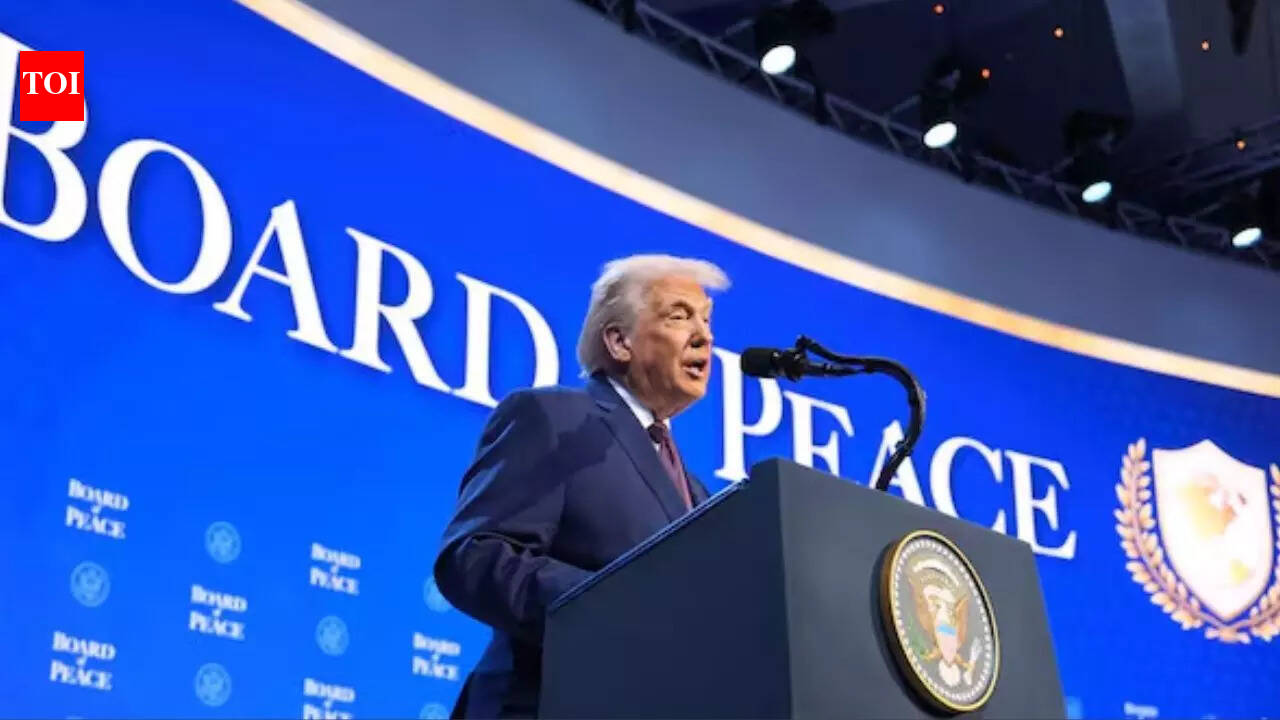

US President Donald Trump on Thursday launched his “Board of Peace”, initially designed to help stabilise Gaza’s fragile ceasefire but which he has said could later take on a broader role in addressing international conflicts. The initiative includes a controversial USD 1 billion fee for countries seeking permanent membership.The initiative was announced during a signing ceremony at the World Economic Forum in Davos on Thursday. Trump said the board is meant to establish an alternative mechanism for conflict resolution beyond existing multilateral institutions. However, it was the organisation’s logo that quickly became the focus of public attention, triggering sharp reactions across social media.
What the Board of Peace logo shows
The Board of Peace logo combines a shield, a laurel wreath, and a globe centered on the Americas.Together, these symbols suggest that peace is something to be protected and enforced, rather than simply negotiated. The shield and laurel wreath: historically associated with defence, victory, and authority, evoke strength and power, while the dominant gold color palette emphasises prestige, permanence, and control.

Although the globe implies a global mission, its focus on North and South America highlights a distinctly US-led worldview, reinforcing the idea of peace shaped through American leadership rather than multilateral consensus.
Social media reacts
The logo has triggered sharp reactions across social media platforms, with many users mocking its design and symbolism.Reacting to the logo, one user wrote: Trump’s ‘Board of Peace’ logo is basically the UN logo, except dipped in gold and edited so the world only includes America.” Another user was more blunt, saying: That logo is objectively terrible.A third post highlighted what critics see as a glaring omission: Hilarious that it doesn’t even include the part of the Middle East it’s supposed to be focused on.The reactions highlight broader skepticism about the board’s credibility and its US-centric presentation.
Who are the members of the Board of Peace
The Trump administration has sent more than 50 invitations to countries around the world to join the board.Under the proposed structure:
- Countries may join free of charge for three years
- After three years, the chairman of the board may choose to renew a country’s membership
- Nations seeking permanent membership must pay a USD 1 billion fee within the first year
The White House has not released a full list of invitees, but the following countries were signatories to the charter document presented on January 22:Saudi Arabia, United Arab Emirates, Bahrain, Jordan, Qatar, Turkey, Hungary, Bulgaria, Argentina, Mongolia, Morocco, Pakistan, Indonesia, Kosovo, Uzbekistan, Kazakhstan, Paraguay, Armenia, and AzerbaijanIn addition, Israel, Egypt, Belarus, Albania, and Vietnam have also agreed to join the board.Trump has claimed that Russia has accepted an invitation as well, though the Kremlin has not officially confirmed his statement.
Countries still undecided & those who said no
Several major countries, including China, Canada, Britain, Germany and Japan, are still considering whether to join the board. Sweden, Norway and France have already declined participation.Ukraine has said it will wait for clarity on Russia’s stance, saying it is difficult to envision joining a peace body alongside a country it is at war with. The Vatican has confirmed that Pope Leo, the first American pontiff, has also been invited, though no decision has been announced. Go to Source