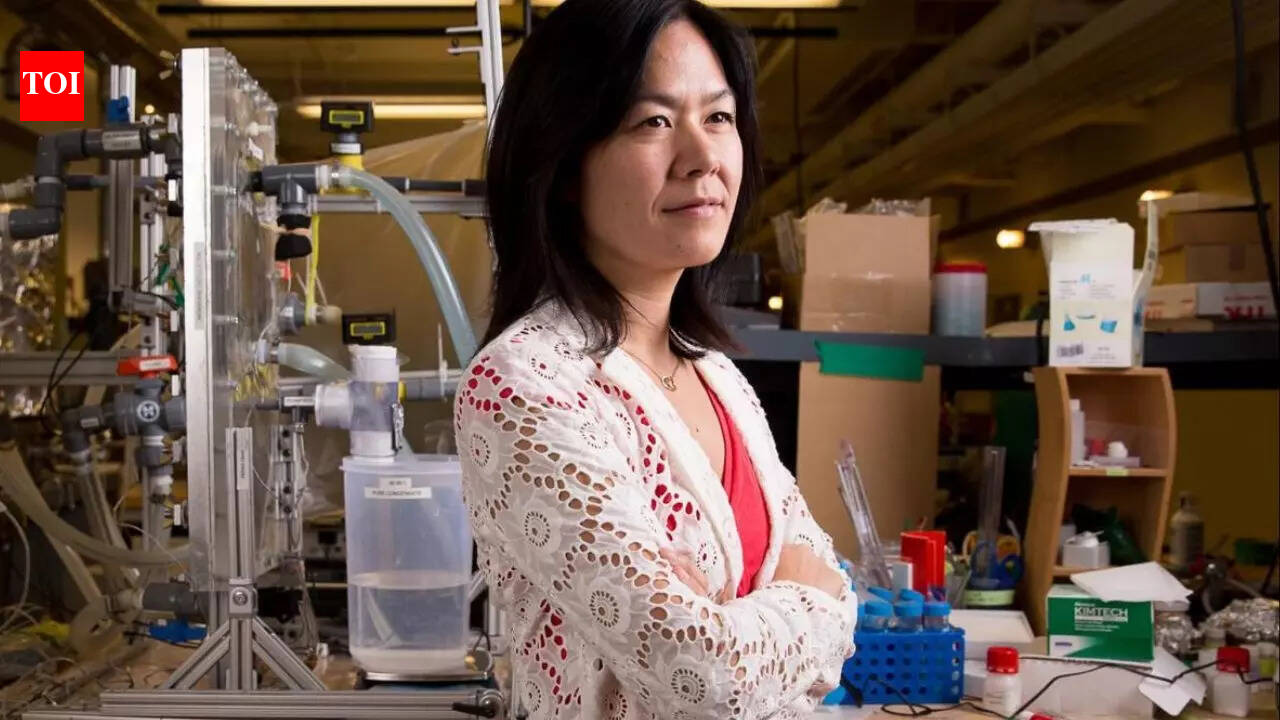

Evelyn N. Wang: The scientist who wants to make every home produce its own water (Image source: MIT Department of Mechanical Engineering )
Water touches every part of human life. We drink it, cook with it, wash with it and depend on it for health and hygiene. Yet according to global estimates, more than 2.2 billion people around the world do not have reliable access to safe drinking water at home. It is especially hard to get clean water to dry places that don’t have pipes or have old infrastructure. For a long time, scientists have been looking for new ways to get clean drinking water that don’t just come from wells, rivers, or treatment plants. One idea that scientists are looking into is taking water straight from the air. Air always has some moisture in it, even in dry places. It could help millions of people who don’t have enough water if that moisture can be collected and turned into clean water quickly.
Israel attacks Iran
Evelyn N. Wang, a mechanical engineer and professor at the Massachusetts Institute of Technology (MIT), is leading this research. Her work is focused on creating technology that could one day allow homes to make their own drinking water from the air around them.
Who is Evelyn N. Wang and what is her research
Evelyn Ning‑Yi Wang is an American mechanical engineer. She serves as the Ford Professor of Mechanical Engineering at MIT and, as of 2025, is also the university’s Vice President for Energy and Climate. Her research covers heat transfer, solar energy, and materials engineering. A significant focus of her work is on atmospheric water harvesting, a process to capture moisture from air and turn it into liquid water.Professor Wang and her team study energy, heat flow, and water systems in her lab at MIT, the Device Research Laboratory. Their goal is to find solutions to real environmental problems. One of their projects is to make devices that can pull water out of the air, even when it’s dry, using solar heat and new materials.
What is atmospheric water harvesting
Atmospheric water harvesting (AWH) is the process of collecting water vapour that is already in the air and turning it into liquid water that can be stored and used. The air has a lot of water in the form of vapour, and this source is found all over the world. You can use AWH technologies to get to that resource.There are multiple scientific approaches to extracting water from air:
- Traditional condensation methods cool air below its dew point, which makes moisture turn into droplets, just like how dew forms in the morning.
- Fog harvesting is the process of using nets or meshes to gather water droplets from thick fog.
- Sorption‑based methods, which Wang’s work uses, rely on materials that absorb water molecules from the air and then release them as liquid when heated or exposed to sunlight.
The sorption‑based method has gained attention because it can work even in low-humidity conditions where relative humidity may be as low as 20 percent, such as in deserts and arid regions.
How Wang’s device works
Professor Wang’s group has built devices that combine special adsorbent materials with solar heat to extract water from air. In an early proof‑of‑concept system, tested by the team together with researchers from the University of California, Berkeley, water vapour is adsorbed at night into a porous material. During the day, heat from sunlight releases that water vapour, which then condenses into a collection reservoir. This setup requires no electrical power input; it runs on heat from the sun.The porous materials used in these devices are sometimes selected for their ability to hold many water molecules on their surfaces. These materials can be engineered so that they attract water vapour even when the air is dry. They let the water out when it gets too hot, and then it can be collected and cleaned.In both the lab and the field, prototypes made by Professor Wang and her team showed that this method could get measurable amounts of water even in very dry desert conditions. At one test site in Arizona, the device operated with no mechanical moving parts and was driven only by sunlight.Because the materials and the device design do not require electricity to operate, researchers believe that future versions could be low‑cost and scalable. The aim is to make systems that can run on ambient heat sources such as sunlight, allowing deployment in homes, rural communities, and regions with limited infrastructure.
Why this research is important
The World Health Organization and the United Nations say that water scarcity is a big problem around the world, especially in dry areas and places where cities are growing quickly. When people have to travel long distances or rely on unsafe sources for drinking water, water shortages can lead to health problems, economic problems, and social stress.Traditional approaches to producing clean water, such as desalination or building large new treatment facilities, can be expensive and energy‑intensive. By contrast, atmospheric water harvesting technology offers a decentralised source of water that could potentially operate without an electricity grid. This makes it especially relevant for homes in rural or remote locations where infrastructure is limited or unreliable.If the technology continues to improve, smaller home‑scale devices could eventually be manufactured and installed much like solar panels are installed on rooftops. Over time, such systems could help communities and households supplement their water supply without dependence on large centralised systems.
What the future could hold
Researchers all over the world are still working on atmospheric water harvesting to make it more efficient, lower costs, and make systems work better in different climates. In recent years, new prototypes using alternative materials and techniques have shown improved performance and faster production. For example, an experimental method that uses ultrasonic waves to release water droplets that have been trapped in sorbents is much better than passive methods that use heat to do the same thing. This is a new direction for future household devices.Professor Wang’s research and similar projects are part of a larger scientific effort to find new ways to solve global water problems. People don’t use the technology at home very often yet, but the progress that’s been made so far suggests that it might be possible to make water from air at home in the future, especially in places where water is hard to find. Go to Source