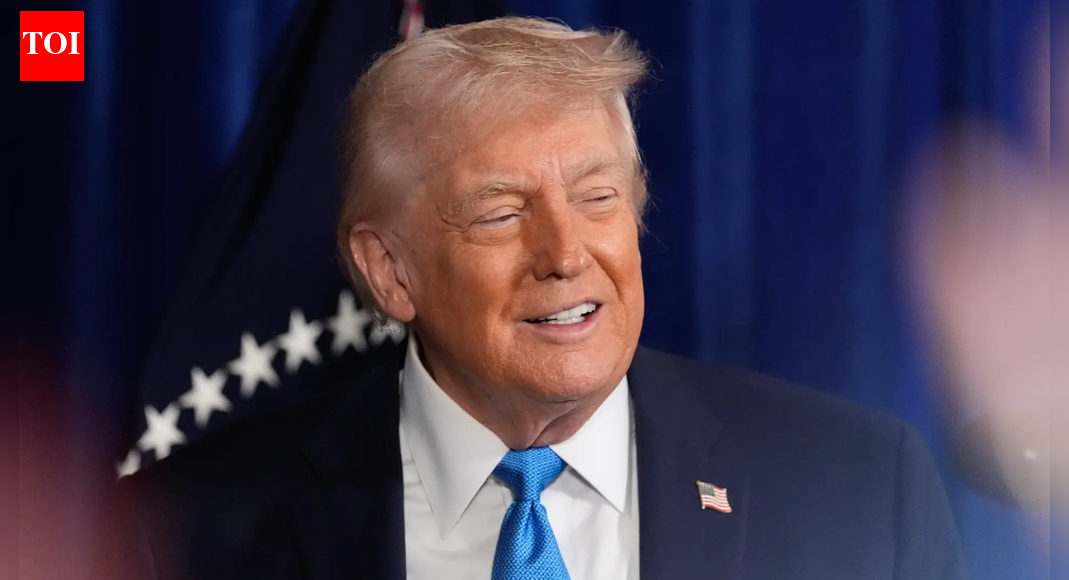

US President Donald Trump (AP)
TOI correspondent from Washington: US President Donald Trump is claiming that India is keeping him happy by meeting his demands to stop buying Russian oil, warning that failing to do so will result in his raising even higher tariffs “very quickly.”“They (India) wanted to make me happy…Modi is a good guy….he knew I was unhappy…and it was important to make me happy,” Trump told reporters on Air Force One, interjecting as US. Senator Lindsay Graham was explaining how the threat of tariffs is effective in forcing countries to stop buying Russian oil as part of Washington’s purported efforts to starve Moscow of oil revenues that it says is funding the war.Graham himself claimed that he was at Indian Ambassador Vinay Kwatra’s residence a month ago and “all he (the ambassador) wanted to talk about was how India is buying less Russian oil.”“And he asked me to tell the President to relieve the 25% tariff… this stuff works… I really believe what he did with India is the chief reason why India is buying substantially less Russian oil,” Graham asserted. Graham is the chief proponent of the Sanctioning Russia Act of 2025, a legislation designed as a “sledgehammer” to force a conclusion to the Russia-Ukraine war by targeting the economic lifelines of the Russian military. Introduced in April 2025 as a legal shield for the executive to protect it from challenges to tariffs in courts, as is currently happening, the bill authorizes the President to impose secondary tariffs ranging up to 500 percent on imported goods, giving him “maximum flexibility” to act as a negotiator. The bill includes a waiver provision, meaning the President has the ultimate discretion over whether or not to actually implement the tariffs, fully ceding to the President what has long been a legislative domain. Graham has explicitly named China, India, and Brazil as primary targets, as they currently purchase roughly 70% of Russia’s oil exports. He claimed on Sunday that the bill now has 85 co-sponsors and indicated it could move forward in the Senate, which resumed its session on Monday.Graham appeared to be getting ahead of an expected US Supreme Court ruling this month on the legality of the current administration’s tariffs that is expected to go against the administration. The case, Learning Resources Inc. v. Trump, argued by Neal Katyal last November, challenges the President’s use of the International Emergency Economic Powers Act (IEEPA) to impose country-level “reciprocal” tariffs.The Trump-Graham remarks left unclear for now the status of the current 25+25 percent tariff on India, the additional 25 percent being punitive taxes for buying Russian oil. While Trump claimed India is making him happy by tapering down Russian oil purchases, Washington appears intent on keeping the tariffs in place till the court ruling, while waiting to see if New Delhi meets a particular publicly undisclosed target, even as India is ramping up purchase of energy from the US.According to industry estimates, Russian oil Imports in December fell to a three-year low of approximately 1.2 million barrels per day (bpd)—a 40% drop from the peaks seen in mid-2025 – after a brief spike in November. Imports are expected to fall below 1 million bpd in the coming months of 2026, a level not seen since the early stages of the Ukraine conflict. Last week, the Indian government ordered all refiners to submit weekly disclosures of their oil purchases from both Russia and the US, ostensibly for use in ongoing trade negotiations with the Trump administration.