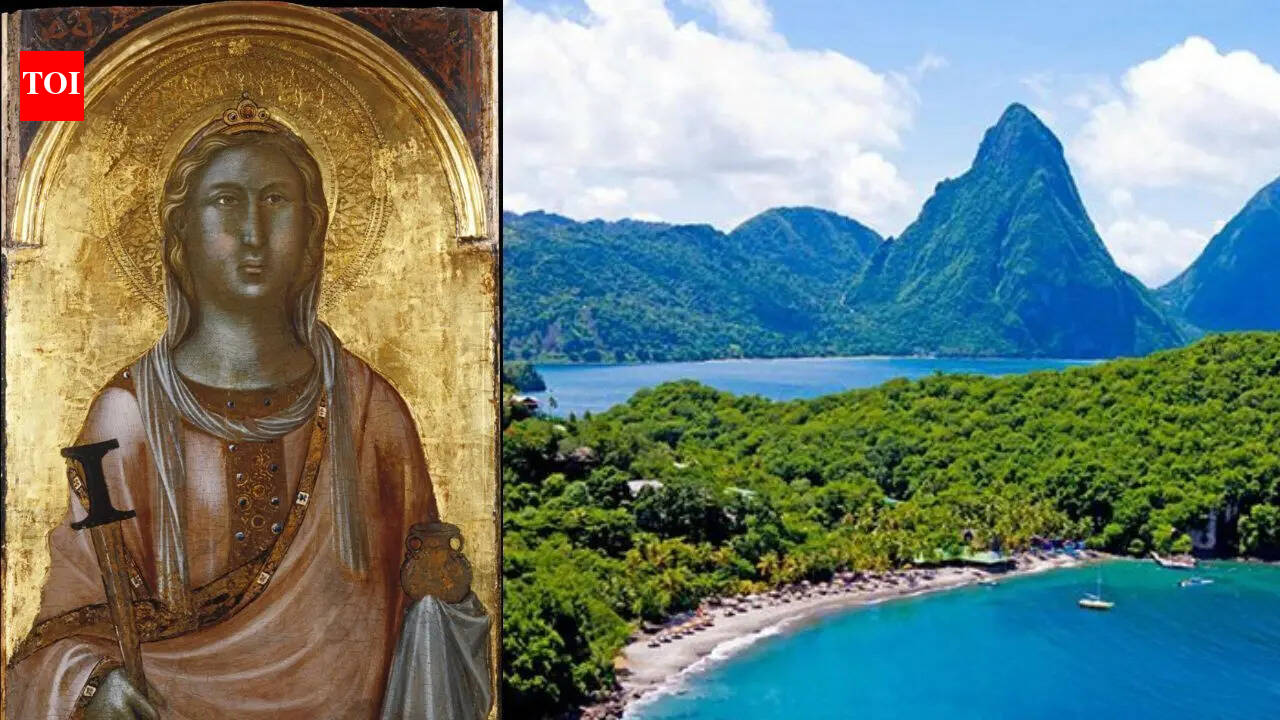

Country names often arrive carrying layers of history that are easy to overlook. Some preserve the memory of dynasties, some echo ancient tribes, and others trace their roots to geography that predates written records. Hidden among them is a small Caribbean nation whose name stands apart for an unusual reason. Saint Lucia is widely regarded as the only sovereign country named after a real woman. As reported by WorldAltas, its name reaches back to a young Christian martyr from Roman Sicily, crosses oceans through centuries of exploration and colonisation, and survives despite older indigenous names that once described the island long before Europeans arrived. The story is less straightforward than a piece of trivia suggests, touching on religion, language, mythology, and the complicated history of the Caribbean itself.
The woman behind Saint Lucia’s unique name
The woman behind the country’s name was Saint Lucy of Syracuse, a Christian who lived during the late Roman Empire. Born in Sicily during the third century, she became associated with stories of faith, charity and resistance during a period when Christians faced persecution under Emperor Diocletian. Accounts of Lucy’s life were written generations after her death and blend historical memory with religious tradition. According to those narratives, she rejected an arranged marriage, distributed wealth intended as her dowry to those in need and refused demands to abandon her faith. She was eventually executed around the year 304.Her name comes from the Latin word lux, meaning light. Over time, she became linked with sight and vision, and artistic depictions often include references to eyes. Across much of the Christian world, her feast day is observed on 13 December, a date that later became tied to the naming of an island thousands of miles away.
How Saint Lucia acquired its European name
The exact moment the island received its modern name remains uncertain. Several traditions survive, though historians have never found definitive evidence proving one version over another.A popular account tells of French sailors who reached the island on Saint Lucy’s feast day after surviving a shipwreck. In gratitude, they supposedly named the land after the saint. Another tradition connects the name with early French explorers who first sighted the island on 13 December and chose the saint’s name for that reason.Neither story can be verified with confidence. What is clearer is that European maps began showing variations of Saint Lucia’s name during the sixteenth century. By then, the connection between the island and the Sicilian saint appears to have become established.The island had already entered European awareness by the end of the fifteenth century. Spanish navigator Juan de la Cosa is generally credited as one of the first Europeans to reach it, while Christopher Columbus likely observed it during later voyages in the region. Permanent settlement, however, came much later.
How Saint Lucia kept its name through centuries of conflict
Saint Lucia became one of the most contested territories in the Caribbean. French and British interests repeatedly clashed over possession of the island, producing a long cycle of occupation and transfer that lasted for centuries.Control changed hands so many times that Saint Lucia earned the nickname “Helen of the West Indies”, a reference to Helen of Troy and the conflicts associated with her in classical mythology.French influence remained strong throughout these struggles, helping preserve the island’s name. When Britain ultimately secured possession in the early nineteenth century, the existing name remained in use rather than being translated or replaced. It has survived ever since.
The names that existed before Saint Lucia
Long before European ships appeared on the horizon, the island already had names of its own.The first known inhabitants to leave a lasting linguistic record were the Arawak people, who arrived from northern South America. They referred to the island as Iouanalao, a name associated with iguanas, which were abundant there.Later, the Kalinago people, often called Caribs by Europeans, established themselves on the island. Their version of the name was Hewanorra, carrying much the same meaning and continuing the connection to the island’s reptile population.These older names never disappeared entirely. Visitors arriving by air today land at Hewanorra International Airport, preserving a word that predates European colonisation by centuries.
Is Saint Lucia really unique
The claim that Saint Lucia is the only country named after a woman often appears in books, quizzes and travel guides. The answer depends partly on how the question is framed.If the definition is a sovereign state named after a real historical woman, Saint Lucia appears to stand alone. Saint Lucy was an actual person whose life, although filtered through religious tradition, is rooted in history rather than mythology.Questions arise when Ireland enters the discussion. The Irish name Éire derives from Ériu, a figure from Gaelic mythology. Because Ériu belongs to legend rather than recorded history, many scholars continue to treat Saint Lucia as the only country named after a historical woman.Other territories linked to female names generally fall outside the category of sovereign states. Places such as Maryland, named after Queen Henrietta Maria, or the Virgin Islands, associated with Saint Ursula and her legendary companions, are not independent countries.By that narrower definition, Saint Lucia occupies a category of one.
A small island with a dramatic landscape
The island itself sits in the eastern Caribbean among the Lesser Antilles. Though modest in size, it possesses terrain that feels far larger than its dimensions suggest.Volcanic mountains dominate the interior, rising above thick vegetation and deeply cut valleys. Mount Gimie forms the highest point, while the twin Pitons have become the country’s most recognisable landmark. These steep volcanic spires rise sharply from the coastline near Soufrière and are visible from great distances offshore.The surrounding waters, rainforest-covered slopes and geothermal activity reflect the island’s volcanic origins. Near Soufrière lies the Sulphur Springs area, often described as a drive-in volcano because visitors can reach the geothermal site by road rather than through a lengthy climb.The Pitons and their surrounding environment received recognition as a UNESCO World Heritage Site in the early twenty-first century, highlighting both their geological significance and visual prominence.
Modern Saint Lucia
Saint Lucia achieved independence from the United Kingdom in 1979 but retained its place within the Commonwealth realm system. The country’s head of state remains King Charles III, represented locally by a Governor-General.Political power rests with an elected parliament and a prime minister, following a Westminster-style system that reflects the island’s British constitutional heritage. The capital, Castries, serves as the country’s administrative and commercial centre, while towns such as Soufrière and Vieux Fort remain important regional hubs.With a population of roughly 180,000 people, Saint Lucia is one of the smaller independent nations in the world. Yet its name carries a distinction unmatched by any other member of the United Nations: a direct connection to a single historical woman whose story began in Roman Sicily and ultimately became attached to a Caribbean island on the other side of the Atlantic. Go to Source