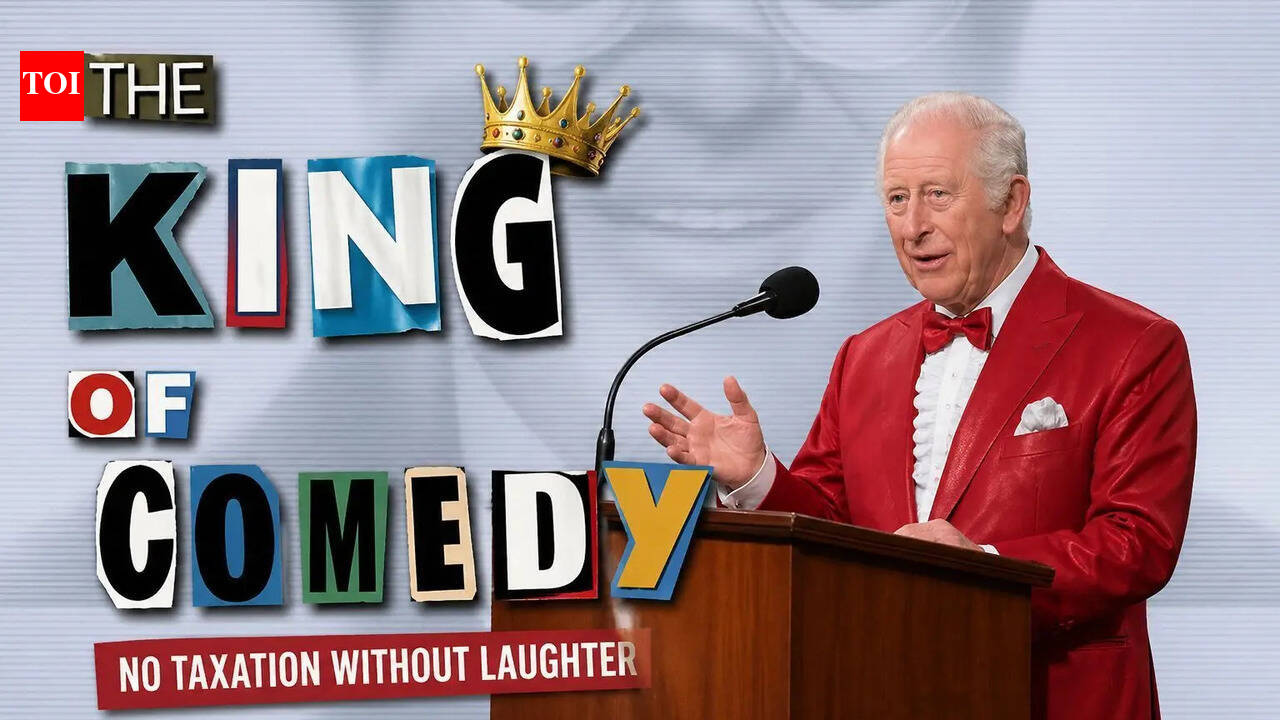

AI image generated by ChatGPT
This is a city which symbolizes a period in our shared history, or what Charles Dickens might have called ‘A Tale of Two Georges’: the first President, George Washington, and my five-times Great Grandfather, King George III. King George never set foot in America and, please rest assured, I am not here as part of some cunning rearguard action, King Charles III said, standing in the US Congress.It was a laugh line. It was also the entire speech in miniature.Charles began with a joke about a king who lost America and a president who won it, only to gently reassure his audience that he had not come back to reclaim the colonies. It landed because it acknowledged the most awkward truth in Anglo-American history and then defused it. But it also set up something more interesting. A monarch who represents one of the oldest surviving institutions in the world was reminding the world’s most powerful republic why it exists.Or so it seemed.What Charles did next was to take that settled story and quietly reopen its meaning. He did not challenge the American Revolution. He reframed it. “We do not always agree — at least in the first instance,” he said later, referring to the founding quarrel between Britain and America. It was a line delivered lightly, but it carried a deeper suggestion. Disagreement is not the enemy of democracy. It is its starting point.That idea ran through the speech, and it was delivered almost entirely through humour. Charles joked about the British parliamentary tradition of holding a member of Parliament “hostage” at Buckingham Palace to ensure the monarch’s safe return, adding that the guest is treated so well these days that they do not want to leave. He paused, then added, “I don’t know, Mr Speaker, if there were any volunteers for that role here today?” Because what sounded like a quaint anecdote was really a lesson in institutional theatre. Britain once solved its conflict between monarch and Parliament through war, execution and revolution. What remains today is ritual. The hostage is no longer a hostage. The monarch is no longer feared. The system survives because everyone understands the limits, and the limits are maintained through performance as much as through law.Charles never said this outright. He did not need to. Every joke pointed in the same direction.The “Two Georges” line reminded America of a king who lost power. The hostage joke reminded America of a monarchy that learned to live without power. Even his aside about visiting Washington for the twentieth time, his first as king, carried a quiet continuity. The Crown endures, not because it dominates politics, but because it has learned to step away from it.
That was the contrast hanging over the speech.On one side stood a constitutional monarch whose institution survived by surrendering authority to Parliament, courts and convention. On the other stood a modern presidency that increasingly flirts with the language of personal power, where the leader is not merely the head of government but the embodiment of a political movement.Charles never made that comparison explicitly. He made it structurally.He spoke of Congress as a place of deliberation rather than command. He spoke of the rule of law as the foundation of prosperity. He spoke of the need for alliances, for shared responsibility, for patience in disagreement. Each of these points was framed positively, almost gently, but together they formed a picture of how power is supposed to behave in a democracy.The humour made that picture sharper. By refusing to sound like a critic, Charles made criticism harder to dismiss.Even his historical references carried a quiet wit. When he described the American founders as having declared independence “just the other day,” he was not merely being charming. He was compressing 250 years into a moment, reminding his audience that history moves quickly and that institutions are more fragile than they appear. When he spoke of the mountains of Scotland and Appalachia once being a single range, he was not simply being poetic. He was suggesting that separation, whether geographic or political, does not erase shared origins.There was also a certain mischief in the way he quoted American voices back to Americans. He invoked Lincoln to remind the United States that actions matter more than words. He cited American ideals as if they were universal truths rather than national slogans. It was a subtle way of holding up a mirror. If these principles are so important, the speech implied, then they must be practised, not merely remembered.This is where the British monarchy’s own history quietly enters the argument. The Crown survived not because it was always wise, but because it learned from failure. It lost a civil war. It lost a king. It lost the American colonies. It watched other monarchies collapse across Europe. At each stage, it adapted, retreating from power, accepting limits, and turning itself into something that could coexist with democracy rather than compete with it.The jokes in Charles’s speech were the final stage of that evolution. A king can now stand in the US Congress and joke about losing America because the Crown no longer claims the authority it once fought to keep. It survives by acknowledging its past rather than denying it.That is what made the speech quietly unsettling.A monarchy that once believed in divine right has become comfortable enough with its limitations to laugh at itself. A republic that was founded to reject monarchy is increasingly comfortable with the spectacle of concentrated power. The roles have not reversed, but the contrast has sharpened.Charles did not accuse. He did not warn in dramatic terms. He told a series of jokes, each one pointing to the same conclusion. Power that refuses limits does not last. Institutions that respect limits endure.The “Two Georges” line opened the speech with history turned into humour. By the end, the humour had turned back into history. America, Charles suggested without saying it directly, had already fought its war against kings. The question now is whether it remembers why. Go to Source