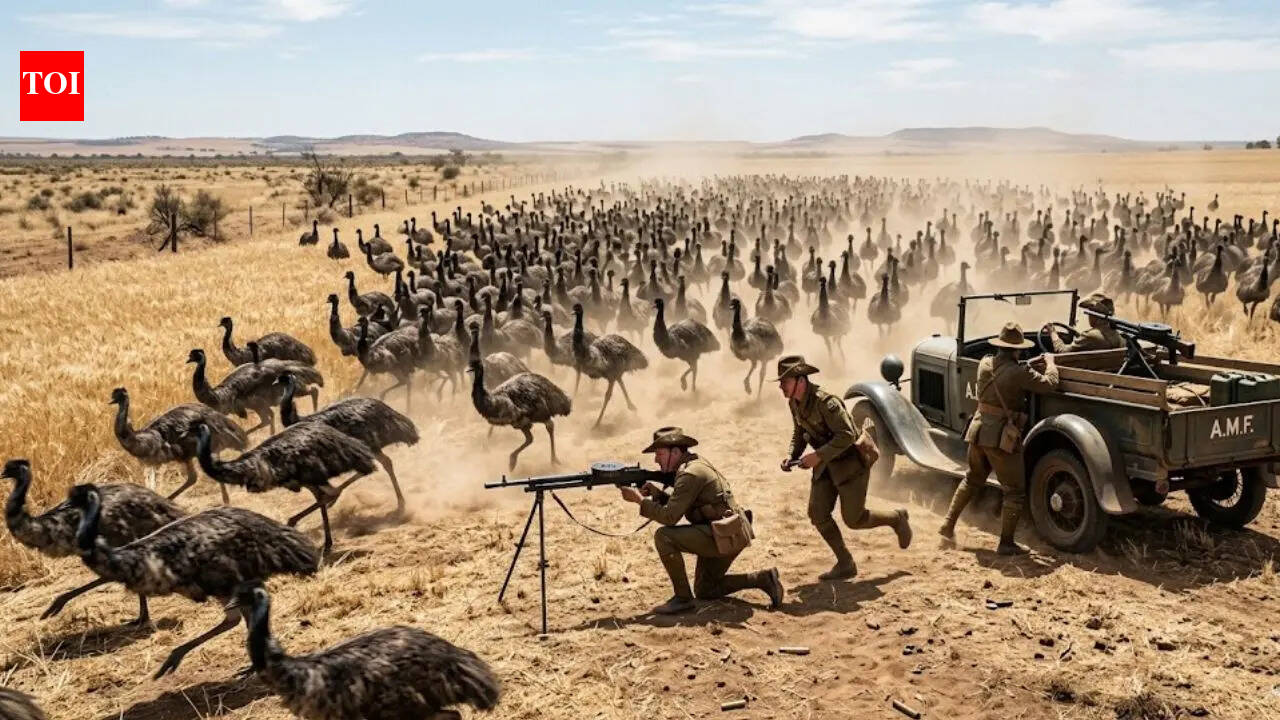

PC: Google Gemini
In 1932, the Government of Australia entered into an unconventional ‘war’ with an unexpected adversary, namely, a large population of approximately 20,000 emus, as reported in Australian Geographic. The emus would migrate from their traditional migratory range to the wheat-growing region of Western Australia after the economic collapse of the Great Depression caused many ex-soldier settlers to lose their homes and means of supporting themselves. In an attempt to rid the settlers of these ‘invading’ birds, the Government sent in Major Meredith and troops armed with Lewis machine guns in order to cull the birds. In the end, the emus proved to be far more tactical than anticipated; through speed and split-second movements, the birds were able to evade the heavy fire of the soldiers. This strange, albeit fascinating event in history has become known as the Great Emu War, and serves as a classic example of poor pest control measures and how wildlife has significant resiliency against even the most sophisticated military technology used against them.
How 20,000 flightless birds outsmarted the army
The emu invasion started when they wandered into the farms in the Campion area, looking for food and water. The Australian military operated under a standard engagement model, assuming that concentrated firepower would result in immediate population reduction. They failed to account for the low-density dispersal of the target species, but the emus’ natural habits gave them a great deal of unintentional protection. Rather than staying together in large groups, the emus formed small clusters. Because of this, the machine gunners were unable to shoot them accurately. As Major Meredith put it, the emus were ‘invincible.’ Even when hit with multiple bullets, many would continue to run at amazing speeds; therefore, exhausting the soldiers’ ammunition faster than they could use it.
Technical failures and 10,000 rounds of wasted ammunition
The Australian military sent in 10,000 rounds of Lewis machine gun ammunition and 2 machine guns. Despite this amount of firepower, there were a lot of technical and logistical problems associated with the operation. One time, soldiers tried to mount a gun on a truck and chase the emus, but the terrain was too rough for the gunners to be able to aim properly, and the emus outran the truck. After 1 campaign, only a few hundred emus had been verified as killed, creating a great deal of ridicule in the press and ultimately causing the military to pull out of the area.
Why complementary local efforts succeeded
The emus’ victory’ brought attention to how useless military responses are to address ecological issues. Ultimately, after abandoning their military involvement, the government put a bounty-based solution in place to complement its efforts, which turned out to be far superior to machine guns for controlling emus. This event has also become a key example in both historical studies and biological research. It has helped to develop new methods for managing wildlife and to understand the complex interactions between humans and animals when faced with environmental changes. Go to Source