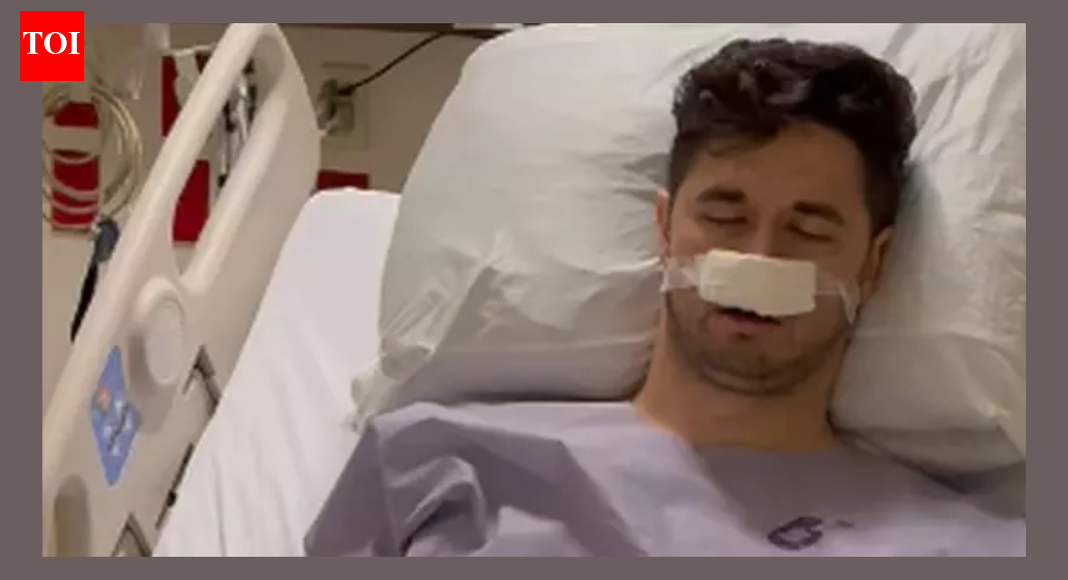

Stephen Chase, a US dad, repeatedly wakes from surgery speaking fluent Spanish, despite previously only knowing how to count to ten/ Image: (Kennedy News and Media)
A father from the United States has described waking up from surgery speaking fluent Spanish, despite having only minimal knowledge of the language beforehand, a phenomenon doctors say may be linked to an extremely rare neurological condition. Stephen Chase, from near Salt Lake City in Utah, first experienced the sudden language switch at the age of 19 after undergoing surgery on his right knee for a football-related injury. According to LADbible, he was able to converse in Spanish for around 20 minutes before returning to English.
What happened after surgery
At the time of his first operation, Chase said his Spanish ability was extremely limited. By his own account, all he could do before the surgery was speak a few basic phrases and count to 10 in Spanish. “The very first time it happened, when I woke up I was speaking in Spanish to the nurses checking on me,” the now 33-year-old said. “I don’t really recollect speaking Spanish, just people asking me to speak English and being really confused.” He added: “I wasn’t capable of speaking for that long in Spanish at that time. I was very shocked.” Chase said he had taken only beginners-level Spanish classes at school and admitted he “didn’t really pay attention at all”.”I did not speak Spanish. I had a year in high school when I’d had a Spanish class,” he said.
A pattern that kept repeating
What initially appeared to be a one-off incident continued to happen. According to Chase, the same language switch occurred after multiple surgeries over the following years. Stephen said that after later procedures, including surgeries for sports injuries and, more recently, a septoplasty, he would wake up answering medical staff in Spanish. “The nurses say they ask me questions like ‘how are you feeling?’ and ‘am I in pain?’ after waking up, and I answer the questions in Spanish,” he said. “In my head, I’m just speaking and can’t understand why they don’t understand me.” He said the fluency typically lasted less than an hour. “I was completely fluent. I think it completely subsides within an hour.” Because the episodes became predictable, Chase said he now warns medical staff ahead of time so they are prepared.
Exposure, not upbringing
Chase does not consider himself bilingual and says he was never fluent growing up. However, he believes repeated exposure to Spanish during childhood may be relevant. “I had grown up around lots of Hispanic people and frequently heard the language around me,” he said. “I spent a lot of time at my best friend’s house and his parents were always speaking Spanish.” “I never knew what anyone was saying, but I heard it all the time.” After the first episode, Chase later spent two years in Chile on a mission for his church, which improved his Spanish. Even so, he said the post-surgery fluency was noticeably different from his everyday ability. “I’m a pretty good second-language speaker, but it became native fluency level,” he said. “It’s interesting what the brain has stored up that we’re not able to tap into.”Also read: 17 year old teen wakes from knee surgery speaking only foreign language
What doctors say about Foreign Language Syndrome
According to the US National Library of Medicine, Foreign Language Syndrome (FLS) is a rare neurological condition in which people suddenly and involuntarily switch from their native language to a second language for a limited period. The condition is distinct from Foreign Accent Syndrome, in which speech remains in the same language but sounds altered. In FLS, patients fully transition to another language.Medical literature notes that FLS has rarely been reported following events such as head injury, stroke, brain tumours, bleeding in the brain, psychological stress, and occasionally general anaesthesia. The precise cause remains unclear. Some researchers have questioned whether FLS represents a distinct condition or a variation of emergence delirium related to the effects of anaesthetic drugs on cognition and their clearance from the central nervous system. What researchers consistently emphasise is that the condition appears temporary, with patients typically making a full recovery and showing no long-term impairment.
Why the case stands out
Foreign Language Syndrome is considered extremely rare. According to authors of published case reports, only a small number of confirmed cases, fewer than a dozen, have been documented in medical literature. Most reported cases involved male patients who were not raised bilingually and who switched to a language learned later in life. Chase’s experience stands out because the phenomenon has occurred repeatedly after different surgeries over more than a decade, rather than as a single isolated episode. Go to Source