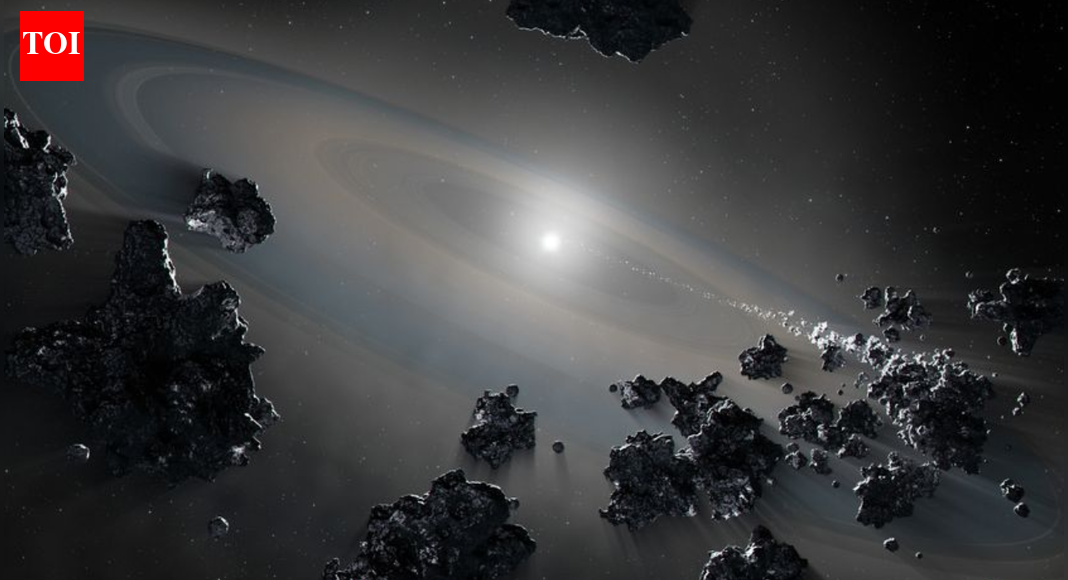

New physics reveals detailed calculations showing the universe’s end may come far sooner than expected, with an exact timeline/ Image: Space.com
For decades, physicists assumed the universe would fade into darkness over a timescale so vast it barely fits in notation: around 10¹¹⁰⁰ years. But researchers at Radboud University in the Netherlands now say the end arrives much earlier, after roughly 10⁷⁸ years, one quinvigintillion years, a one followed by 78 zeros.Their calculation comes from revisiting one of the most famous ideas in modern physics: Hawking radiation. In 1975, Stephen Hawking proposed that black holes slowly lose mass over time because temporary particle pairs at their edges can separate, “one particle is sucked back into the black hole and the other escapes.” As more particles escape, the black hole gradually evaporates.Earlier predictions of the universe’s lifespan assumed this process applied only to black holes. But in recent research, published in Physical Review Letters in 2023 and extended in a new study accepted by the Journal of Cosmology and Astroparticle Physics, Heino Falcke, Michael Wondrak and Walter van Suijlekom argue that a Hawking-like evaporation mechanism applies to all compact massive objects, including white dwarfs and neutron stars, the stellar remnants left after ordinary stars die.White dwarfs form when stars like our Sun run out of nuclear fuel and collapse into dense, Earth-sized cores. Neutron stars form when massive stars explode as supernovae, leaving behind an object so dense that its protons and electrons have fused into neutrons. These remnants can survive for trillions upon trillions of years, long after galaxies fade and ordinary stars burn out.The Radboud team’s key claim is that these stellar corpses will also evaporate, extremely slowly, through a radiation process that depends only on density. As they put it in their earlier paper, if spacetime is curved strongly enough by mass, “all objects with a gravitational field should be able to evaporate.”If that’s true, then the final objects in the universe will not last anywhere near 10¹¹⁰⁰ years. Instead, calculating how long it takes for a neutron star or white dwarf to dissipate gives a new upper limit on the universe’s lifespan: around 10⁷⁸ years.“So the ultimate end of the universe comes much sooner than expected, but fortunately it still takes a very long time,” Falcke said in a statement.The study also reframes Hawking’s original insight. What the team did differently was focus on the role of spacetime curvature around any massive object. Hawking’s original insight applied to event horizons; the Radboud calculations suggest that a Hawking-like mechanism operates wherever gravity compresses space enough, and that its rate depends chiefly on density. Less dense objects evaporate far more slowly; very dense ones, much faster. Apply that rule to the final population of compact remnants and the evaporation clock runs out sooner than previously thought.The previous overestimate, 10¹¹⁰⁰ years, came from ignoring this possibility. Once white dwarfs and neutron stars are included, the cosmic clock runs out much sooner, though it remains far beyond any imaginable human, or even galactic, timescale.Co-author Walter van Suijlekom emphasised how interdisciplinary the work is. The project blends astrophysics, mathematics and quantum physics: “By asking these kinds of questions and looking at extreme cases, we want to better understand the theory, and perhaps one day, we will unravel the mystery of Hawking radiation.”Even with the revised estimate, nothing about daily life or the future of humanity changes. This is deep-time cosmology, timelines so huge that they stop feeling like time at all. What the new work really shifts is the theoretical picture. It suggests that Hawking radiation, still never seen directly, plays a much bigger role in the universe’s long-term fate than scientists once assumed.The study doesn’t mean the universe is “dying faster” in any way we could notice. Instead, it tightens the timeline by linking the universe’s final moments to the slow fade-out of the last neutron stars and white dwarfs.The idea is stark but also almost abstract: once those final stellar remnants evaporate through this Hawking-like process, there will be no luminous matter left. And according to the Radboud team, that happens not in 10¹¹⁰⁰ years, but in 10⁷⁸ years, still so far beyond human comprehension that the difference barely lands outside the language of cosmology. Go to Source