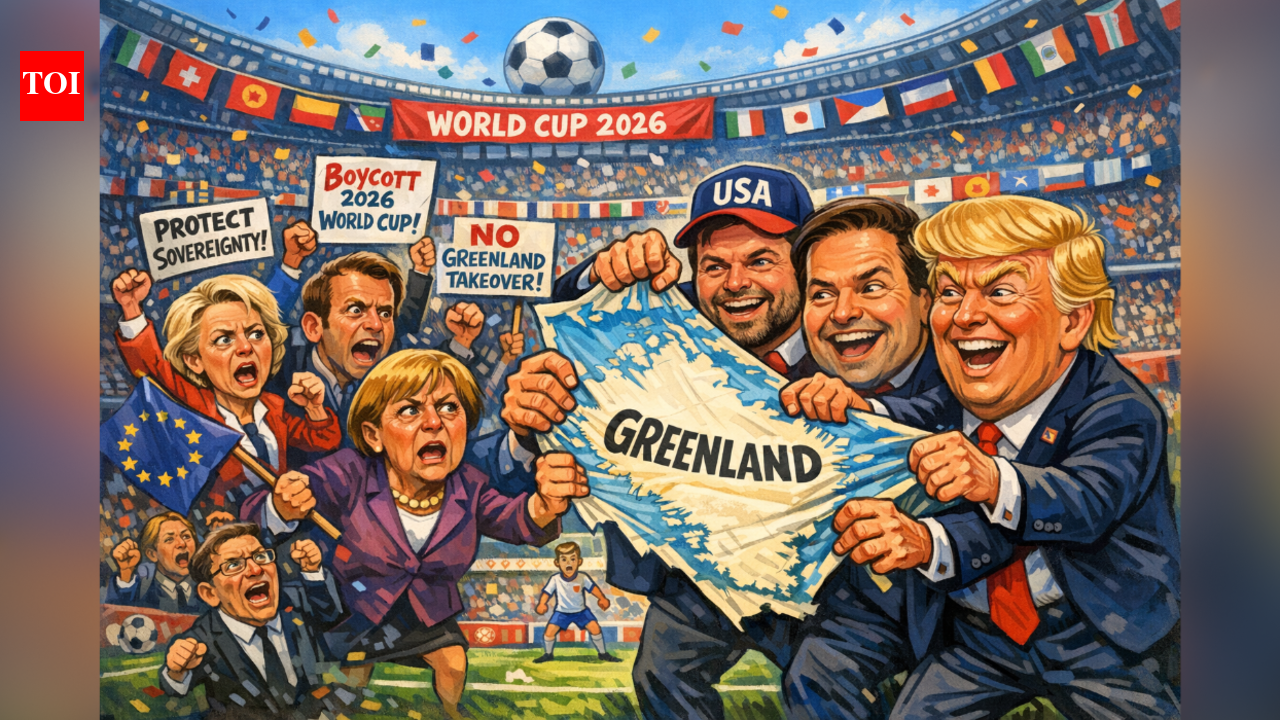

Is Europe ready to boycott the 2026 World Cup over Trump’s threats to Greenland?? AI Image
Five months before the first ball is kicked, the 2026 World Cup is already being pulled into a geopolitical argument that has nothing to do with football. The trigger is not the tournament itself, but a widening rupture between the United States and Europe, fuelled by President Donald Trump’s increasingly blunt language over Greenland and his willingness to frame territorial control as a legitimate objective.No federation has drawn a line yet. UEFA has not threatened withdrawal, and no European government has formally tied participation in the World Cup to Trump’s actions. But the conversation has shifted from fringe speculation to something more serious, surfacing in parliaments, football associations and public debate across Europe. What was once unthinkable so close to a World Cup is now being openly weighed: whether staying away from a tournament hosted in the United States could become a political signal rather than a sporting decision.
Why Greenland has become a flashpoint
Greenland’s status places Trump’s remarks in unusually sensitive territory, the island is a self-governing part of the Kingdom of Denmark, a NATO member state. The United States is also part of NATO, whose Article 5 treats an armed attack on one member as an attack on all. Against that backdrop, Trump’s public statements about annexing Greenland have alarmed European leaders. Over the weekend, Trump wrote on Truth Social that he no longer needed to “think purely of peace” when it came to controlling the world’s largest island. He has also threatened punitive tariffs against European countries that resist US demands over Greenland, deepening fears of a transatlantic rupture. On Wednesday, Trump said he had reached what he called a “framework of a future deal” with NATO, temporarily dropping the tariff threat. The announcement did not include any indication that the US would gain “ownership” of Greenland, and it remains unclear whether it would satisfy Trump in the long term. That uncertainty has fed into the World Cup debate. A coordinated withdrawal by UEFA nations would plunge the tournament into chaos: European teams account for 16 of the 48 places at the expanded World Cup, and their absence would be both a logistical disaster for FIFA and a political embarrassment for Trump, who has taken centre stage in the build-up to the event.
What European figures are saying
European leaders and football officials have so far struck a careful tone, acknowledging public concern without committing to action. In Germany, Jürgen Hardt, a Bundestag member and foreign policy spokesperson for Chancellor Friedrich Merz’s Christian Democratic Union, told BILD that a boycott could be considered “as a last resort in order to get Trump to see sense on the Greenland issue”. Oke Göttlich, president of St. Pauli and a member of the executive boards of both the German FA (DFB) and the German Football League (DFL), raised the issue more pointedly in a LinkedIn post this week. “The question is indeed justified as to whether Europeans should participate in a competition in a country that is indirectly, and possibly soon directly, attacking Europe, don’t you think?” Göttlich wrote. In the UK, MPs Simon Hoare and Kate Osborne told Metro that a boycott should not be ruled out. “We should send as many messages as possible to the Trump administration and the American people that there are certain red lines in regards to upholding sovereignty and international affairs,” Hoare said. “If that means not going to the World Cup then we shouldn’t go to the World Cup.” Osborne went further, adding: “The USA should not be able to participate in the World Cup, let alone be part of hosting it, so yes I support those calling for a boycott.”France’s sports minister, Marina Ferrari, adopted a cautious stance amid growing debate over a potential European boycott of the 2026 World Cup. “At the moment we are speaking, there is no desire from the ministry to boycott this major, much-anticipated competition,” Ferrari told reporters on Tuesday, as cited by the Associated Press. “That said, I am not prejudging what might happen.”Ferrari emphasized the importance of keeping sports and politics separate. “The 2026 World Cup is an extremely important moment for all sports lovers,” she said.
The Dutch position: ‘for now, no boycott’
In the Netherlands, debate has intensified as Trump’s threats have escalated. The Dutch FA (KNVB) has issued multiple statements aimed at lowering the temperature. KNVB secretary general Gijs de Jong said he was “aware of geopolitical developments” concerning the United States, but stressed that any decision would be guided by FIFA, UEFA, and the Dutch government. “We live in a rapidly changing world,” De Jong said. “Therefore, we closely monitor international developments, in consultation with FIFA, UEFA, the Ministry of Foreign Affairs, and local embassies.” He added that the association remained “alert and flexible”, but that its priority was allowing players and staff to focus on football. “It is up to the Dutch government to determine its position on international political developments,” De Jong said. “By continuing to play football and engage in dialogue, we link our progressive stance to our values, convinced that football can unite.” KNVB president Frank Paauw echoed that position during an award ceremony in The Hague, saying the Netherlands would “so far” not boycott the World Cup. Paauw acknowledged that Trump “draws new lines” in global politics and “threatens a lot”, but insisted the federation would not act independently of political authorities. “As long as politicians do not engage in politics, we will not engage in politics either,” he said. Calls for a boycott are nevertheless gaining traction domestically. Dutch journalist and opinion-maker Teun van de Keuken has organised a petition urging the KNVB to withdraw from the tournament, which has attracted nearly 120,000 signatures. The petition argues that participation would amount to tacit support for Trump’s immigration policies and expansionist rhetoric.
Has a World Cup boycott happened before?
Boycotts are rare but not unprecedented in World Cup history. Since the tournament began in 1930, nine countries, and once, an entire continent, have boycotted editions of the competition. Uruguay refused to defend its title in 1934, declining to travel to Italy, and also boycotted the 1938 World Cup alongside Argentina. India withdrew in 1950, while Turkey, Indonesia, Egypt and Sudan pulled out of qualifying in 1958. In 1966, all African nations boycotted the tournament in protest at the allocation of places. The most recent boycott came in 1974, when the Soviet Union refused to play Chile in a qualifying playoff. More than half a century on, the question now facing Europe is whether geopolitical pressure, alliance politics and public opinion could again collide with football, and whether the 2026 World Cup could become the stage on which that conflict plays out. Go to Source