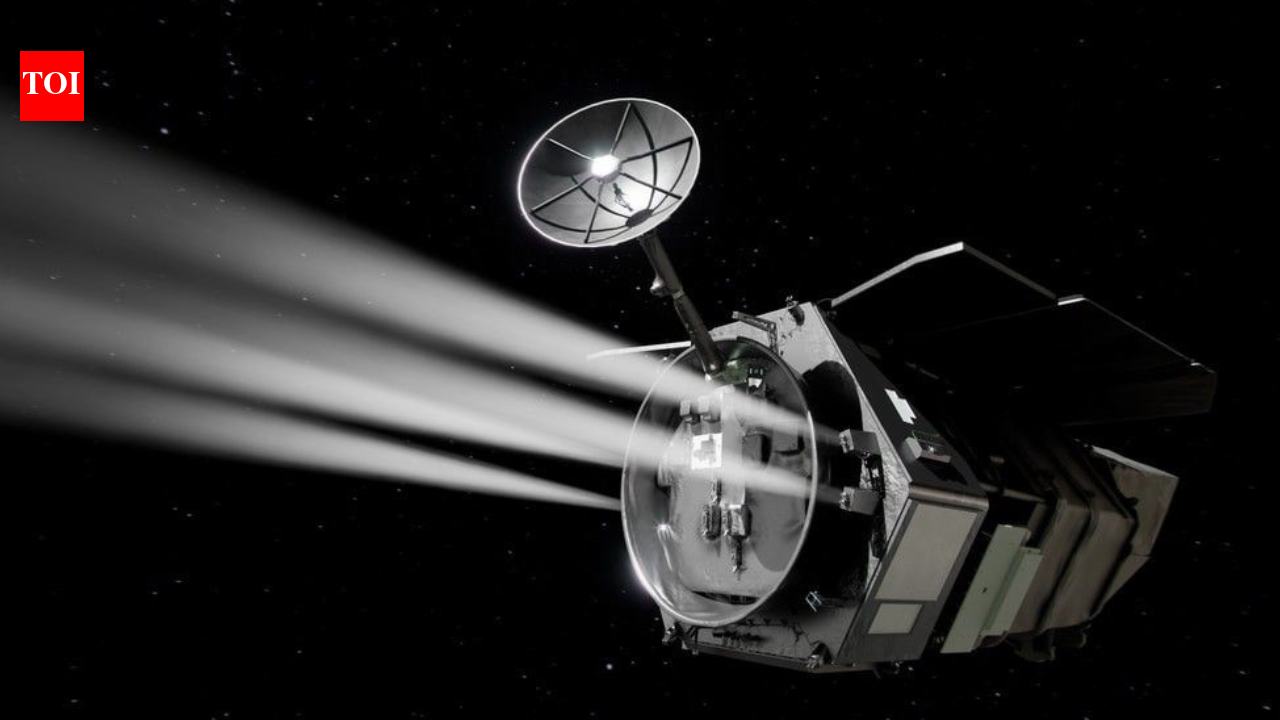

NASA’s Nancy Grace Roman Space Telescope has reached Kennedy Space Center in Florida, where it has begun final preparations for launch aboard a SpaceX Falcon Heavy rocket. The observatory arrived on NASA’s Pegasus barge on June 21, 2026, after travelling in a protective, environmentally controlled container from Goddard Space Flight Center in Maryland. Roman is one of NASA’s major next-generation observatories and carries a total lifecycle cost of about $4.3 billion. Officials are now targeting launch no earlier than August 30, 2026, eight months ahead of the mission’s required readiness date. Once launched, the telescope will begin a mission designed to answer some of the biggest mysteries in astronomy, from dark energy to the search for distant worlds.
Roman Space Telescope arrives at Kennedy Space Center
After docking in Florida, technicians transported the 43-foot-tall observatory to the Payload Hazardous Servicing Facility, where it will spend roughly 70 days undergoing final inspections, testing and fueling before being integrated with a SpaceX Falcon Heavy rocket. The telescope travelled inside a specially designed protective container nicknamed the “Chariot” and made the journey aboard NASA’s Pegasus barge. Engineers had to add extra cooling units during the trip to keep the spacecraft below its required temperature limit of 74°F (23°C). Despite the challenge, NASA officials said the observatory arrived safely and on schedule.
What makes Roman different from Hubble
Although Roman has a mirror similar in size to Hubble’s 2.4-metre mirror, the two telescopes are designed for different purposes. Roman’s 300-megapixel Wide Field Instrument contains 18 advanced detectors and provides Hubble-like image quality while covering an area of sky at least 100 times larger in a single observation. According to NASA, what would take Hubble hundreds or even thousands of years to survey could be accomplished by Roman in just a few years. This ability will allow astronomers to study billions of galaxies and create some of the most detailed maps of the universe ever assembled.The Wide Field Instrument was developed by BAE Systems and will operate primarily in infrared wavelengths, allowing Roman to peer through cosmic dust and observe extremely distant objects from the early universe.
A telescope built to study the dark universe
One of Roman’s main objectives is to investigate dark energy and dark matter, which together make up roughly 95 percent of the universe. Scientists still do not know what these mysterious components are, but they believe they play a key role in shaping the cosmos and driving its accelerated expansion.By observing millions of galaxies and measuring the distribution of matter across vast distances, Roman will help researchers determine whether dark energy is changing over time or whether current theories of gravity need to be revised. NASA scientists say the mission could fundamentally alter our understanding of how the universe evolved and where it is heading.
Roman will also hunt for alien worlds
Besides studying cosmology, Roman will search for exoplanets using a technique known as gravitational microlensing. This method can detect planets that are difficult to find using traditional approaches and may even discover free-floating planets that do not orbit stars.The telescope also carries a cutting-edge coronagraph instrument developed by NASA’s Jet Propulsion Laboratory. The instrument is designed to block out the overwhelming light from stars, enabling scientists to directly observe nearby exoplanets and the dusty discs surrounding them. The technology is considered an important stepping stone toward future missions that may eventually image Earth-like planets around Sun-like stars.
What happens before launch
Roman still has a busy few weeks ahead. Engineers will conduct a series of electrical and mechanical checkouts, load propellant and encapsulate the observatory inside the Falcon Heavy payload fairing. The launch is scheduled no earlier than August 30, 2026, from Launch Complex 39A at Kennedy Space Center.After launch, the telescope will travel nearly 1.5 million kilometres to the Sun-Earth Lagrange Point 2, or L2, the same gravitationally stable region occupied by the James Webb Space Telescope. From there, Roman will continuously observe the universe while remaining shielded from much of the Sun’s heat and light.NASA designed the mission to last at least five years, but mission officials estimate that enough fuel is onboard to keep the telescope operating for a decade or even longer.
Why scientists are excited
Scientists consider Roman one of NASA’s most important observatories since Hubble and James Webb because it combines a powerful mirror with an exceptionally wide field of view. While James Webb excels at studying individual objects in extraordinary detail, Roman will provide the bigger picture by surveying immense portions of the cosmos.Researchers expect the mission to discover thousands of exoplanets, identify billions of galaxies and capture rare events such as exploding stars and gravitational lensing phenomena. The observatory’s enormous datasets could lead to discoveries that scientists have not yet anticipated.Named after Nancy Grace Roman, NASA’s first Chief of Astronomy and often called the “Mother of Hubble,” the telescope represents decades of planning and technological development. Scientists hope it will answer profound questions about the nature of the universe and humanity’s place within it. Go to Source