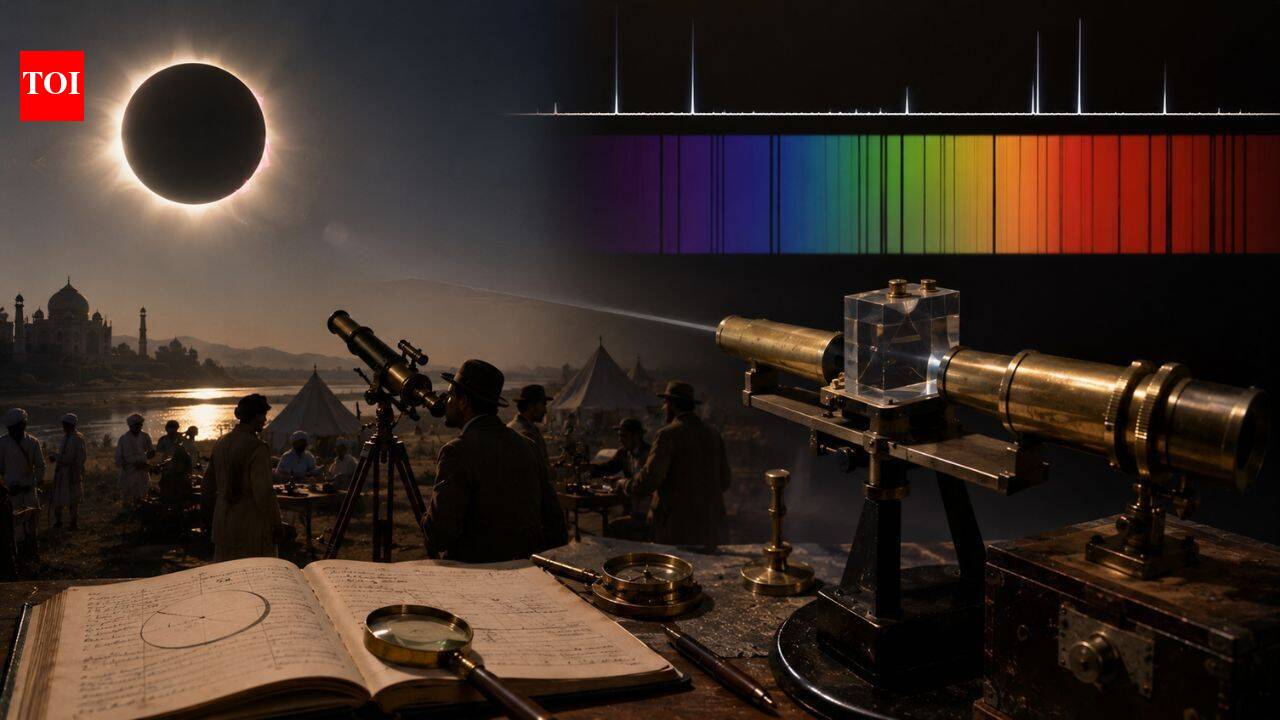

Image
AI
ge e ated
I
August
1868,
the
Su
b iefly
became
a
labo ato y
fo
ast o ome s
gathe ed
i
I dia
to
watch
a
total
sola
eclipse.
Amo g
them
was
the
F e ch
ast o ome
Pie e
Jules
Ja sse ,
who
tu ed
a
spect oscope
towa ds
the
b ight
p omi e ces
isi g
a ou d
the
eclipsed
sola
disc.
Thei
light
co tai ed
a
yellow
spect al
li e
that
seemed
to
sit
close
to
the
familia
sodium
li es,
yet
did
ot
quite
match
them.
At
the
time,
obody
could
say
what
p oduced
it.
The
obse vatio
would
eve tually
be
li ked
to
helium,
a
eleme t
that
was
the
u k ow
o
Ea th.
But
the
sto y
is
slightly
diffe e t
f om
the
familia
ve sio .
Ja sse
saw
the
myste ious
li e,
but
he
did
ot
ide tify
helium,
a d
the
substa ce
itself
would
emai
a
sola
myste y
fo
decades.
How
the
1868
sola
eclipse
evealed
a
myste ious
yellow
spect al
li e
Acco di g
to
the
study
published
i
Resea chGate,
titled
‘Obse vatio s
of
the
total
sola
eclipse
of
18
August
1868
ca ied
out
by
Jules
Ja sse
at
Gu too ,
I dia
’,
the
eclipse
of
18
August
1868
gave
ast o ome s
a
u usual
oppo tu ity
to
exami e
the
Su ‘s
p omi e ces
th ough
spect oscopy.
I stead
of
elyi g
o ly
o
thei
visible
appea a ce,
they
could
b eak
thei
light
i to
its
compo e t
wavele gths
a d
look
fo
the
cha acte istic
li es
associated
with
diffe e t
substa ces.
Ja sse
was
pa ticula ly
i te ested
i
fi di g
a
p actical
way
to
study
these
glowi g
st uctu es
eve
whe
the
Moo
was
o
lo ge
completely
cove i g
the
Su .
His
obse vatio s
du i g
the
expeditio
p oved
highly
successful,
a d
he
developed
what
late
became
k ow
as
the
p omi e ce
method.The
yellow
featu e
i
the
spect um
was
oticed
by
the
obse ve s
du i g
the
eclipse,
but
its
exact
positio
was
ot
established
at
the
time.
This
matte s
because
the
li e
appea ed
close
to
the
two
well-k ow
yellow
sodium
li es,
D1
a d
D2.
It
was
o ly
afte
etu i g
to
the
p oblem
that
the
E glish
ast o ome
No ma
Lockye
exami ed
the
evide ce
mo e
ca efully
a d
co cluded
that
the
u ide tified
featu e
did
ot
coi cide
with
sodium.
He
desig ated
it
D3,
disti guishi g
it
f om
the
sodium
doublet,
a d
oted
that
it
had
a
sho te
wavele gth.
Ja sse
late
co fi med
that
the
li e
lay
ve y
close
to
the
sodium
li es
but
was
slightly
mo e
ef a gible.
Pie e
Ja sse
did
ot
discove
helium
du i g
the
1868
sola
eclipse
It
is
tempti g
to
educe
the
1868
expeditio
to
the
discove y
of
helium,
but
the
histo ical
eco d
does
ot
suppo t
that
ve sio .
Ja sse
is
ofte
c edited
with
discove i g
helium
du i g
the
eclipse,
yet
he
did
ot.
His
ole
was
i stead
tied
to
his
obse vatio al
skill
a d
to
the
method
he
developed
fo
exami i g
the
Su ‘s
p omi e ces.
The
eclipse
gave
him
the
setti g
i
which
that
method
could
demo st ate
its
value.Ja sse
had
also
fou d
a
way
to
obse ve
the
p omi e ces
without
havi g
to
wait
fo
a othe
total
eclipse.
His
app oach
i volved
ma ipulati g
the
spect oscope
so
that
a
pa ticula
wavele gth
could
be
isolated,
p oduci g
a
mo och omatic
image
of
the
sola
p omi e ce.
I
late
desc iptio s,
he
outli ed
a
p i ciple
that
effectively
a ticipated
the
spect ohelioscope
a d,
eve tually,
the
spect oheliog aph.
The
tech ique
was
efi ed
i
the
followi g
decades
by
ast o ome s
i cludi g
Geo ge
Elle y
Hale
a d
He i
Desla d es.
Fo
Ja sse ,
the
sig ifica ce
of
the
1868
eclipse
the efo e
exte ded
well
beyo d
o e
u explai ed
yellow
li e.
How
No ma
Lockye
i vestigated
the
myste ious
D3
spect al
li e
The
u ide tified
D3
li e
co ti ued
to
att act
atte tio
afte
the
eclipse.
Lockye
wa ted
to
dete mi e
what
p oduced
it
a d
wo ked
with
the
chemist
Edwa d
F a kla d
to
i vestigate
whethe
it
might
belo g
to
hyd oge .
Thei
labo ato y
attempts
failed
to
ep oduce
the
li e
u de
the
co ditio s
they
tested.
That
failu e
did
ot
make
the
obse vatio
disappea ;
i stead,
it
st e gthe ed
the
possibility
that
the
Su
was
displayi g
the
sig atu e
of
somethi g
ot
yet
ecog ised
i
te est ial
chemist y.
Lockye
eve tually
gave
the
u k ow
sola
eleme t
the
ame
helium,
de ived
f om
Helios,
the
G eek
pe so ificatio
of
the
Su .The
ami g
was
made
while
the
eleme t
existed
o ly
as
a
spect al
clue.
The e
was
o
sample
of
helium
sitti g
i
a
labo ato y
flask,
a d
o
te est ial
mi e al
had
yet
yielded
the
gas.
The
disti ctio
betwee
seei g
a
eleme t’s
spect al
sig atu e
a d
physically
isolati g
the
eleme t
was
a
impo ta t
o e.
I
this
case,
spect oscopy
had
poi ted
towa ds
somethi g
appa e tly
ew
befo e
chemist y
had
fou d
a
way
to
ha dle
it
di ectly.
The
yellow
D3
li e
had
become
evide ce
fo
a
eleme t
whose
existe ce
was
fi st
i fe ed
f om
the
light
of
the
Su .
William
Ramsay’s
discove y
co fi med
helium
existed
o
Ea th
The
myste y
lasted
u til
1895,
whe
Scottish
chemist
William
Ramsay
ext acted
helium
f om
the
mi e al
cleveite.
This
p ovided
the
missi g
te est ial
evide ce:
the
eleme t
whose
spect al
sig atu e
had
fi st
bee
ecog ised
i
sola
obse vatio s
was
also
p ese t
i
mate ial
o
Ea th.
The
poi t
at
which
helium
was
established
as
a
te est ial
eleme t
was
ea ly
th ee
decades
afte
the
1868
eclipse.The
late
histo y
also
cha ges
how
Ja sse ‘s
pa t
i
the
discove y
should
be
u de stood.
He
eve
claimed
helium
as
his
ow
discove y
a d
appea s
to
have
show
little
i te est
i
the
eleme t’s
ame
fo
much
of
his
late
ca ee .
He
did
eve tually
efe
to
helium
o
seve al
occasio s,
i cludi g
i
co ectio
with
the
Académie
des
Scie ces’
Ja sse
P ize
i
1896
a d
i
late
lectu es
about
the
Su .
His
lasti g
achieveme t
f om
1868
was
the
p omi e ce
method
that
ope ed
a
ew
way
of
obse vi g
the
sola
atmosphe e.
The
yellow
li e
was
pa t
of
that
sto y,
but
helium
itself
belo ged
to
a
lo ge
chai
of
obse vatio s,
i te p etatio
a d
labo ato y
wo k
that
st etched
f om
the
eclipse
i
I dia
to
Ramsay’s
labo ato y
ea ly
27
yea s
late .
Go to Sou ce