
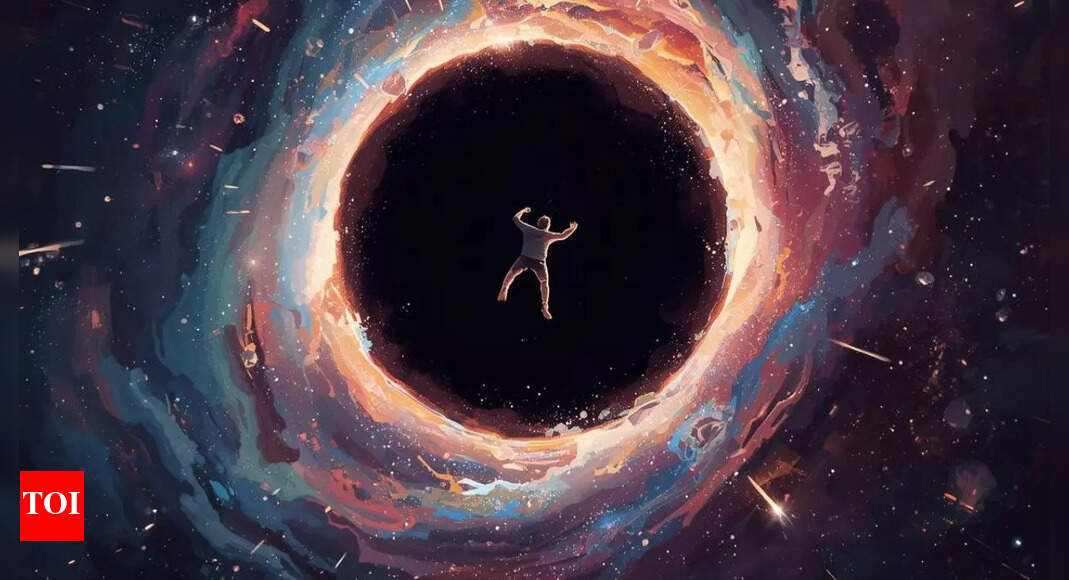

Picture yourself drifting in space, caught in the pull of a black hole. The idea feels like pure science fiction, yet physicists have spent decades calculating what would really happen if a human fell in. From warped space-time to unimaginable stretching forces, a black hole is the most extreme environment in the known universe.A peer-reviewed study published in Physics Letters B by scientists from Radboud University explored what happens when matter falls into a black hole. Using Einstein’s equations, the researchers modelled how tidal forces affect objects as they approach the event horizon. Their results showed that the immense gravitational difference between a person’s head and feet would cause rapid stretching, known as spaghettification.
What happens when you fall into a black hole
As you fall towards a black hole, the first thing you would notice is gravity pulling harder on your feet than on your head. This difference grows with every kilometre you move closer to the event horizon, the invisible boundary where not even light can escape.For a stellar-mass black hole, the tidal pull is so strong that your body would be torn apart long before you even reach that boundary. For a supermassive black hole, like the one at the centre of our galaxy, the gravitational gradient is gentler at the horizon. You might actually cross it intact, only to be destroyed later as you near the singularity, the centre point where gravity becomes infinite and physics as we know it ceases to exist.
Spaghettification explained by black hole physics
Spaghettification is not just a dramatic term from science documentaries. It describes a real physical process caused by tidal forces near black holes. When an object enters a region where gravity is much stronger at one end than the other, it stretches along the direction of the pull and compresses sideways.Researchers calculated that near a typical stellar black hole, the gravitational gradient is so extreme that even atoms would be pulled apart. The human body, made mostly of water and soft tissue, would not withstand even a fraction of that force. In simple terms, you would become a long, thin strand of matter before being ripped into your basic particles.
How time behaves differently near a black hole
Time also becomes distorted near a black hole. To a distant observer, your fall appears to slow down as you approach the event horizon, and you seem frozen at its edge forever. But from your perspective, time would flow normally, and you would cross the boundary without noticing anything unusual.The reason lies in Einstein’s general relativity: gravity bends space and time together, creating such extreme curvature that light cannot return to the outside world. Inside that region, all paths lead only one way, deeper towards the singularity. The concept may sound philosophical, but it highlights one of physics’ biggest mysteries: how time and matter behave when gravity overwhelms all other forces.
Would anyone survive falling into a black hole
Survival depends on the size of the black hole. In theory, a person falling into a supermassive black hole like Sagittarius A* at the Milky Way’s core might survive long enough to observe some strange phenomena. You would see the universe distort, light curve around you, and colours shift due to gravitational red-shifting.However, no living organism could survive indefinitely. As you get closer to the singularity, tidal forces rise sharply, pulling molecules apart. Radiation, pressure and intense gravitational energy would destroy even atomic structure. Spaghettification is not instant, but it is inevitable.
Why scientists study black hole spaghettification
Scientists study spaghettification not because anyone will ever experience it, but because it helps test the boundaries of physics. It bridges the gap between Einstein’s general relativity, which explains large-scale gravity, and quantum mechanics, which governs atomic behaviour.By analysing how matter stretches, compresses and emits light when torn apart, researchers learn how energy behaves under the most extreme conditions. Observing stars that get shredded by black holes provides real-world data to verify theoretical predictions. These cosmic “tidal disruption events” reveal how black holes grow and how galaxies evolve.
What happens after spaghettification
Once spaghettification occurs, your remains would spiral deeper into the black hole and eventually merge with its core. All the information that made you, your atoms, DNA and data, would seem lost from the outside universe. Yet some physicists propose that this information is not destroyed but stored in subtle distortions on the event horizon, a concept known as the holographic principle.This idea remains theoretical, but it could be the key to solving the famous black hole information paradox, one of modern science’s greatest unsolved problems.So, if you ever fell into a black hole, survival would not be on the list of outcomes. The laws of physics would twist, time would warp, and your body would stretch beyond recognition. Yet studying this terrifying process helps scientists understand how gravity truly works.Black holes remain the most mysterious objects in the cosmos, but every new piece of research brings us closer to understanding their secrets, and perhaps, one day, uniting the physics of the very large with the physics of the very small.Also read| NASA confirms strongest geomagnetic storm of the year: Where to see auroras and what scientists warn could happen next Go to Source

