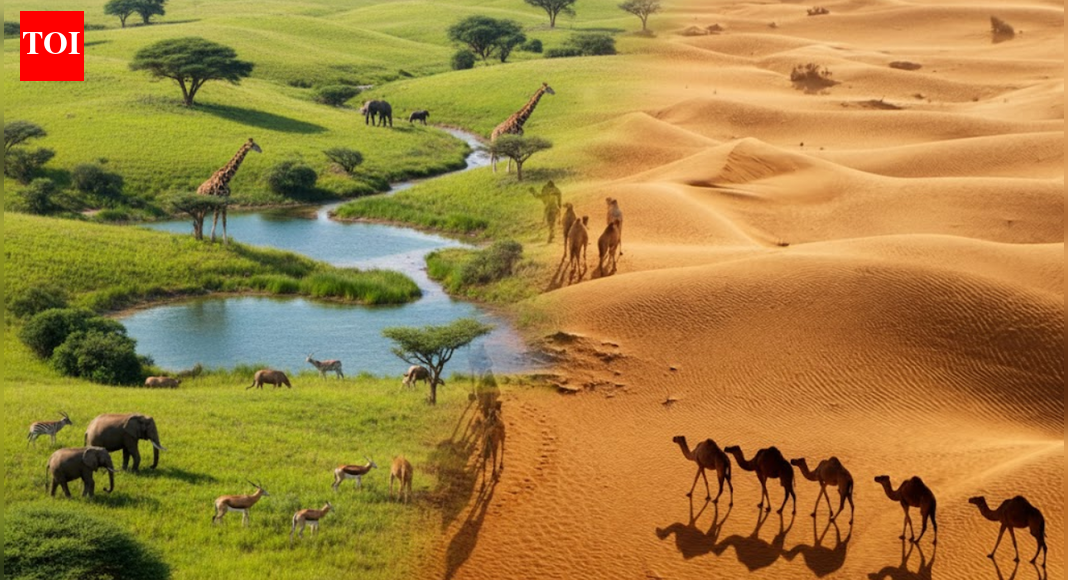

Multiple studies show Saudi Arabia’s deserts were once green grasslands fed by rivers, lakes and monsoon rains during wet phases/ Representative Image
Today, Saudi Arabia is a modern, oil-rich state pouring investment into infrastructure and economic diversification as it looks beyond fossil fuels. Yet it remains one of the most arid countries on Earth: around 95 per cent of its land is desert, dominated by the Arabian Desert and the vast Rub’ al Khali, or Empty Quarter. That tension has driven major efforts to combat desertification, including ambitious greening programmes and a pledge to plant 10 billion trees to combat desertification. What recent science now suggests, however, is that Saudi Arabia’s dryness is not its natural state. Multiple independent studies show the peninsula was once humid and green, shaped by rivers, lakes and monsoon rains that supported wildlife and repeated human settlement.
When Arabia was green
Much of this story unfolds during the Pleistocene Epoch, a long stretch of Earth’s history often called the Ice Age. It ran from about 2.6 million to 11,700 years ago and was marked by repeated cycles of colder and warmer climates. While glaciers expanded and retreated across the Northern Hemisphere, rainfall patterns elsewhere shifted dramatically. The Pleistocene forms part of the Quaternary Period, the current geological period, which spans from roughly 2.6 million years ago to today. During this time, modern humans evolved, large mammals such as mammoths roamed widely, and climate swings repeatedly reshaped landscapes. New multidisciplinary research shows that during wetter phases of this period, Arabia was transformed. Instead of desert, it supported grasslands, savannahs, rivers and large lakes, conditions capable of sustaining animals and people for long periods, not just brief migrations. Researchers say these findings overturn older assumptions that the peninsula was merely a harsh corridor people passed through.
Rivers, lakes and a landscape seen from space
One major strand of evidence comes from landscape analysis, archaeology and satellite imagery. What appear today as dry channels on the ground become vast ancient river systems when viewed from space.Michael Petraglia, professor of human evolution and prehistory at the School of Archaeology at the University of Oxford, leads one of the major research groups examining this transformation.Speaking to the BBC, Petraglia said:“Innovative space shuttle technology has allowed the mapping of over 10,000 lakes across Arabia including the now barren Nafud desert.”“This finding links directly with the discovery of the remains of elephants, hippos, crocodile and molluscs at a couple of our sites in the Kingdom.”
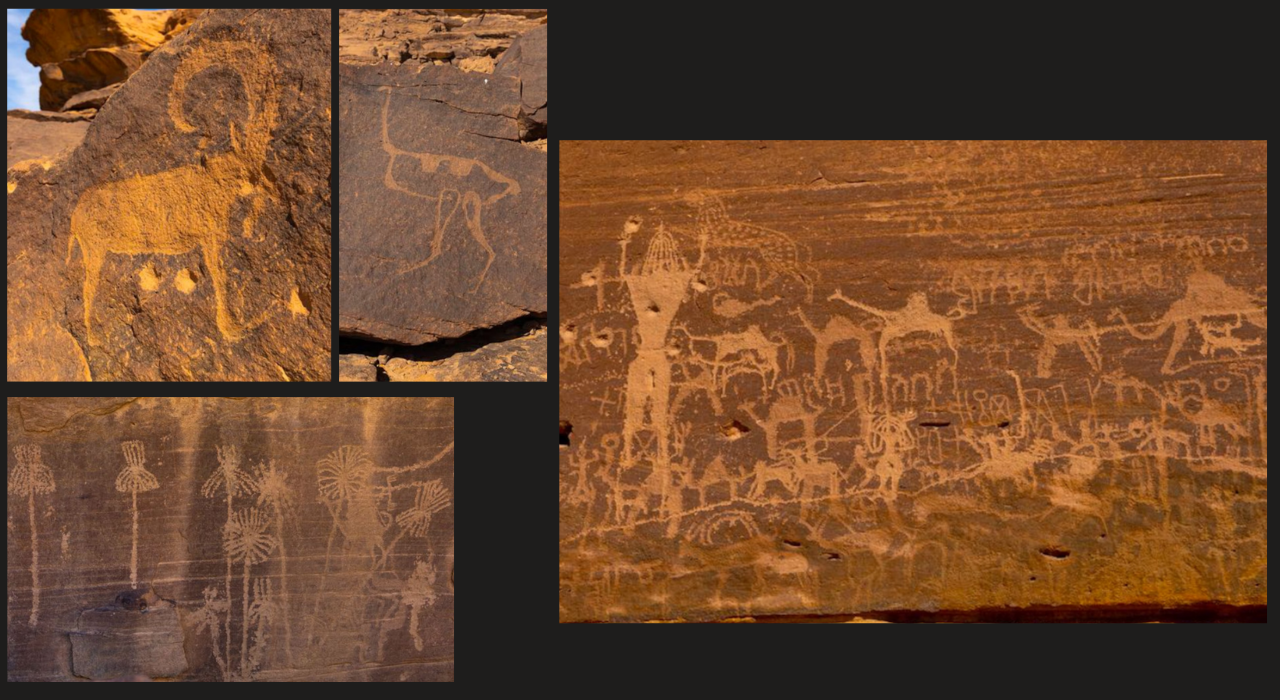
Ancient Saudi Arabian petroglyphs depict palm trees, ibex, camels, ostriches, hunters, and the fertility goddess Aliya from a greener era/ Image: National Geographic
The presence of such animals, all dependent on abundant water, reinforces the conclusion that these were long-lived wet environments. According to Petraglia and colleagues, combining archaeology, palaeontology, geochronology and remote sensing allows scientists to reconstruct how Arabia’s environment shifted repeatedly over the last million years.
The Empty Quarter’s hidden lakes
A separate but complementary line of evidence comes from geological studies of Rub’ al-Khali, or the Empty Quarter, today the world’s largest sand desert, covering nearly 650,000 square kilometres, mostly in Saudi Arabia. New research led by scientists at King Abdullah University of Science and Technology (KAUST), alongside collaborators from the University of Geneva, Griffith University, California Institute of Technology, the University of Texas and the University of the Fraser Valley, shows the region once held vast lakes and river systems. Published in Communications Earth & Environment, the study was led by Abdulkader M. Afifi, with KAUST researchers Antoine Delaunay and Guillaume Baby, alongside Abdallah Zaki of the University of Geneva. “Beneath Rub’ al Khali’s desolate sands lies a vibrant past of lakes and rivers,” Delaunay said. “Our study highlights the transformative power of the climate on Arabian landscapes and their profound connection to human occupation; further investigation is crucial to unraveling these complex interactions.” The researchers identified an ancient lake covering about 1,100 square kilometres and reaching depths of up to 42 metres. As rainfall intensified during the so-called “Green Arabia” phase, roughly 11,000 to 5,500 years ago, near the end of the Quaternary, the lake overflowed, carving a 150-kilometre-long valley into the desert floor. Scientists traced sediments and landforms across more than 1,000 kilometres and concluded the rains were driven by the northward expansion of African and Indian monsoons.
Climate cycles and human movement
These wet phases were not uniform. Researchers say they lasted for several millennia in southern Arabia, but only a few centuries in the north. Even so, they repeatedly created habitable corridors. According to Michael Petraglia, now director of the Australian Research Centre for Human Evolution at Griffith University, these environments fundamentally shaped human behaviour. “The formation of lake and river landscapes, along with grasslands and savannahs, would have facilitated the expansion of hunting, gathering, and pastoral groups into what is now a dry, barren desert,” Petraglia said. “This is confirmed by abundant archaeological evidence found in the Empty Quarter and along its ancient lake and river systems.” Around 6,000 years ago, rainfall declined sharply, returning the region to arid conditions and forcing populations to move again. These findings echo earlier work highlighting Arabia’s role in early human migration. Prince Sultan bin Salman bin Abdulaziz, who heads the Saudi Commission for Tourism and National Heritage and was the first Arab to travel into space, has said evidence suggests early humans left Africa via Arabia earlier than once believed. “The Arabian Peninsula has witnessed dramatic changes in climate,” he said. “In the middle Pleistocene this encouraged early man to make for the then-green peninsula as his destination.”
Evidence from caves and stone
Another independent line of evidence comes from caves. Scientists analysed stalagmites, mineral deposits that grow upward from cave floors as water drips from above. Because these deposits form slowly, layer by layer, their chemical composition preserves a long-term record of rainfall, allowing researchers to reconstruct past wet and dry periods in the region allowing scientists to read past wet and dry periods much as they would the growth rings of a tree. A recent study of stalagmites from caves in central Saudi Arabia shows the region was lush and green for much of the last eight million years, providing long-term support for the “Green Arabia” hypothesis. The study suggests that the belt of deserts stretching from the Sahara, across Arabia, to India’s Thar Desert, often thought of as permanent barriers, were at times savannah-like landscapes. “The sand seas that we are used to seeing have not always been the case,” Petraglia said. “That has had a huge effect on human evolution.”Those scientific findings sit alongside Saudi Arabia’s current land-restoration push. Through the Saudi Green Initiative, the kingdom has committed to planting 10 billion trees and rehabilitating about 74.8 million hectares of degraded land over the long term, as part of wider efforts to combat desertification and improve air quality. By mid-2025, more than 151 million trees and shrubs had already been planted and around 500,000 hectares restored, according to official figures. The interim target is to exceed 600 million trees by 2030, including large urban greening projects such as Riyadh’s plan for 7.5 million trees. The programme relies on native, drought-resistant species, treated wastewater, smart irrigation systems and drone-assisted planting, and forms part of the broader Middle East Green Initiative, which aims to plant 50 billion trees across the region.With modernity, capital and a push to move beyond oil now reshaping the kingdom, it will be telling to see whether Saudi Arabia, one of the world’s most arid regions, can use science and scale to revive echoes of its former Green Arabia, and in doing so offer a model for other desert nations confronting the same challenge. Go to Source