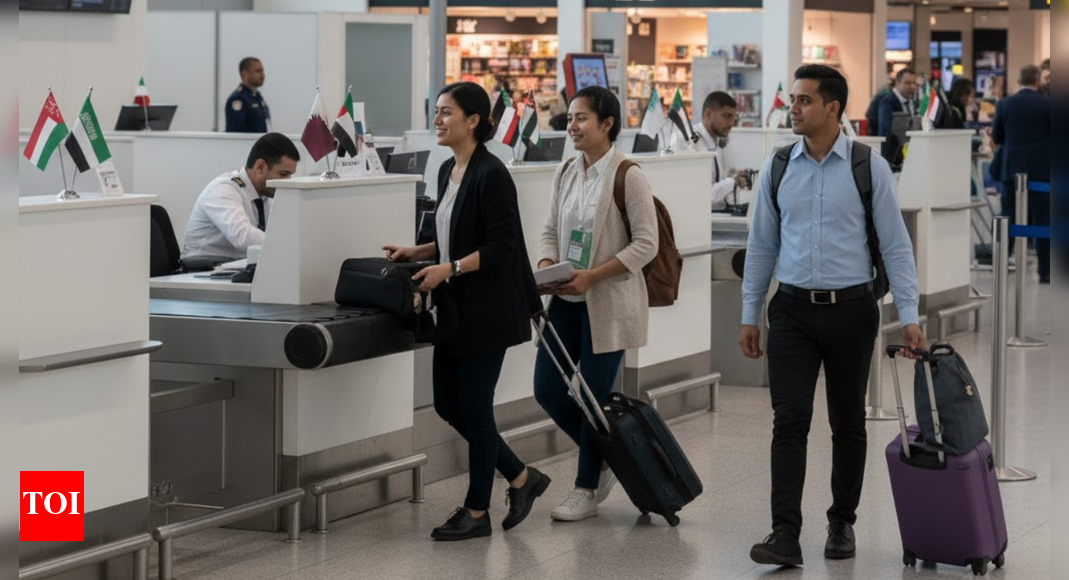

GCC will launch a travel system in December 2025 between UAE and Bahrain for single-checkpoint processing/Representative Image
Imagine flying between Gulf countries and stepping off your plane without queues for immigration, customs, or security. That reality may soon arrive as the Gulf Cooperation Council (GCC) launches an ambitious project to simplify regional travel, beginning with the UAE and Bahrain.The GCC has approved a new “one-stop” travel system that will allow citizens of member states to complete all travel formalities at a single checkpoint, eliminating repeated inspections upon arrival. The pilot phase is scheduled to begin in December 2025, marking a significant leap toward regional integration. If successful, the model will extend to all six GCC nations — Saudi Arabia, Oman, Qatar, Kuwait, Bahrain, and the United Arab Emirates.
Streamlined travel through a single checkpoint
The new travel framework was announced during the 42nd meeting of GCC Interior Ministers held in Kuwait City. GCC Secretary-General Jasem Mohamed Albudaiwi confirmed that the initiative will first apply to air travel between the UAE and Bahrain.Under the “one-stop” system, Gulf nationals will undergo immigration, customs, and security checks at a single location before departure. Upon arrival, travelers will be treated as though arriving on a domestic flight, bypassing multiple clearance procedures. According to Albudaiwi, the program aims to make cross-border travel “smoother and more efficient,” serving as a model for deeper regional coordination. The system will also be supported by a unified electronic platform designed to record and share travel-related violations among GCC countries, enhancing both security and administrative efficiency.
A step toward regional integration
This new travel mechanism mirrors the Schengen-style coordination practiced in the European Union, signaling the GCC’s commitment to building a more connected and accessible bloc.If the UAE–Bahrain pilot proves successful, the system will gradually expand to include all six GCC states, transforming the experience of intra-Gulf travel for both citizens and residents. The streamlined system is expected to reduce airport processing times, strengthen cooperation between immigration and aviation authorities, and boost regional connectivity.While specific details on the system’s technical architecture and digital operations have yet to be disclosed, the December 2025 rollout marks a defining moment in the Gulf’s long-term plan to integrate travel infrastructure.
Unified GCC tourist visa on the horizon
The “one-stop” travel initiative coincides with another major milestone, the upcoming Unified GCC Tourist Visa, officially known as the GCC Grand Tourist Visa.Abdulla bin Touq Al Marri, UAE Minister of Economy and Tourism and Chairman of the Emirates Tourism Council, confirmed that the unified visa’s pilot launch is scheduled for the fourth quarter of 2025. He described the initiative as a “strategic step toward deeper regional integration”, adding that it will enhance the Gulf’s appeal as a single tourism destination.The unified visa will allow travelers to move freely between Bahrain, Kuwait, Oman, Qatar, Saudi Arabia, and the UAE using a single permit. Applicants will be able to apply online through a central digital platform once the system is operational.GCC Secretary-General Albudaiwi noted that the visa program has entered its final approval stage following years of planning, while Saudi Tourism Minister Ahmed Al Khateeb told Reuters that the visa could be fully operational by 2026 or 2027.
The future of mobility in the gulf
Together, the “one-stop” travel system and the Unified GCC Tourist Visa form the backbone of a new phase in Gulf cooperation, one that emphasizes seamless mobility, economic integration, and tourism growth.These initiatives are expected to simplify logistics, attract more international visitors, and strengthen intra-regional ties among Gulf states. For citizens, it could mean quicker travel and fewer bureaucratic steps; for the wider region, a future where borders feel less like barriers and more like gateways.As the pilot projects take flight, the Gulf is positioning itself not just as a group of neighboring states, but as a cohesive, connected region ready to redefine travel in the Middle East. Go to Source