
Some relationships are hard to decipher: full of contradictions, confusing signals, and mood swings. Yet people stick with them, hoping that someday the pieces will click into place. That’s precisely how the India–United States relationship feels like today.Once feted as a natural marriage of the world’s two biggest democracies, relations between New Delhi and Washington nowadays seem querulous, unpredictable and hostage to the fluctuations in US President Donald Trump’s mood. In fact, a partnership that experienced its heyday in public bonhomie and conjoined strategic interests seems increasingly held hostage to transactional politics and personal ego.
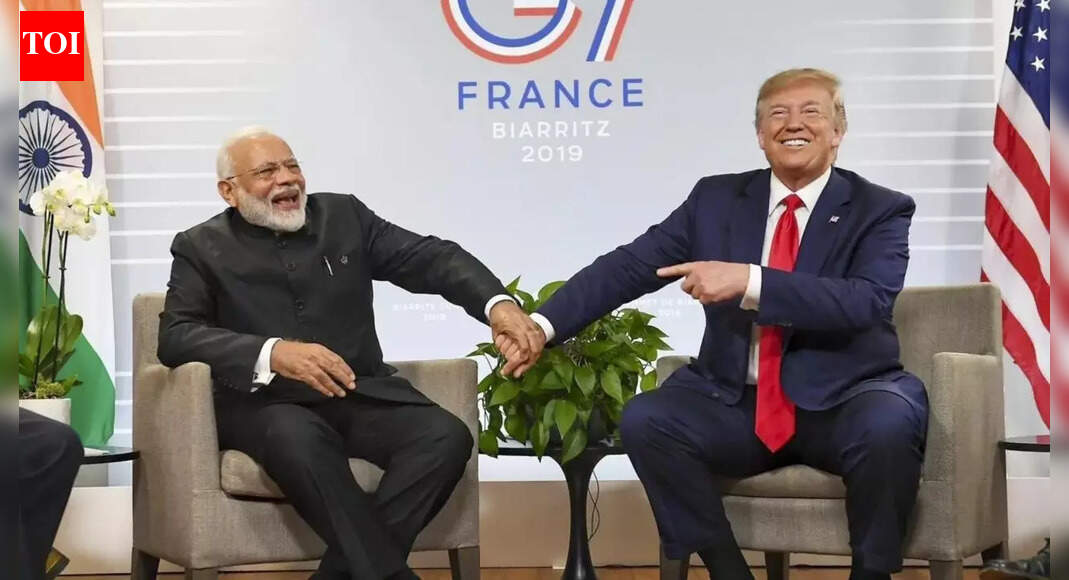
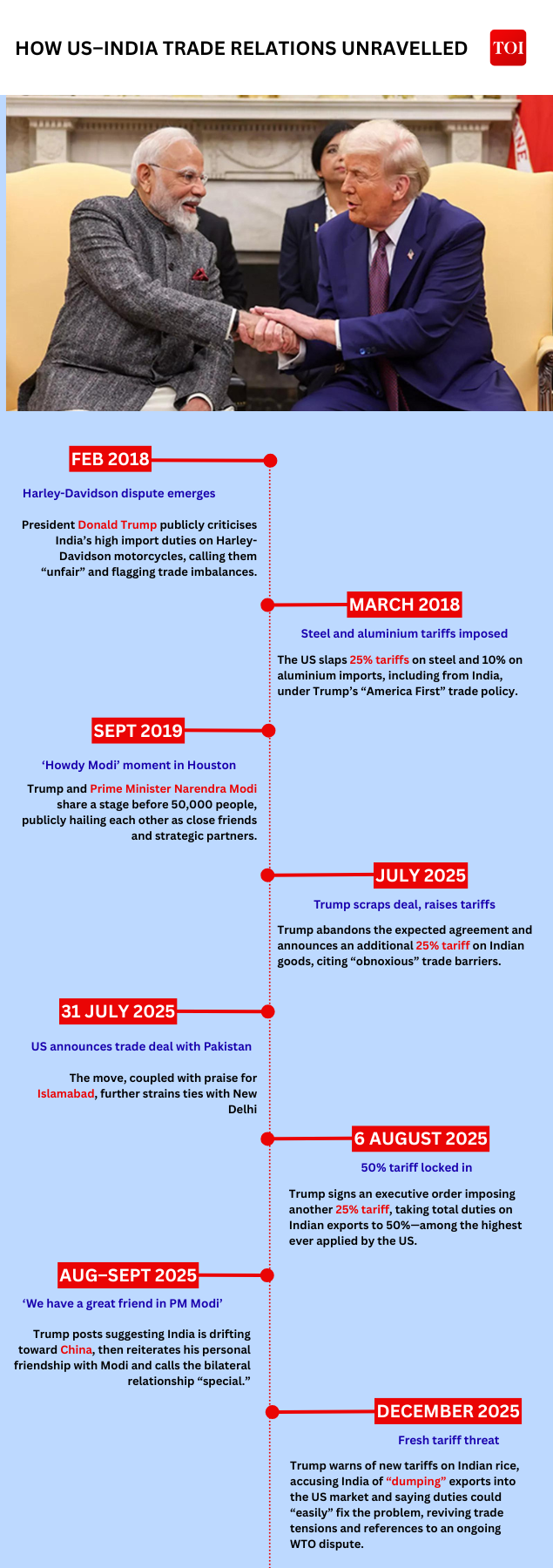
When the US went to the polls in 2024, many Indians watched closely. Some even prayed. After Trump returned to office on January 20, Prime Minister Narendra Modi made an early visit to the White House on February 12, signalling India’s intent to stabilise and strengthen ties. Talks of a bilateral trade deal followed, briefly reviving optimism.But that optimism quickly faded.The US administration’s failure to resolve the Russia–Ukraine war within its first 100 days—despite all the bold early promises—altered global equations. The India–US ties, too, had started fraying.From hugs to hostilityIt wasn’t always that way. Last September, Donald Trump and Narendra Modi stood before a screaming crowd of more than 50,000 at the “Howdy Modi” rally in Houston. Trump referred to India as a loyal friend. Modi lavished praise on Trump as a “true friend in the White House.” The chemistry seemed real. The optics were perfect.
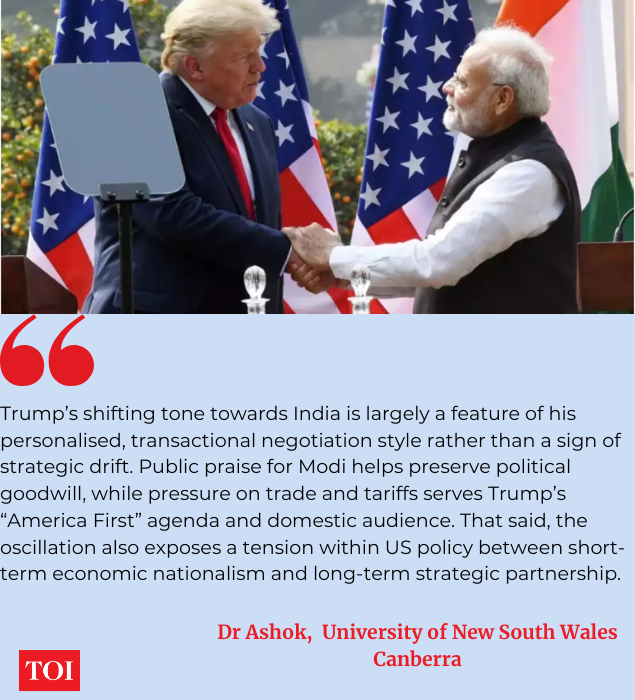
Six years on, that bonhomie seems a distant memory.By August 2025, the two countries were in a bruising trade war, with Washington slapping a staggering 50 per cent tariff on Indian exports. What transpired between those hugs in Texas and the hammer blows of tariffs is a sobering tale of ego clashes, hardening trade positions, and a friendship severely tested to survive realpolitik.The first cracksThe warning signs had flashed early. In 2018, Trump had publicly denounced India’s high import duties on Harley-Davidson motorcycles as “unfair.” Next came the “America First” tariffs-25 per cent on steel and 10 per cent on aluminium. Last March, India lost its preferential access under the US Generalised System of Preferences, affecting billions of dollars in exports.Then came another sensitive flashpoint—India and Pakistan.Trump had repeatedly claimed credit for a ceasefire between the two nuclear-armed neighbours, saying the US had mediated talks and urged both sides to focus on trade instead of war. The conflict had been triggered by an April 22 attack in Pahalgam, in which 26 civilians, mostly tourists were killed.On 10 May, Trump said he and the vice-president, JD Vance, had intervened to bring about an “immediate ceasefire.” Pakistan’s version of events kept shifting. India, however, was unequivocal.”PM Modi told President Trump clearly that during this period, there was no talk at any stage on subjects like India-U.S. trade deal or US mediation between India and Pakistan,” Indian Foreign Secretary Vikram Misri said.”Talks for cease of military action took place directly between India and Pakistan through established military channels and on the insistence of Pakistan. Prime Minister Modi underscored that India has never accepted mediation in the past and will never do.”Ego over economics?According to Prof Rajan Kumar of JNU, the connection of Trump’s behaviour with economics is very minimum.“Actually, but Trump’s tariff is not as much about economics or the benefit of United States policy as much as it is for the ego of President Trump,” he added.”The fact that he wanted to take the credit for the ceasefire between India and Pakistan, but India didn’t accept it… he was really, really upset with that.”Prof Rajan said, “His policies are essentially driven by MAGA-style loyalty politics, not by consistent diplomacy. And indeed, if you look at countries like China and Russia that have stood up to Trump, they seem to bear fewer consequences than those perceived as more vulnerable.He also argued that this was one of the reasons why the US seemed to be becoming amiable towards Pakistan once again.Dr. Ashok Kumar, employed at University of New South Wales Canberra at Australian Defence Force Academy, was more circumspect, saying Trump’s seesawing reflects a transactional negotiating style, rather than a complete strategic break. Public praise preserves goodwill, tariffs satisfy domestic politics. But the contradiction, he said, exposes deeper tensions within US foreign policy.
From 25 to 50 per centVery early into 2025, optimism did briefly revisit. Modi’s visit to Washington revived hopes for a big-ticket trade deal as ambitions to double bilateral trade to $500 billion by 2030 were floated. But on 30 July, Trump derailed the talks abruptly when he announced an additional 25 per cent tariff. Days later, he revealed a trade deal with Pakistan.On August 6, he signed an order raising tariffs on Indian exports to 50 per cent—placing India among the most heavily tariffed US partners in history.
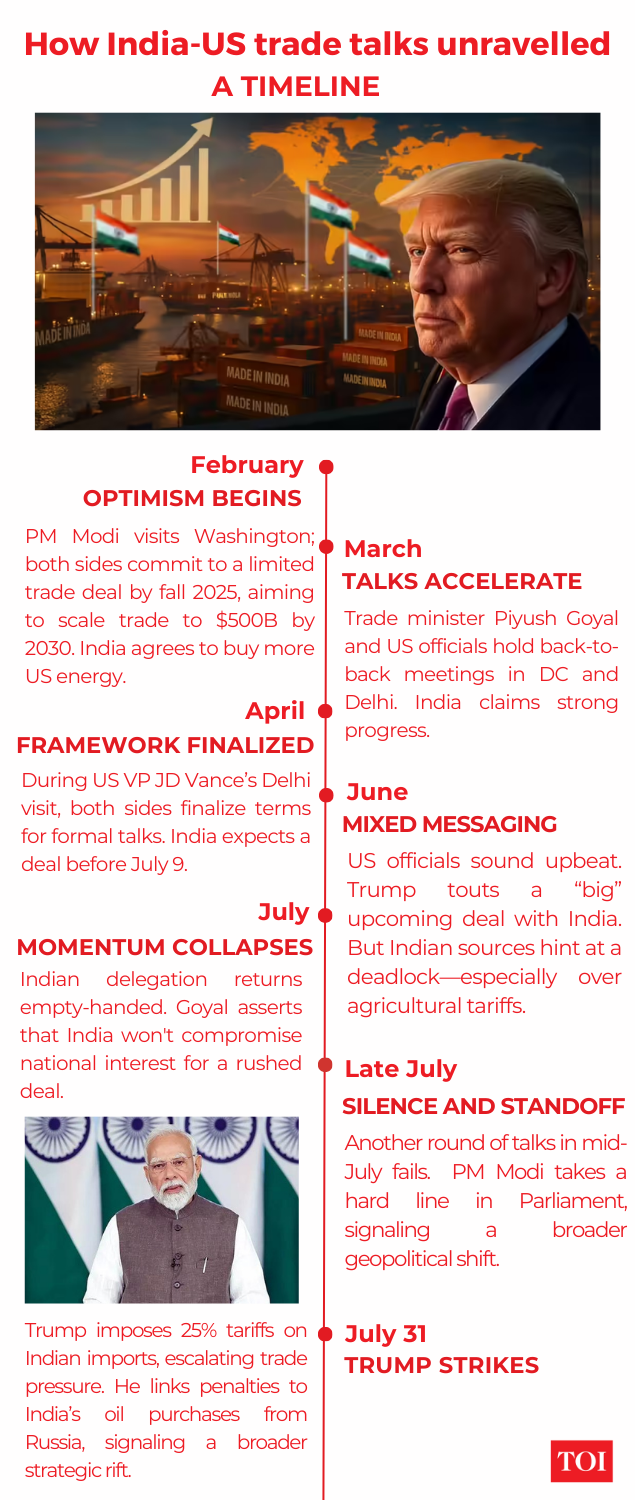
Mixed messages, rising uncertaintyOn September 5, US President Donald Trump dropped a cryptic message that set off fresh speculation about the future of India–US ties and the stalled trade negotiations between the two countries.In a post accompanying a photograph of Prime Minister Narendra Modi posing with Chinese President Xi Jinping and Russian President Vladimir Putin, Trump suggested Washington was losing ground to Beijing’s influence.”Looks like we’ve lost India and Russia to deepest, darkest, China. May they have a long and prosperous future together!” he said. The post came amid growing trade tension and the increasing frustration in Washington over India’s continued energy ties with Russia and unresolved tariff disputes.Needed, though: From various international sources, a worldwide release.Within a day of the above observation, Trump placed emphasis on how the India–US relationship was “special” and that the personal friendship he had with Prime Minister Modi was intact.Speaking at the Oval Office, Trump said, “I’ll always be friends with (Narendra) Modi… He’s a great prime minister. He’s great. But I just don’t like what he’s doing at this particular moment. But India and the United States have a special relationship. There’s nothing to worry about. We just have moments on occasion.” His comments came despite lingering tensions over tariffs and Indian purchases of Russian oil.Fresh tariff threats over Indian riceSince then, Trump has escalated the trade rhetoric, warning that additional tariffs could be placed on Indian rice imports. Accusing India of ‘dumping’ rice into the US market, Trump promised he would “take care” of the issue, insisting that tariffs could “easily resolve the problem.”The remarks came in a White House roundtable with representatives of the farming sector and senior cabinet officials, including Treasury Secretary Scott Bessent and Agriculture Secretary Brooke Rollins. During the same event, Trump announced a $12-billion federal aid package for American farmers.Throughout the conversation, Trump presses Bessent on India’s trade practices. “India, tell me about India. Why is India allowed to do that? They gotta pay tariffs. Do they have an exemption on rice? When told, “No sir, we’re still working on their trade deal”, Trump responded, “But they shouldn’t be dumping. I mean, I heard that. I heard that from others. They can’t do that.”It triggered references to an ongoing World Trade Organisation case involving India.‘We have a great friend in PM Modi’Meanwhile, Trump has consistently praised Modi in public, and reassured India of its strategic relevance to Washington despite the sharp trade rhetoric.The US Embassy in India on Tuesday quoted Trump as saying on X: “India is home to one of the world’s oldest civilizations. It is an amazing country, and a very important strategic partner for America in the Indo-Pacific region. We have a great friend in PM Modi.” A statement from the ministry stated that the visit was a follow-up to the recent phone conversation between Modi and Trump, during which the two leaders reviewed bilateral relations besides discussing regional and global developments. The call came soon after Modi’s summit with Russian President Vladimir Putin and amidst renewed international efforts to end the Russia–Ukraine war through an expanded peace plan proposed by Trump.Trade negotiations also featured in the discussion, including US demands for India to allow greater access to its markets for agricultural produce including corn and soybean. Modi later characterized the discussion as “warm and engaging,” adding that both sides had reviewed the steady progress being achieved in ties and reaffirmed cooperation for global peace and prosperity.
Strategic imperatives, political uneaseEven as public messaging oscillates, several US lawmakers have cautioned that Trump’s policies risk straining ties with India at a time when Washington increasingly views New Delhi as a vital counterweight to China.Speaking to The Times of India, Vivek Mishra, Deputy Director of the Strategic Studies Programme at the Observer Research Foundation, underlined why India remains indispensable to US strategy.”Partners like India are therefore indispensable. But this strategic logic is now constrained by a resurgent nationalist imagination within the United States – one that questions America’s role as a global policeman and is deeply sceptical of complex, multi-aligned partnerships. India’s ties with Russia sit uncomfortably within this worldview. From Washington’s perspective, the contradiction is managed rhetorically rather than resolved strategically: India is expected to act as a counterweight to China while simultaneously being pressured to align more closely with US preferences,” Mishra said.”This tension reflects a broader uncertainty in US foreign policy-between realism, which acknowledges India’s strategic autonomy, and ideological nationalism, which demands clearer lines of allegiance,” he added.US elections and the immigration factorWith the US edging closer to another election cycle, immigration is slowly emerging as a point of political confrontation. The harshest criticism has been directed at Trump, whose name is already being bruited about as one of those likely to join the fray.Prof Rajan told The Times of India that anti-immigration sentiment is gathering steam across Western democracies.”And, you know, today only one scholar was saying Trump might go, but Trumpism will remain. So we’ve seen in the first administration also. Trump in his first administration imposed some tariffs, and Biden continued with those tariffs which he didn’t remove when he came to power,” he said.He added that the supremacy of America in the world is crumbling, providing fertile soil for blame politics.”And the easiest target in this situation becomes the immigrant… And Trump’s policy of nationalism, economic protectionism, etc, will continue,” Prof Rajan said.He further alleged that Trump pursues a policy of creating a white-dominant Western hemisphere and seeks control over territories from Greenland to Latin America.Tough talk vs diaspora politicsDr Ashok said Trump’s statements are carefully calibrated to appeal to his conservative base.”His remarks continue to underscore his brand as a prime minister who can wrest concessions from his partners. But they also risk offending the Indian-American diaspora, that has grown politically influential and generally prefers stable respectful bilateral relations. The interplay between domestic posturing and diaspora sensitivities remains a delicate balance,” he said.While Mishra said the Trump administration has softened overt rhetoric against India, its approach nonetheless remains transactional. The Indian-American community, he said, has limited room to openly push back in the political climate where support for foreign partnerships is easily labelled anti-American.”This is compounded by an ongoing debate within the United States about national identity-what it means to be American,” he said, citing that Indian-Americans are often torn between ethnic pride, strategic alignment, and domestic loyalty.C5 and a fragile hopeThere have been various reports that Trump is considering a new ‘C5’ grouping—comprising the US, Russia, China, India, and Japan—that could eventually displace the G7. Dr Ashok believes the idea reflects Washington’s recognition of India’s rising global stature.”The concept of a ‘C5′ group signals that Washington sees India as much more than a regional power, and increasingly as a pivot for a rebalanced international order. It shows US acknowledgment of India’s economic heft, demographic size, and strategic independence,” he said.Meanwhile, Mishra added, this is not radically different from earlier strategic imaginations that began at the turn of the century; this is simply a reassertion of those ideas. The implicit assumption herein is that a small cabal of major economies must come together in order to maintain order and stability in the global financial and strategic system.” What distinguishes the idea of a C5, however, is that it implicitly attempts to manage the growing distance between Russia and China, with the United States positioning itself as a central balancer. In the aftermath of the Russia-Ukraine war, which the Trump administration has sought to resolve or at least contain, these structural divergences between the US and China, and between the US and Russia, are unlikely to disappear any time soon. The C5 does not magically bridge these gaps; rather, its effectiveness would remain contingent upon the bilateral dynamics among these powers,” he said.”For India, however, the significance is clear: the very articulation of such a grouping suggests that the United States increasingly views India as a pillar of the next global order-one that deserves a seat at the high table, whether in the UN system or in shaping the political and economic architecture of the coming decades.”The C5 represents a broader and more ambitious conception of India’s role, extending well beyond regional balancing, compared to the Indo-Pacific framework, he further said.For now, India–US ties stay impossibly unpredictable–caught between strategic compulsion and political turbulence. Yet, beneath the noise, there is cautious optimism that both sides may still find a way to steady and strengthen the partnership. Go to Source