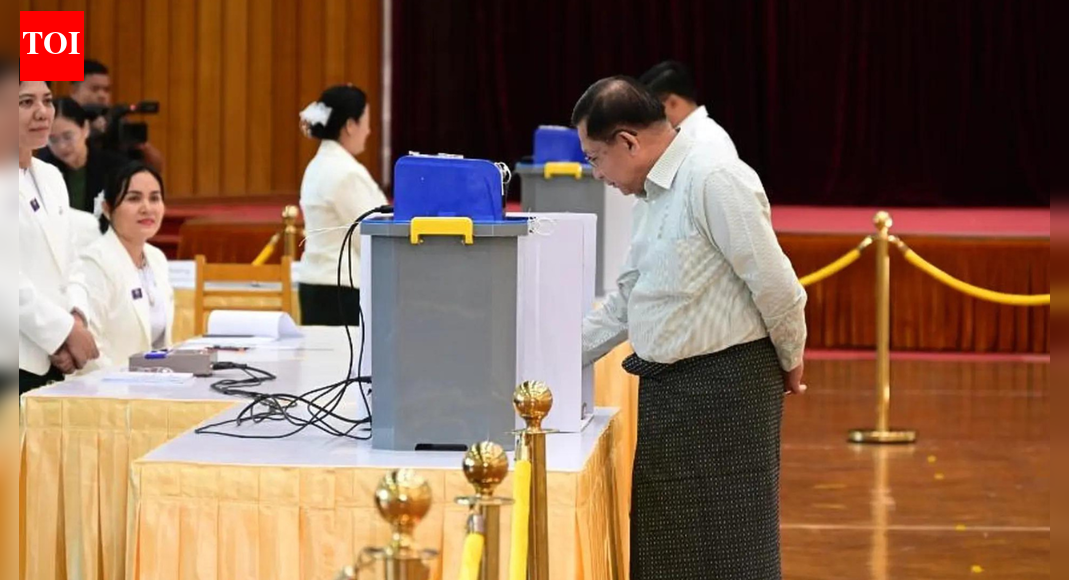


Myanmar has begun voting in its first general election since the military seized power in a coup in February 2021, an event the ruling junta presents as a return to democratic order after years of turmoil. Polling started on December 28 in the first of three phases and will run through January, even as a brutal civil war continues across large parts of the country.For the generals, the election is meant to signal stability and provide a pathway out of diplomatic isolation. For critics, including Western governments, the United Nations and rights groups, it is something else entirely: a tightly controlled exercise designed to entrench military power behind a civilian façade. With major parties banned, opposition leaders jailed, and millions unable to vote, the ballot has become one of the most contentious political moments in Myanmar’s modern history.
A vote held amid war and fragmentation
The election is taking place nearly five years after the army, known as the Tatmadaw, overturned the landslide 2020 victory of Aung San Suu Kyi’s National League for Democracy (NLD), alleging fraud without credible evidence. The coup triggered mass protests, a violent military crackdown, and the emergence of armed resistance groups aligned with ethnic minority militias. The conflict has since displaced more than 3.6 million people and left over 11 million facing food insecurity, according to UN agencies.Against this backdrop, voting is being held only in areas under junta control. The military has acknowledged that elections cannot take place in at least 56 of Myanmar’s 330 townships, many of them in rebel-held regions. Even within townships that are voting, entire constituencies have been cancelled on security grounds, leaving nearly one in five seats in the lower house uncontested.The poll itself is staggered across three dates — 28 December, 11 January and 25 January — a structure critics say allows the authorities to adjust tactics as results come in.
Who is running — and who is missing
On paper, 57 political parties and more than 4,800 candidates are contesting the elections. In reality, the field is heavily skewed. Only six parties have been allowed to compete nationwide under tightened registration rules. The largest and most dominant is the military-backed Union Solidarity and Development Party (USDP), which is effectively running unchallenged in dozens of constituencies.The absence of Aung San Suu Kyi and her party looms over the process. The NLD, which won around 90 per cent of parliamentary seats in 2020, was dissolved after refusing to re-register under rules imposed by a junta-appointed election commission. Suu Kyi herself remains in military detention, serving a 27-year sentence on charges widely described by rights groups as politically motivated.According to the Asian Network for Free Elections (ANFREL), parties that collectively won more than 70 per cent of votes and 90 per cent of seats in the last election will not appear on the ballot this time. More than 22,000 political prisoners remain behind bars, further hollowing out any sense of political competition.
How the system favours the military
Even if the election were competitive, Myanmar’s political system is designed to preserve military dominance. Under the army-drafted 2008 constitution, 25 per cent of parliamentary seats are reserved for serving officers, giving the military an effective veto over constitutional change.Seats are allocated using a mix of first-past-the-post and proportional representation, a system election monitors say favours large, well-resourced parties like the USDP. New electronic voting machines, introduced for the first time, do not allow write-in candidates or spoiled ballots, limiting voter choice further.Once parliament is formed, the president is chosen indirectly. Lawmakers from the lower house, upper house and the military bloc each nominate a vice-president, with the full assembly then selecting the president from among the three. The structure all but guarantees that the armed forces will retain decisive influence regardless of the outcome.
Repression, restrictions and a climate of fear
The run-up to the vote has been marked by widespread repression. The Union Election Commission overseeing the polls is staffed by junta appointees, including its chairman Than Soe, who is under EU sanctions for undermining democracy. Independent election observation is minimal, with most Western governments refusing to send monitors.A new Election Protection Law has criminalised protest, criticism or alleged “disruption” of the poll, carrying penalties of up to ten years in prison, and in some cases the death penalty. More than 200 people have been charged under the law, including artists, filmmakers and social media users accused of opposing the elections. Even private online messages have been used as evidence.Social media platforms such as Facebook and Instagram have remained blocked since the coup, sharply curtailing political debate. Campaigning has been muted, with none of the mass rallies that once defined Myanmar’s elections.
Why the election still matters
Despite the restrictions, the election carries real consequences. For the junta, it is a bid to rebrand military rule as a quasi-civilian government and persuade regional neighbours to re-engage. China, Myanmar’s most powerful ally, has backed the vote, viewing it as a potential route to stability and protection for its strategic infrastructure projects. Russia and, more cautiously, India have also signalled acceptance.Western governments have taken a different view. The UK, the European Parliament and the UN have dismissed the poll as lacking legitimacy. UN human rights chief Volker Türk has warned that the elections are taking place in an environment of “violence and repression”, with no conditions for free expression or assembly.Inside Myanmar, reactions are mixed. Some voters, exhausted by years of war and economic collapse, see the election as offering at least the promise of order. Others reject it outright as a dangerous illusion. As one resistance fighter put it, holding elections now is like “injecting steroids into a patient” — easing pain briefly while worsening the disease. Go to Source