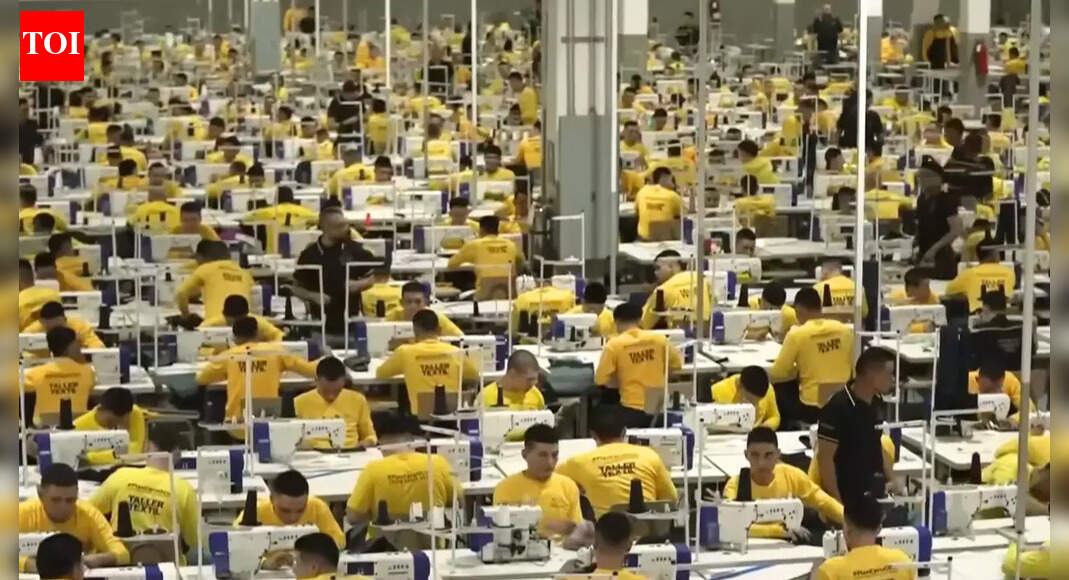

Inside one of El Salvador’s sprawling prison complexes, rows of sewing machines operate in day and night shifts. Inmates produce clothing for public institutions as part of a state-backed prison labour programme that expanded in early 2025. The initiative, promoted by the administration of Nayib Bukele, is presented by officials as a way to make prisons more functional while offering inmates structured work, basic training and the possibility of sentence reductions. Supporters describe the programme as a practical attempt to introduce routine and skills into a system long shaped by overcrowding and instability.
How the prison factory works
Thousands of inmates rotate through continuous shifts, producing uniforms for police, soldiers and other public workers. The workshops operate under strict supervision, with clearly defined roles and set schedules. Participation in the programme allows inmates to earn sentence credits, although authorities have not publicly outlined a single standard formula for how those reductions are calculated.Social media posts and some local reporting have claimed that each day an inmate works can count as two days off a sentence. While Salvadoran authorities have confirmed that prison labour can reduce time served, they have not publicly verified a fixed two-for-one formula, leaving the precise mechanics of sentence credits unclear. The factory system has expanded alongside the rapid growth of El Salvador’s prison population following the government’s crackdown on gangs. Newly built mega-prisons now house tens of thousands of detainees, and prison labour has grown with that expansion. Textile workshops are one part of a broader system that also includes construction and maintenance work carried out inside and outside prison facilities.The prison factory programme is also designed to reduce government spending by producing uniforms in-house rather than outsourcing them. By supplying clothing for public institutions directly from prison workshops, the state aims to cut procurement costs and reduce reliance on private contractors. Supporters argue this approach allows the prison system to offset some of its operating expenses while keeping inmates engaged in structured work.
Public reaction and wider interest
Videos filmed inside the workshops and shared online have drawn significant attention. Many viewers have expressed cautious admiration for the order and organisation on display, while others have focused on the potential of work-based programmes to reduce repeat offending. Some commentators abroad have suggested that similar models, if carefully regulated, could play a role in prison reform elsewhere.