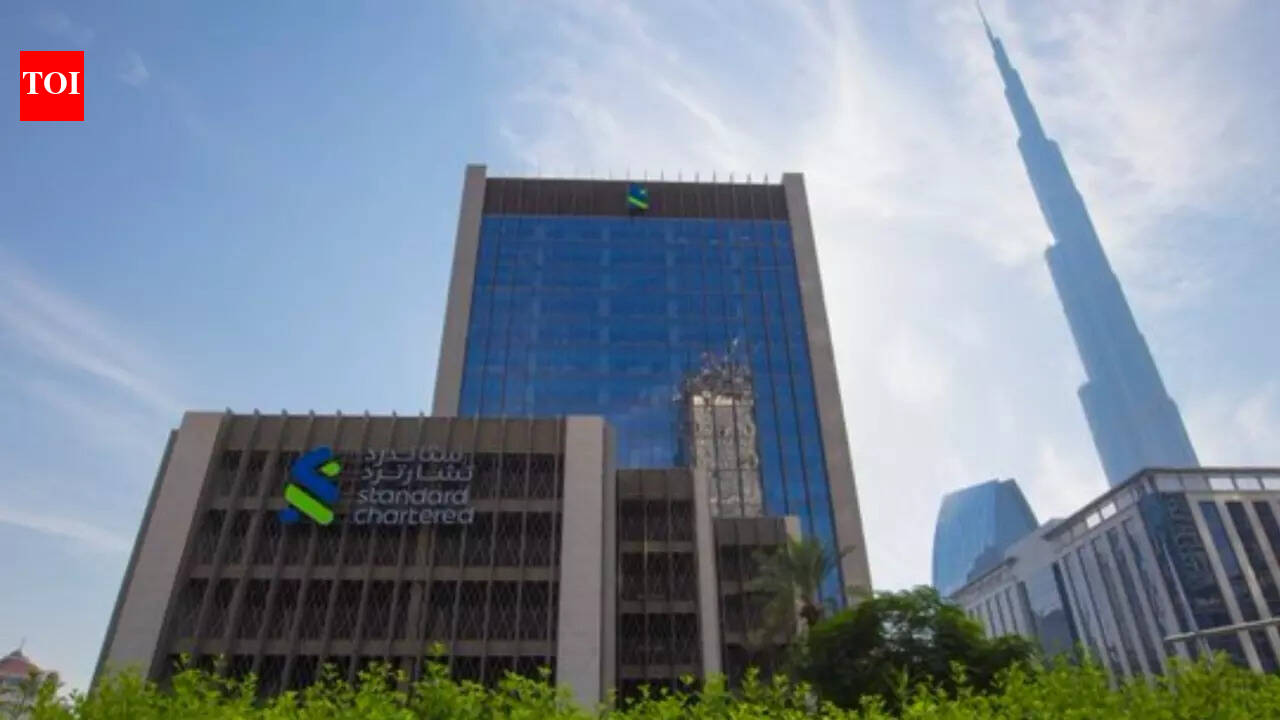


Did Banks Start Leaving Dubai? Standard Chartered Issues Urgent Statement Amid Iran vs US-Israel War
The intensifying geopolitical conflict between Iran, the United States and Israel is beginning to ripple through global financial markets, prompting international banks to reassess operations in the Gulf. At the center of the latest developments is Standard Chartered, which has moved to clarify reports suggesting that it evacuated staff from its offices in Dubai.The London-headquartered bank said that reports of a full evacuation of its Dubai offices were inaccurate. Instead, the bank confirmed that it had extended a precautionary work-from-home arrangement already in place, emphasising that its regional operations remain active and business continuity measures are functioning normally.
Israel Iran War
The clarification came after multiple international media reports suggested that several global financial institutions were evacuating offices in the emirate amid rising security concerns linked to the ongoing Iran vs US-Israel war.
Rumours of evacuations spread across the banking sector in Dubai amid Iran vs US-Israel war
Earlier reports indicated that some international banks had begun moving employees out of physical offices in Dubai following warnings from Iranian officials that economic and financial targets associated with the US and Israel could become potential targets in the conflict. These warnings came after an attack on a Tehran administrative building linked to Bank Sepah, one of Iran’s major state-owned banks historically tied to military networks.Iranian officials subsequently warned that economic infrastructure connected to US and Israeli interests in the region could face retaliation. As a result, financial institutions operating in the Gulf began activating contingency plans designed to protect employees and maintain operations even if the security environment deteriorates. Several banks reportedly advised staff to temporarily work remotely or avoid office buildings in major financial districts. However, Standard Chartered moved quickly to clarify that these steps were precautionary rather than emergency evacuations.
Work-from-home arrangements extended amid Iran vs US-Israel war
According to the bank’s statement, employees in Dubai and the wider Middle East had already been operating under a flexible remote-working framework introduced during the early stages of the regional crisis. The extension of the arrangement was therefore described as a safety measure rather than a response to any specific threat to the bank’s facilities.Standard Chartered also stressed that its operations in the Gulf remain fully functional and that the UAE continues to be a key market for the bank’s global strategy. The clarification aims to reassure clients and investors that the institution’s regional presence remains stable despite the volatile geopolitical environment.
Why Dubai matters to global banks
Dubai has become one of the most important financial hubs in the Middle East over the past two decades, attracting global banks, investment firms, hedge funds, and wealth managers. Much of this growth has been driven by the rise of the Dubai International Financial Centre, often referred to as DIFC.Established in 2004, the DIFC has transformed Dubai into a regional financial powerhouse. By the end of 2025, the district hosted more than 290 banks, over 100 hedge funds, around 500 wealth management firms and more than 1,200 family offices and related entities. For international lenders like Standard Chartered, the UAE plays a strategic role in connecting markets across Asia, Africa and the Middle East. The bank generates a significant share of its income from operations in the region and has placed several senior executives in Dubai to oversee regional business expansion.
Wider corporate precautions across the Gulf amid Iran vs US-Israel war
Standard Chartered is not alone in implementing precautionary measures. Other international firms and financial institutions have also taken steps to protect staff as the regional conflict escalates. Some companies have instructed employees to work remotely, while others have allowed staff to temporarily relocate outside the region.Meanwhile, several global banks have reviewed business continuity plans to ensure operations can continue even if physical offices become inaccessible. In some cases, banks temporarily closed branches or limited on-site operations while shifting services to digital platforms. These measures highlight the increasing sensitivity of multinational corporations to geopolitical risk in the Middle East.The current crisis stems from the escalating confrontation between Iran and the U.S.–Israel alliance, which has triggered missile strikes, drone attacks, and military exchanges across the region. The conflict has already disrupted aviation routes, shipping lanes, and energy markets. Financial institutions, particularly those with large regional operations, have therefore been closely monitoring the situation to ensure the safety of employees and clients. Analysts say such precautionary measures are common during periods of geopolitical instability and do not necessarily indicate an imminent withdrawal of investment. Nevertheless, the situation has sparked concerns about how prolonged instability could affect Dubai’s reputation as a stable global financial hub.
Dubai’s safe-haven status under scrutiny amid Iran vs US-Israel
For years, Dubai has marketed itself as one of the safest and most business-friendly environments in the Middle East. Its political stability, world-class infrastructure and international regulatory frameworks have attracted hundreds of multinational firms. However, regional conflict has occasionally tested that reputation.Reports suggesting that global banks were evacuating offices sparked debate over whether geopolitical tensions could undermine the city’s status as a safe haven for global finance. Experts note that while short-term precautionary measures are common, the long-term fundamentals that support Dubai’s financial ecosystem remain strong.As the Iran vs US-Israel war continues to evolve, multinational corporations operating across the Gulf are likely to maintain heightened security protocols. Remote work policies, contingency planning, and staff relocation options are expected to remain part of corporate strategies until the geopolitical outlook stabilises.For now, Standard Chartered’s clarification highlights an important distinction: precautionary measures should not necessarily be interpreted as a corporate retreat from the region. Instead, they reflect the careful balancing act global companies must perform when operating in a region facing sudden geopolitical shocks. Despite the uncertainty, Dubai’s financial sector continues to function and major institutions remain committed to maintaining operations while prioritising the safety of employees. Go to Source