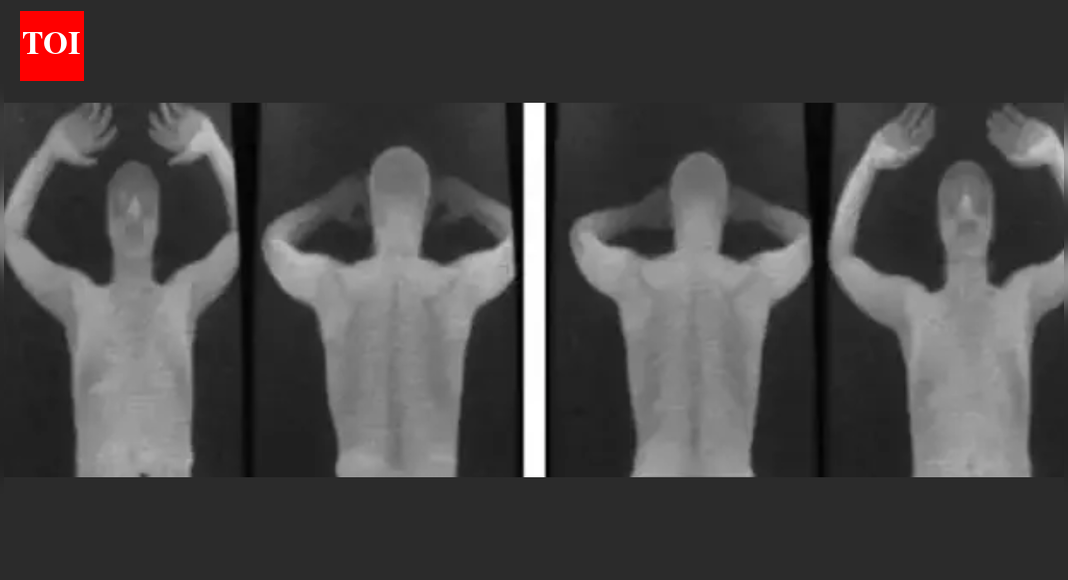

Old airport security used Rapiscan backscatter scanners that showed fully detailed body images/ image:X
If you’ve ever shuffled through an airport body scanner wondering how much the machine can actually see, you’re not alone. For a while, the answer was: far more than most travellers realised. And that’s exactly why the technology had to change.
When airport scanners really did see everything
In the early 2010s, US airports rolled out Rapiscan X-ray body scanners after the 2009 Christmas Day bombing attempt, when Umar Farouk Abdulmutallab tried to detonate explosives hidden in his underwear on a flight from Amsterdam to Detroit. The US Transportation Security Administration (TSA) responded by installing 174 of these machines in 30 airports, at around $180,000 each. Similar scanners appeared in UK airports. They quickly picked up a nickname: “virtual strip searches.” Images said to come from those early scanners went viral because they were so explicit: highly detailed outlines of completely naked bodies, right down to personal anatomy. Communication researcher Shawna Malvini Redden, PhD, who has studied the TSA since 2010 and wrote 101 Pat-Downs, confirmed to Reader’s Digest what those images showed. “Early versions of the scanners came out without any privacy protections, and TSOs in the checkpoint could be looking at naked images of passengers as they went through the screening,” she said. Even though the officer looking at the screen was often in a separate room, away from the checkpoint, they could see under passengers’ clothing. A remote officer would then radio to colleagues at the lane where on the body to search. For many travellers, that crossed a line.Public anger didn’t take long to build. At the time, privacy advocates condemned the scanners as intrusive “virtual strip searches”, and health experts raised questions about repeated radiation exposure. When images allegedly pulled from the machines later resurfaced online, a new wave of commentary followed, with today’s social media users joking that the scans looked more suited to OnlyFans than airport security. The combination of privacy concerns, mounting criticism and technical shortcomings eventually pushed the TSA to remove the backscatter X-ray machines from US airports in 2013.
What replaced them – and how they work
Airports didn’t ditch body scanning altogether, they just swapped out the controversial machines for something far less invasive. Modern checkpoints now use millimetre-wave scanners with what’s known as Advanced Imaging Technology (AIT), the standard kit you step into at almost every major airport today.“Body scanners use a technology called Advanced Imaging Technology (AIT) for full-body scans at airport checkpoints,” TSA spokesperson R. Carter Langston explained to Reader’s Digest. “It’s a millimeter-wave scanner that detects a wide range of metallic and nonmetallic threats in a matter of seconds.” The key change isn’t just the type of waves used. It’s what appears on the screen. Modern scanners do not show a photo-real image of your body. “The body scanners provide a nondescript avatar image of the human anatomy,” said Eri Jenkins, a former TSA checkpoint officer now working as an advisor. “Images reveal items that might be on skin or inside clothing.” Instead of a detailed body, the machine generates a generic “paper doll” or “gingerbread man” outline. That avatar is used “to ensure passenger privacy while maintaining security effectiveness,” Langston explained.
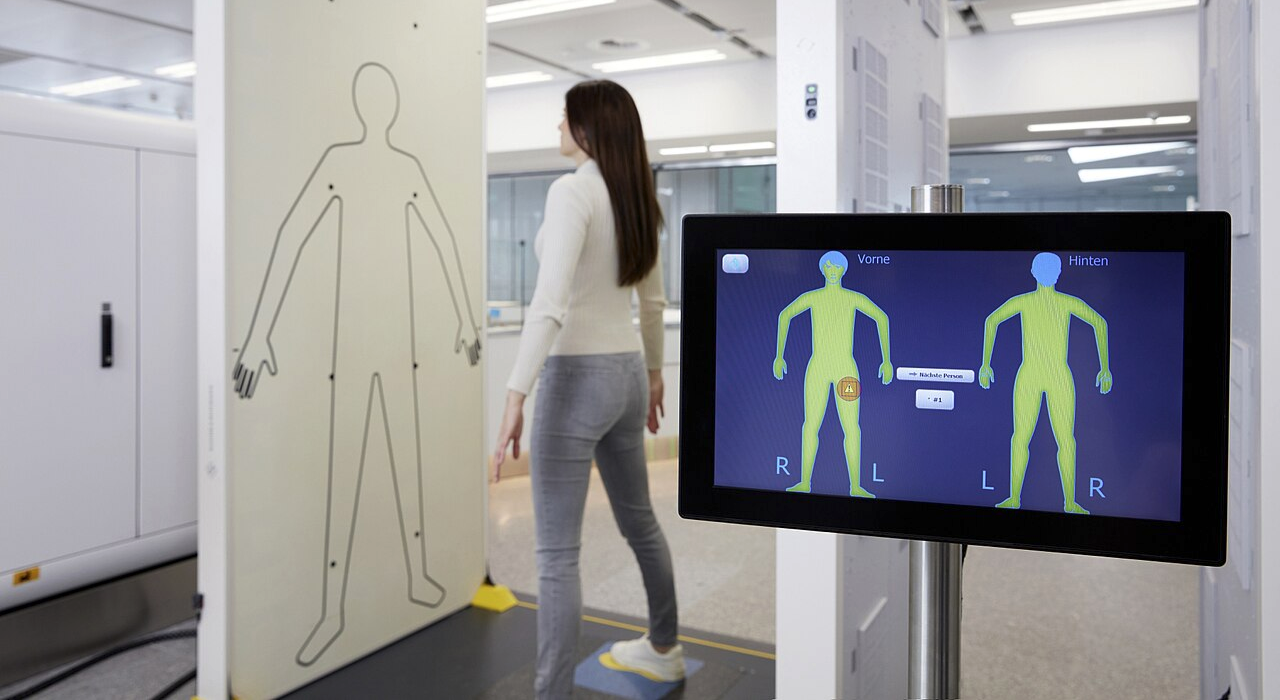
Millimeter wave scanner machines are generate generic images of a body instead of the passenger’s unique image/ Wikipedia
If the machine doesn’t detect anything, officers don’t see your outline at all, just a screen that reads “OK”. If it flags something, a box appears on the avatar to show where officers should check. “With millimeter wave machines that have the privacy software installed, TSOs are only seeing this outline with a green ‘clear’ or a red ‘stop and check’ signal,” Malvini Redden said. “If someone has something in their pockets, for instance, the machine will put an alarm note in the paper doll’s groin region so the officer knows generally where to search.” You’re not shut out of the process either. “Passengers are able to see the viewing monitor throughout the process,” Jenkins noted. You see what they see.
So… can they still see you naked?
Short answer: no, not anymore. Those older backscatter X-ray machines that produced near-nude images were removed from checkpoints in 2013. “This technology has since been replaced, and an avatar ensures privacy for all passengers,” Jenkins said.Today’s millimetre-wave scanners bear almost no resemblance to their early, intrusive predecessors. They don’t reveal private anatomy, they don’t map the contours of your body, and they don’t capture anything resembling height, weight or shape. Instead, the machine produces a neutral, paper-doll-style avatar, flagging only the area where something in a pocket or under clothing has triggered an alarm. “Now when passengers are scanned, the machines are supposed to generate generic images of a body instead of the passenger’s unique image,” Malvini Redden said. The focus is on what you’re carrying, not what you look like. If the electromagnetic waves hit something that seems suspicious, a TSA officer will check further. If not, you walk straight through without a pat-down.
Why people are shocked now
Clips and images from the old scanners still circulate online, often without context. Travellers who never encountered that era of airport security are only now discovering what those machines showed, and reacting with horror. “Wait when you walk through the airport security scanner thing do the tsa agents see you naked???!!?!! I should have been flexing!!!!!!!!” one person joked on X after learning about the early tech. Another admitted, “I thought X-ray meant you could only see bones.” The reality is more nuanced. Yes, there was a brief period when officers could see near-naked outlines of passengers. That sparked enough outrage, and enough serious privacy questions, that the machines were scrapped. Now, scanners are blunter tools: they spot objects, mark a generic avatar, and tell officers where to check. You still have to empty your pockets and stand with your arms over your head. You still might get pulled aside if you forget a coin or a tissue. But you don’t have to assume that every walk through the scanner is turning into an anatomy lesson for the person on the other side of the screen. Go to Source