
Thursday, February 19, 2026
25.1 C
New Delhi

Deep beneath the Red Sea, the Gulf of Aqaba hides a toxic ‘ocean within an ocean’ where life cannot survive

Deep beneath the Red Sea, the Gulf of Aqaba hides a toxic ‘ocean within an ocean’ where life cannot survive

Deep beneath the Red Sea, the Gulf of Aqaba hides a toxic ‘ocean within an ocean’ where life cannot survive (Image Source – Communications Earth & Environment )

The surface of the Gulf of Aqaba appears calm for most of the year, with little to suggest what sits far below. Nearly 1,800 metres down, researchers have identified a dense pool of highly saline water resting on the seafloor, separated from the surrounding Red Sea. The feature, known as the NEOM brine pools, covers roughly 10,000 square metres, with three smaller pools nearby. Scientists say the water inside is several times saltier than normal seawater and contains almost no oxygen. Because of its weight, the brine remains trapped in a basin, forming what researchers describe as an isolated underwater lake. The discovery adds to growing interest in deep sea brine pools and their role in preserving environmental records in tectonically active regions.

NEOM brine pools form a separate layer on the seafloor of Gulf of Aqaba

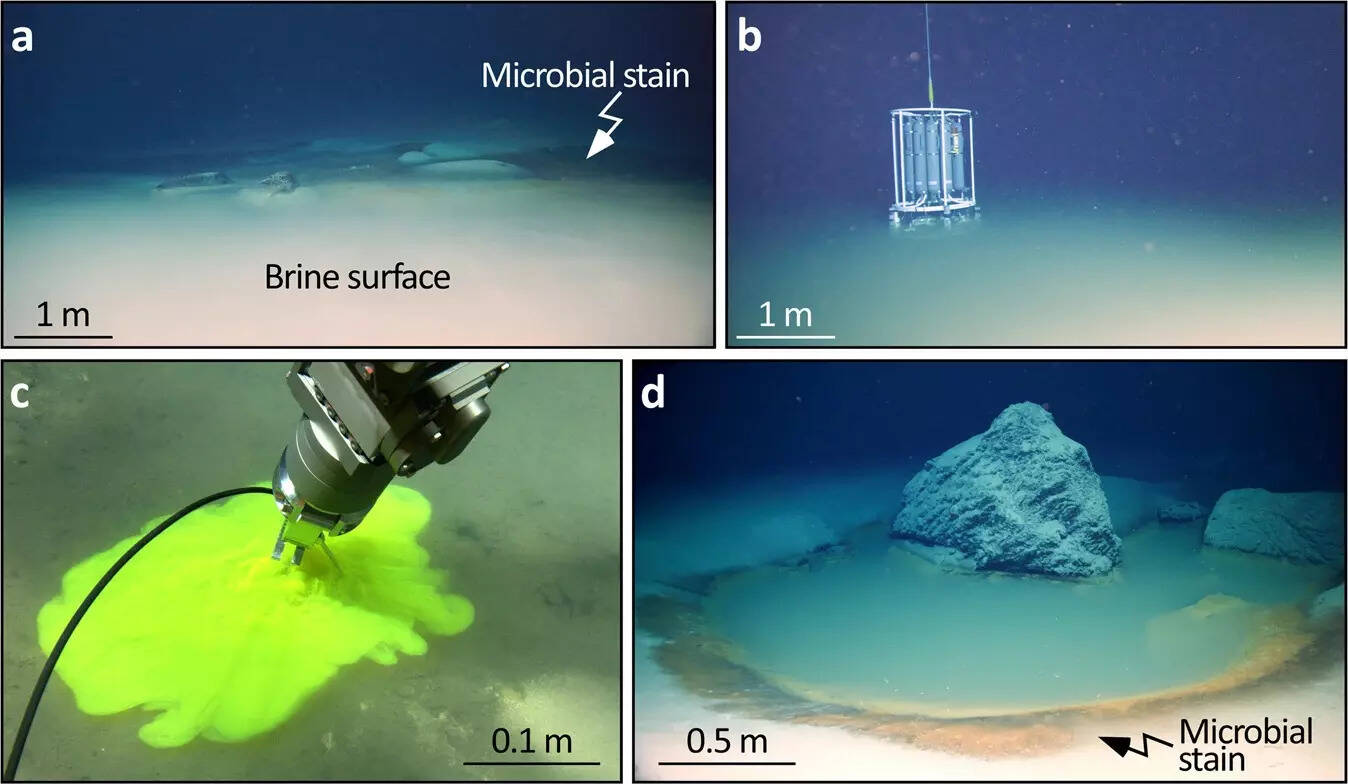
The NEOM brine pools were mapped using remotely operated vehicles working at depth in the northern Red Sea. Video and sampling show a clear boundary between normal seawater and the darker, denser brine below. Salinity levels are estimated to be around four times higher than typical seawater. Oxygen is largely absent. Marine animals that stray into the pool appear disoriented and do not remain there for long. The water does not mix easily, so the basin acts as a contained body within the larger sea.

Life holds at the margins rather than inside

According to the study, “Discovery of the deep-sea NEOM Brine Pools in the Gulf of Aqaba, Red Sea”, the centre of the pool is mostly empty of larger marine life. Conditions are too extreme. Animals that drift too far in appear stunned. At the edges, though, there is activity. Microbes cluster along the thin boundary where oxygenated seawater meets the brine. The chemistry shifts across just a short distance. Bacteria adapted to high salinity seem to thrive there. Small crustaceans have been seen feeding in that narrow strip.Researchers interested in extremophiles pay attention to such places. The environment is harsh but not entirely sterile. It resembles conditions that might have existed in older oceans. That comparison is cautious, not exact.
NEOM brine pools form a separate layer on the seafloor of Gulf of Aqaba

NEOM brine pools form a separate layer on the seafloor of Gulf of Aqaba (Image Source – Communications Earth & Environment, Nature)

Sediment remains undisturbed in the absence of oxygen

Below the brine, the seabed looks layered and quiet. In most marine settings, worms and other organisms churn through mud and sand. Here, little moves. The lack of oxygen limits disturbance. Microbial communities appear concentrated along the boundary where normal seawater meets the brine. This narrow zone supports specialised bacteria adapted to low oxygen and high salinity. Small crustaceans and shell-forming organisms have also been observed nearby, feeding on microbial growth.Scientists studying extremophile microbes see these habitats as useful analogues for early Earth conditions. Cores taken from the bottom show thin bands of sediment stacked over time. The record may reach back around 1,200 years, though dating is still being refined. Some layers are thicker, composed of sand washed in from sudden floods or underwater landslides.


Go to Source

Hot this week

‘Just bed and toilet’: No royal privileges for arrested ex-prince Andrew Mountbatten-Windsor

Britain’s former prince Andrew Mountbatten-Windsor, arrested on suspicion of misconduct in public office, will receive no special treatment in custody and can legally be held for up to 96 hours, according to experts cited by the BBC. Read More

Britain’s ex-prince Andrew Mountbatten-Windsor arrested over misconduct amid Epstein row

Britain’s ex-Prince Andrew Mountbatten-Windsor has been arrested on suspicion of misconduct in public office, the BBC reported, marking the first time the Duke of York has been detained in connection with allegations linked to his pub Read More

Who is Nick Fuentes, the ‘white nationalist’ provocateur even MAGA won’t touch?

Nick Fuentes is a 27-year-old far-right provocateur, livestreamer, and ‘Groypers’ leader courting controversy online. Read More

These 5 Common Cooking Oils Could Be Slowly Damaging Your Heart; Here’s What The Study Reveals

Many common cooking oils, including sunflower, corn, and more can produce toxic compounds when overheated or reused, increasing risks of inflammation, heart disease, and cancer. Read More

Bengaluru Doctor Waits 10 Years, Moves High Court To Donate Kidney To A Stranger

She wanted to donate a kidney to anyone who needed it. No relative, no friend, no emotional bond. Just a stranger whose life might continue because of her choice. Read More

Topics

‘Just bed and toilet’: No royal privileges for arrested ex-prince Andrew Mountbatten-Windsor

Britain’s former prince Andrew Mountbatten-Windsor, arrested on suspicion of misconduct in public office, will receive no special treatment in custody and can legally be held for up to 96 hours, according to experts cited by the BBC. Read More

Britain’s ex-prince Andrew Mountbatten-Windsor arrested over misconduct amid Epstein row

Britain’s ex-Prince Andrew Mountbatten-Windsor has been arrested on suspicion of misconduct in public office, the BBC reported, marking the first time the Duke of York has been detained in connection with allegations linked to his pub Read More

Who is Nick Fuentes, the ‘white nationalist’ provocateur even MAGA won’t touch?

Nick Fuentes is a 27-year-old far-right provocateur, livestreamer, and ‘Groypers’ leader courting controversy online. Read More

These 5 Common Cooking Oils Could Be Slowly Damaging Your Heart; Here’s What The Study Reveals

Many common cooking oils, including sunflower, corn, and more can produce toxic compounds when overheated or reused, increasing risks of inflammation, heart disease, and cancer. Read More

Bengaluru Doctor Waits 10 Years, Moves High Court To Donate Kidney To A Stranger

She wanted to donate a kidney to anyone who needed it. No relative, no friend, no emotional bond. Just a stranger whose life might continue because of her choice. Read More

‘Was Sort Of Confused’: OpenAI’s Altman On Awkward Moment With Anthropic’s Amodei At AI Summit

Altman and Amodei, standing next to each other, contemplated for a few seconds whether they wanted to hold hands. Read More

ABP Live Doc Talk | Glaucoma Explained: Silent Thief Of Sight And How To Protect Your Vision

Show Quick Read Key points generated by AI, verified by newsroom Glaucoma is often called the “silent thief of sight”, and for good reason. Read More

Related Articles