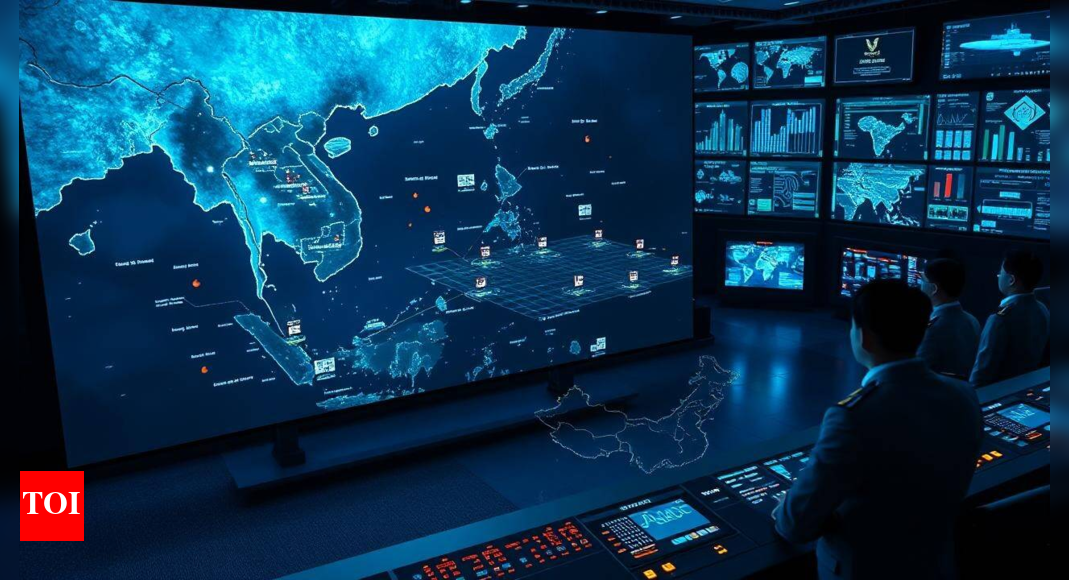

A strategic military map highlighting China’s AI system (AI generated Image)
Psychological warfare has often involved touting technological superiority while suggesting that opponents are powerless against it. That might be the right context in which to view a new study about an advanced artificial intelligence-driven anti-submarine warfare (ASW) system out of China that can reportedly detect 95% of even the stealthiest submarines.Last week, the Hong Kong-based South China Morning Post outlined the study, published in August by the trade journal Electronics Optics & Control. It announced that the china helicopter research and development institute had created an AI system that can simultaneously evaluate measurement data from various sources. From sonar buoys and underwater microphones to water temperature and salinity, the system reportedly creates a dynamic map of the underwater environment in real time.The game-changing technology developed under chief engineer Meng Hao can also respond flexibly to countermeasures such as zigzag maneuvers and the deployment of decoys or drones. The study said that in computer simulations, the system was able to successfully locate the target in about 95% of cases, thus jeopardizing proven methods of submarine camouflage and defense.Another important advance is that the AI translates this complex data into simple action points for military personnel, helping them to make the right decisions quickly, even in stressful situations. In future versions, the team of developers hopes to have the AI system work closely with drone swarms, surface ships and autonomous underwater robots. The aim is to create a three-dimensional, self-learning detection network that adapts to increasingly sophisticated evasion strategies and “scans” the ocean in real time.
A strategic dilemma for world powers
Existing defense strategies would be seriously undermined if the team successfully reaches their goals. The three pillars of nuclear deterrence, known as the “nuclear triad,” consist of land-based intercontinental ballistic missiles, strategic bombers and submarine-launched ballistic missiles.These delivery systems are designed to deter a potential attacker from launching a nuclear first strike because they ensure reliable retaliation. Entire naval fleets, which have so far relied on the strategic hide-and-seek tactics of nuclear-powered submarines, would face uncertainty if their submarine capabilities were threatened.
Psychological warfare?
An important caveat, however, is that military tactics involve not only deterrence, but also psychological warfare. News about things such as the new study are intended to anchor China’s strategic superiority in the public perception. Simultaneously, China has been demonstrating its presence in strategically important waters such as the Taiwan Strait and the South and East China Seas.Gaining control of Taiwan would be particularly significant to the Chinese submarine fleet because they have so far had to launch mainly from shallow waters near the Yulin and Yalong bases on Hainan Island. There, they are easily located by enemy sensors and reconnaissance systems.
Taiwan in the crosshairs
If China could control access to the Pacific Ocean via Taiwan and the surrounding island groups, its submarines would gain direct access to deep water to be deployed more credibly as nuclear second-strike options.This is why China has been heavily upgrading its naval forces in recent years, equipping strategically important sea areas with radar, sonar and buoy chains, in addition to intimidating its neighbors with large-scale naval maneuvers.
Playing cat and mouse
While China is making remarkable progress with AI, western military experts doubt that the new submarine detection system poses an immediate threat to global defense strategies.Professor Paul S. Schmitt, a US expert on strategic and operational naval warfare, told DW that AI has the potential to make submarine hunting more successful by evaluating large amounts of data from different sensors and supporting human decision-makers, but implementation remains difficult because the underwater environment is extremely complex.The idea of a fully networked and integrated AI-controlled solution is an interesting goal for the future, but currently seems optimistic due to the constant arms race between submarine technology and the means to detect it, he said. Schmitt is affiliated with the Naval War College, but noted that his comments do not necessarily represent those of the US Department of War, the Navy or the Naval War College.German security experts have also said maritime armament dynamics are constantly locked in a game of cat and mouse with an uncertain outcome. This is precisely why maritime attack and defense techniques must also be developed dynamically.
The global balance of underwater power
China currently has 105 submarines, the largest fleet worldwide, followed by North Korea (90), the United States (74) and Russia (62).However, modern, nuclear-powered submarines equipped with ballistic missiles (SSBNs) are particularly crucial to strategic competition, and the US has the largest and most advanced fleet, with around 14 Ohio-class SSBNs and more than 50 modern attack submarines. Russia follows with around 16 strategic submarines and numerous other nuclear attack and cruise missile submarines.Meanwhile, China is rapidly expanding its fleet with at least six Jin-class and one Xia-class SSBNs, as well as several other new types. The United Kingdom and France each ensure their strategic security with four SSBNs (Vanguard and Triomphant classes, respectively) and additional nuclear-powered attack submarines.Germany relies on modern diesel-electric submarines and plays a leading role in conventional technology, but does not have nuclear capabilities. Other relevant NATO countries with submarines include Italy, Spain, Norway, Sweden, the Netherlands, Canada and Turkey, which rely on proven conventional technology. Go to Source