
Forty Thousand Cubic Meters of Fresh Water Flow from the Congo into the Atlantic Every Second. A New Study Traces Where It Goes from There.
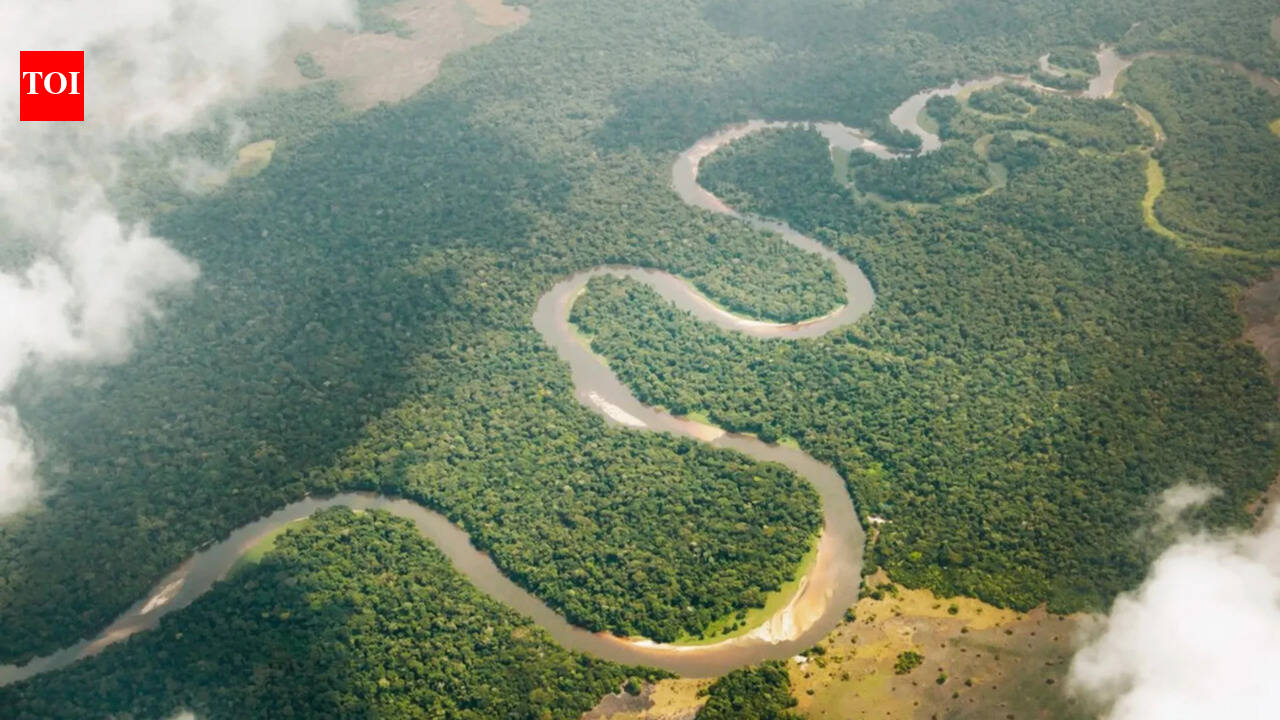
Every second, the Congo River releases about 40,000 cubic metres of freshwater into the Atlantic Ocean. That makes it the world’s second largest river by discharge. But once that enormous volume of water reaches the sea, where does it go?A new study has answered that question by following the river’s freshwater after it leaves the African coast. Using a high-resolution computer model, satellite observations and measurements collected at sea, researchers found that giant swirling ocean currents can trap freshwater from the Congo River and carry it hundreds of kilometres into the open Atlantic.The findings show that this movement is not steady or gradual. Instead, short-lived but powerful ocean events do much of the work, helping transport freshwater, nutrients and other materials far from the river mouth. The researchers say this has important implications for ocean circulation, climate, marine ecosystems and fisheries across the tropical Atlantic.
A freshwater plume stretching 800 kilometres
The Congo River is one of the world’s biggest sources of freshwater flowing into the ocean. On average, it releases around 40,000 cubic metres of water every second. At its mouth, near the west coast of Central Africa, that freshwater spreads across the ocean surface to form a vast plume, or broad area of less salty water, stretching as far as 800 kilometres offshore. This plume changes with the seasons.The river reaches its highest discharge around December, while the amount of water falls to its lowest level around August. Because of this seasonal cycle, the freshwater plume grows and reaches its greatest offshore extent around March before shrinking again during July and August.During the wetter part of the year, from January to April, the plume shifts towards the south-west under the influence of winds, ocean currents and the shape of the coastline. It is during this period that large rotating ocean currents known as mesoscale eddies become especially important.Mesoscale eddies are huge circular currents that can measure hundreds of kilometres across and last for weeks or even months. They behave like giant spinning pools in the ocean, trapping water inside them as they move.
Following the water into the Atlantic
To understand how these eddies affect the Congo River plume, scientists from the Laboratory of Space Geophysical and Oceanographic Studies (LEGOS) and collaborating institutions focused on conditions during 2016. They chose that year because it offered an unusually rich collection of observations from satellites, ships and ocean monitoring instruments.The researchers used NEMO, short for Nucleus for European Modelling of the Ocean, a sophisticated computer model that simulates ocean circulation at a resolution of about three kilometres. The model covered the Gulf of Guinea and surrounding waters and included daily measurements of Congo River discharge.To check that the simulation reflected real conditions, the team compared it with several independent sources of information. These included sea surface salinity data from NASA’s Soil Moisture Active Passive satellite, sea surface height measurements from satellite altimeters, current measurements from the Prediction and Research Moored Array in the Tropical Atlantic, known as PIRATA, and surface currents estimated using Automatic Identification System data from ships processed by eOdyn.The comparisons showed that the model accurately reproduced the size, position and seasonal movement of the Congo River plume, giving the researchers confidence to examine individual events in greater detail.
A giant ocean whirlpool changes the picture
One event in particular stood out.During March and April 2016, a large anticyclonic eddy formed close to the freshwater plume. In the Southern Hemisphere, an anticyclonic eddy rotates counterclockwise. The spinning current survived for 49 days and eventually reached a radius of about 150 kilometres.As it rotated, the eddy trapped low-salinity water from the Congo River plume in its centre. It then carried that freshwater roughly 200 kilometres away from the coast before eventually breaking apart.
Tracking more than 5,000 virtual particles
To discover exactly where the trapped water had come from, the researchers carried out particle-tracking experiments. They released more than 5,000 virtual particles inside the computer model and traced them backwards through time.The results showed that the water found inside the centre of the eddy during April could be traced back to the southern part of the Congo River plume in early March.That finding revealed something important. Rather than freshwater slowly spreading into the Atlantic through continuous mixing, much of the transport happens during occasional but intense events when large eddies capture and carry river water offshore.
Freshwater moves in bursts, not steadily
The scientists also examined how freshwater moved in and out of the study area over the course of the year.They found that most of the net export of freshwater travelled westwards into the Atlantic. The strongest changes in salinity, or the amount of salt dissolved in seawater, came from water entering the study area from the eastern boundary and from vertical mixing between surface and deeper layers.The role of mesoscale eddies was different. Their effect was intense but intermittent. During periods when the freshwater plume stretched furthest offshore, these spinning currents could dominate the movement of river water into the open ocean.The team also looked at even smaller swirling features called submesoscale eddies. These are only a few kilometres wide and exist for much shorter periods. While they generally played a smaller role over the year, they occasionally accounted for more than 30 per cent of salinity transport during short-lived events.Despite these bursts of activity, the researchers found that the overall seasonal cycle remained the main driver of freshwater movement over the course of the year.
Why these swirling currents matter
The Congo River plume is important for far more than ocean salinity.The river carries large amounts of dissolved organic carbon, nutrients and other materials that help support marine life. Previous studies have shown that the Congo ranks among the world’s largest rivers for exporting particulate organic carbon into the ocean. Those nutrients can boost biological productivity, supporting plankton that forms the base of the marine food web.As the freshwater spreads through the Atlantic, it also affects how heat, salt and other substances are distributed in the upper ocean. Those changes can influence regional ocean circulation and, in turn, climate patterns.By showing how giant eddies move freshwater away from the coast, the study offers a clearer picture of how these materials are redistributed across the tropical Atlantic.
What comes next for researchers
The researchers say their work shows the importance of mesoscale ocean activity in carrying freshwater away from the Congo River during short but significant episodes. At the same time, they caution that their analysis focused on a single year.Future research covering multiple years will be needed to understand how these processes change from one year to the next and to make use of new high-resolution satellite missions that will provide an even more detailed view of ocean currents.The findings were published in the peer-reviewed Journal of Geophysical Research: Oceans on 10 June 2026. The study, titled Dynamics off the Congo River and Its Impact on the Water Exchange Between the Coastal and Open Ocean at Different Timescales, was led by C. Cardot and co-authored by I. Dadou, D. C. Napolitano, H. M. A. Aguedjou, R. Ngakala, Y. Morel, G. Morvan, G. Alory, C. Le Goff, G. Jan and J. Jouanno. The researchers used a high-resolution NEMO ocean model together with satellite observations and in situ measurements to investigate how freshwater from the Congo River is transported into the Atlantic Ocean. Go to Source