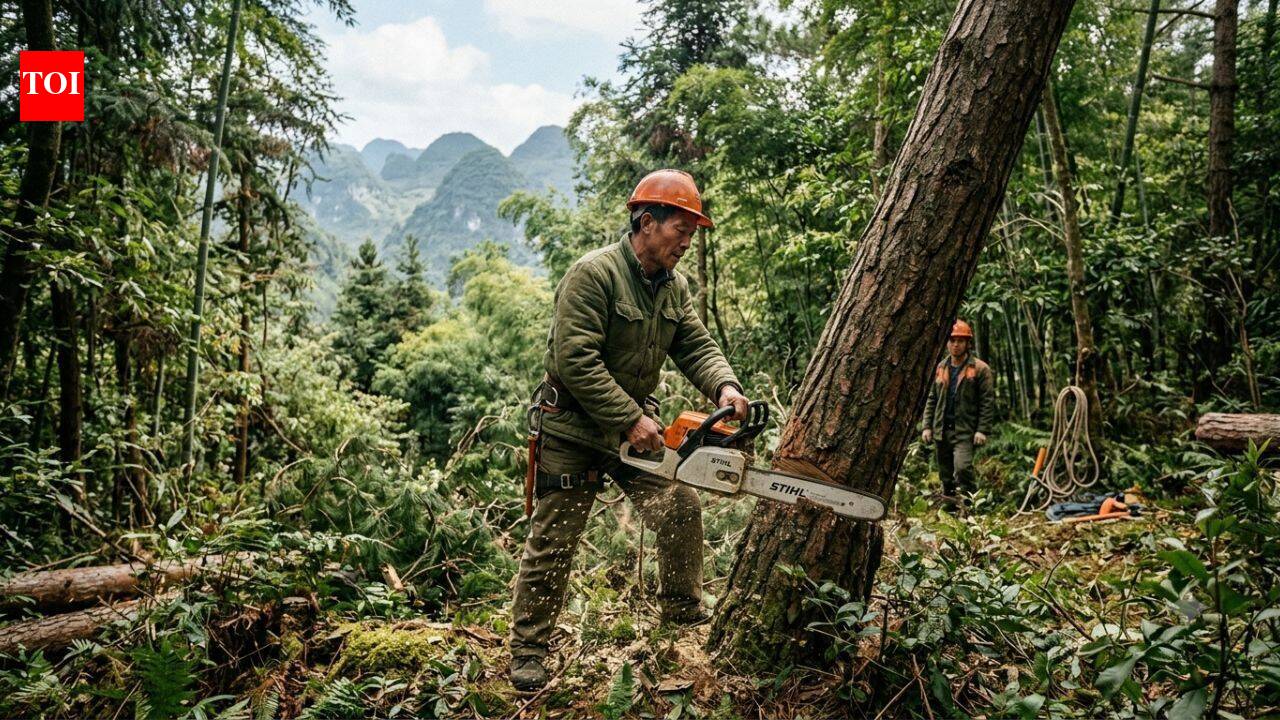

China’s tree cover increased, but natural forests kept shrinking and fragmenting. (AI photo)
China’s ambitious tree-planting campaigns have helped increase the country’s overall forest cover over the past three decades. But a new study says the growth in planted forests tells only part of the story.While millions of hectares of trees were added to the country’s forest cover, natural forests continued to shrink and became increasingly fragmented.The study, published in Communications Earth & Environment, reported Nature Portfolio, found that China gained 447,500 square kilometres of planted forest between 1990 and 2020, but lost 219,100 square kilometres of natural forest during the same period.By 2020, only 9.6% of the country’s natural forests remained fully intact.
More trees, fewer forests
The researchers analysed forest changes across China from 1990 to 2020 using maps that separated natural forests from planted forests.Their findings showed that fragmentation of natural forests increased across 60% to 64% of China’s provinces and counties. The biggest increases were recorded in tropical and subtropical regions in southern China, including provinces such as Fujian, Guangxi and Hainan.At the same time, fragmentation of planted forests declined across the country. Before 2010, planted forests were generally more fragmented than natural forests. But after 2010, that pattern changed with natural forests becoming more fragmented than planted forests.The researchers also observed that fragmentation increased gradually during the 1990s before accelerating between 2000 and 2015. The fastest rise occurred between 2005 and 2010. After 2015, fragmentation slowed in many parts of the country, although natural forests remained more fragmented than before.The study says combining all forest types into one national figure can hide these differences and create the impression that forests are becoming healthier simply because overall tree cover has increased.
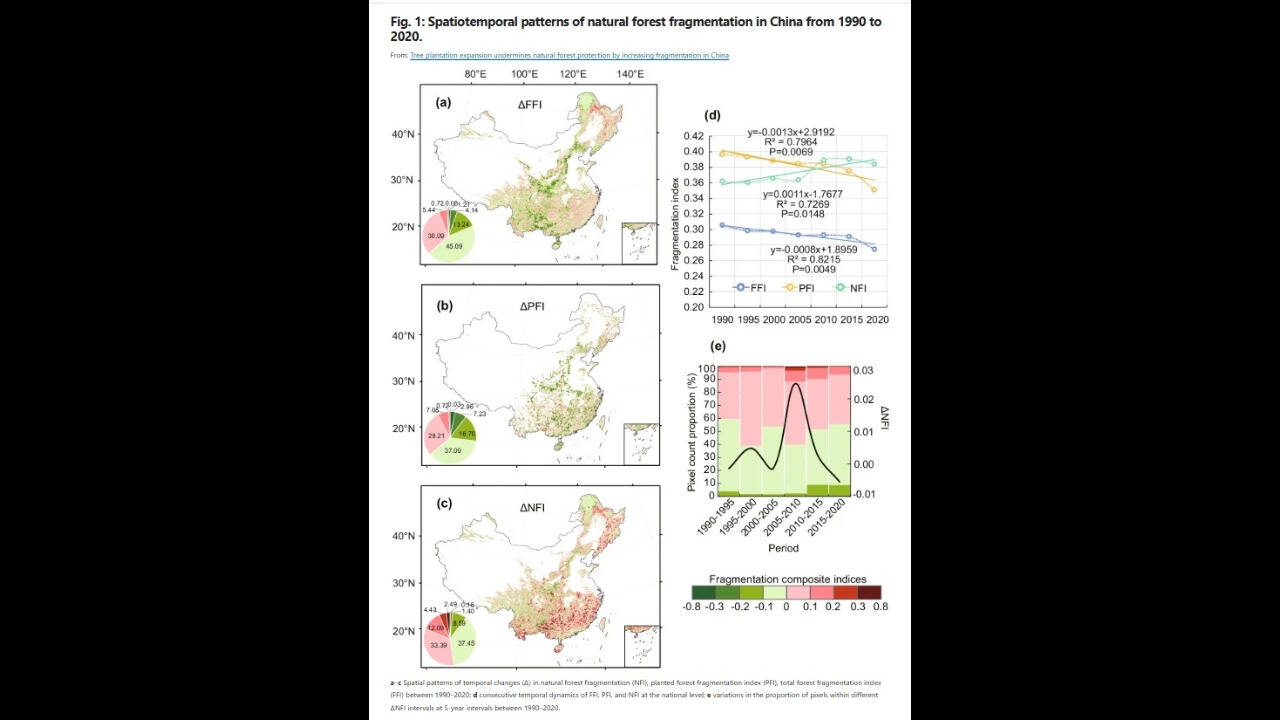
Natural forest fragmentation in China (Picture: Nature portfolio)
Plantations drove fragmentation
One of the main drivers identified by the researchers was the rapid expansion of tree plantations. Unlike natural forests, tree plantations are done for timber production or commercial use. Many plantations contain only one or two tree species, while natural forests support a much wider variety.The study found that about 34% of the increase in planted forests came from tree plantations. More importantly, researchers found that 56% of new tree plantation growth took place within one kilometre of the edges of natural forests. Another 20% was established just outside these forest boundaries.This pattern is important because plantations built along the edges of natural forests create new forest boundaries. Instead of one continuous forest, the landscape becomes divided into smaller patches separated by plantations or other land uses.The researchers also found that large areas of core natural forest were either converted to non-natural forests or degraded into forest edges during the study period. According to the study, around 37% of lost core forests were converted to non-natural forests, while another 23% became forest edges.
Cost of fragmentation
Forest fragmentation is different from simply losing trees. A forest may contain many trees, but if it is divided into small and isolated patches, it becomes harder for wildlife to move between habitats. Plants and animals become more isolated and the edges of forests become more exposed to heat, wind and human activity.The study notes that more than 70% of the world’s forests are already located within one kilometre of a forest edge. Over the past 35 years, forest fragmentation has contributed to biodiversity loss and ecosystem degradation around the world.The researchers say natural forests are especially valuable because they support biodiversity, store carbon, protect soils and are generally more resilient than commercially planted forests.Their analysis also showed that tree plantation expansion worked together with logging and cropland expansion, making fragmentation even worse.At local levels, these combined pressures had a greater impact than any single factor. In southern China, plantation expansion explained much of the increase in fragmentation. In northern regions, climate-related factors such as rainfall, drought and temperature also interacted with land-use changes.
Few forests remain intact
The researchers also examined how much of China’s natural forests remain in an undisturbed condition. They found that by 2020, only 9.58% of China’s natural forests remained intact. Nearly 49% were affected by extensive forest edges, showing how widespread fragmentation has become.The remaining intact forests are mainly located in remote regions such as the southern flank of the Eastern Himalayas, the Greater and Lesser Khingan Mountains, the Changbai Mountains, the Qinling Mountains and Shennongjia.Even there, protection remains limited. According to the study, only about 9.9% of intact forests and just over 9% of all core natural forests are protected inside national nature reserves.Using information on fragmentation, forest structure, protected areas and the Natural Forest Protection Program, the researchers identified around 219,400 square kilometres as priority areas for future conservation.While the study identified growing fragmentation across much of China, it also found that one major conservation policy helped reduce the problem. China launched the Natural Forest Protection Program (NFPP) in 2000 to protect natural forests and reduce logging.The researchers say future forest restoration should focus not only on planting more trees but also on protecting existing natural forests.They recommend expanding the Natural Forest Protection Program into lowland tropical and subtropical regions, where fragmentation remains high and protection is limited. Go to Source