
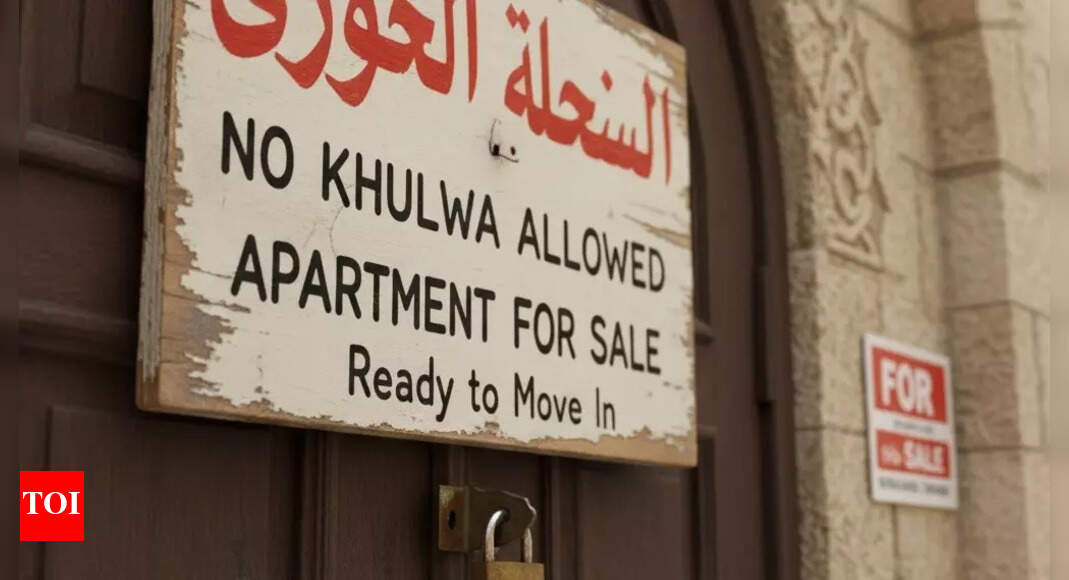

Legal consequences of unrelated men and women alone in a apartment / AI-generated illustration via
If unmarried men and women are found alone together in private in Saudi Arabia, they can be investigated and, depending on the circumstances and evidence, face police questioning, short detention, criminal charges, fines or deportation for foreigners. Enforcement varies by case, location and the presence of aggravating evidence (explicit images, drugs, complaints), but the risk is real enough that people should not assume informal tolerance equals legal safety.
Understanding Khulwa Law
In many Gulf Cooperation Council (GCC) countries, particularly Saudi Arabia, laws derived from Islamic Sharia prohibit khulwa, which refers to the unlawful seclusion of an unrelated man and woman in a private place without a lawful chaperone (mahram). While massive social reforms have recently eased restrictions on gender mixing in public spaces, the laws governing private conduct, especially within residences, remain in effect and are systemically criminalized. Saudi legal experts clarify that a social gathering of young men and women in an apartment, often referred to as a “soirée,” is both religiously forbidden and a criminal offense under the legal system.
When simple Khulwa becomes a major crime
While the act of khulwa itself may not immediately lead to jail time, the reality of legal enforcement means that authorities look for evidence of greater moral or criminal corruption. The penalties escalate dramatically if other illegal activities are discovered during the investigation or search of the scene.The key turning point that transforms the non-detainable offense into a major crime is the discovery of:
- Photos or evidence of illegal drugs.
- Pornographic clips or images found on the individuals’ mobile phones.
If such illegal content is discovered, the offense becomes classified as a major crime requiring mandatory detention (mujibah li-al-tawqif). In this aggravated scenario, individuals found with the illegal content are kept in detention pending trial, while others in the group who do not possess such material may still be released on bail.
Initial penalties
Although the act of khulwa is classified as a criminal offense, it does not automatically trigger the most severe penalties. This is a critical distinction clarified by Saudi legal analysts.
- Non-Detainable Offense: For a simple case of khulwa (where no other crimes are immediately evident), the offense is not considered a major crime requiring mandatory detention.
- Release on Bail: Typically, after an initial investigation into the circumstances of the gathering, the individuals involved are released on bail or personal guarantee.
- Legal Process: They are released from custody to await trial for the initial offense, confirming that the gathering itself, though prohibited, is not always grounds for immediate imprisonment.
The fall of Khulwa enforcement
To understand the current law, it is essential to recognize the dramatic changes in enforcement over the last decade. Historically, the law against khulwa was enforced publicly by the Committee for the Promotion of Virtue and the Prevention of Vice (CPVPV), commonly known as the religious police or Mutaween.
- The Mutaween’s Role: Drawing from the Islamic principle of hisbah (enjoining good and forbidding wrong), the Mutaween had extensive powers for decades, patrolling public areas to enforce strict rules on gender segregation (ikhtilat), dress codes, and prayer attendance.
- The Crucial Legal Shift (2016): In a landmark move, the Saudi cabinet issued a royal decree in April 2016 that fundamentally curtailed the religious police’s authority. This ruling stripped the Mutaween of the power to arrest, pursue, detain, or request identification from suspects. Their role was officially downgraded to advising, acting “kindly and gently,” and reporting violations solely to the regular police or anti-drug forces. This move essentially ended the aggressive public enforcement of khulwa by the morality police.
- The Final Easing (2019): Following the 2016 decree, the Ministry of Municipalities and Rural Affairs announced in December 2019 that restaurants and cafes were no longer required to maintain segregated entrances for single men and families/women, making gender mixing in public social settings optional.
These reforms clarified that while the religious prohibition on khulwa remains part of the cultural and legal background, the government has decisively stopped the aggressive policing of gender mixing in public.
Is living together legal?
The simple answer is that for Saudi citizens and expatriate residents, it is illegal for unrelated, unmarried men and women to live together habitually in an apartment or shared residence.
- Living together is not a one-time offense but a continuous, sustained state of unlawful seclusion (khulwa). It is considered a prolonged “assembly for corruption,” falling under the same criminal classification as the apartment gathering. While the law is not aggressively enforced in the public sphere anymore, the underlying prohibition against cohabitation outside of marriage remains on the books for residents.
- While Saudi Arabia made changes to its laws to accommodate international tourism—specifically allowing unmarried foreign couples to share hotel rooms—this specific reform does not extend to residents renting apartments or habitually cohabiting. The hotel exemption is a specific, limited carve-out for tourism.
- For residents, the risk of legal action exists if authorities are notified, especially if the activity is deemed to be a public disturbance or leads to the discovery of illegal activities. Because the penalties for khulwa are tied to judicial discretion and aggravating factors (like pornography or drugs), living together continually carries a significant, sustained risk of triggering police intervention and subsequent legal penalty, including mandatory detention if those aggravating factors are present.
Living together is not legal for unmarried residents and citizens; it is a serious form of khulwa. The primary distinction in current Saudi law is between the publicly permitted mixing (which is now optional/allowed) and the privately prohibited cohabitation/seclusion (which is still criminalized). Go to Source

