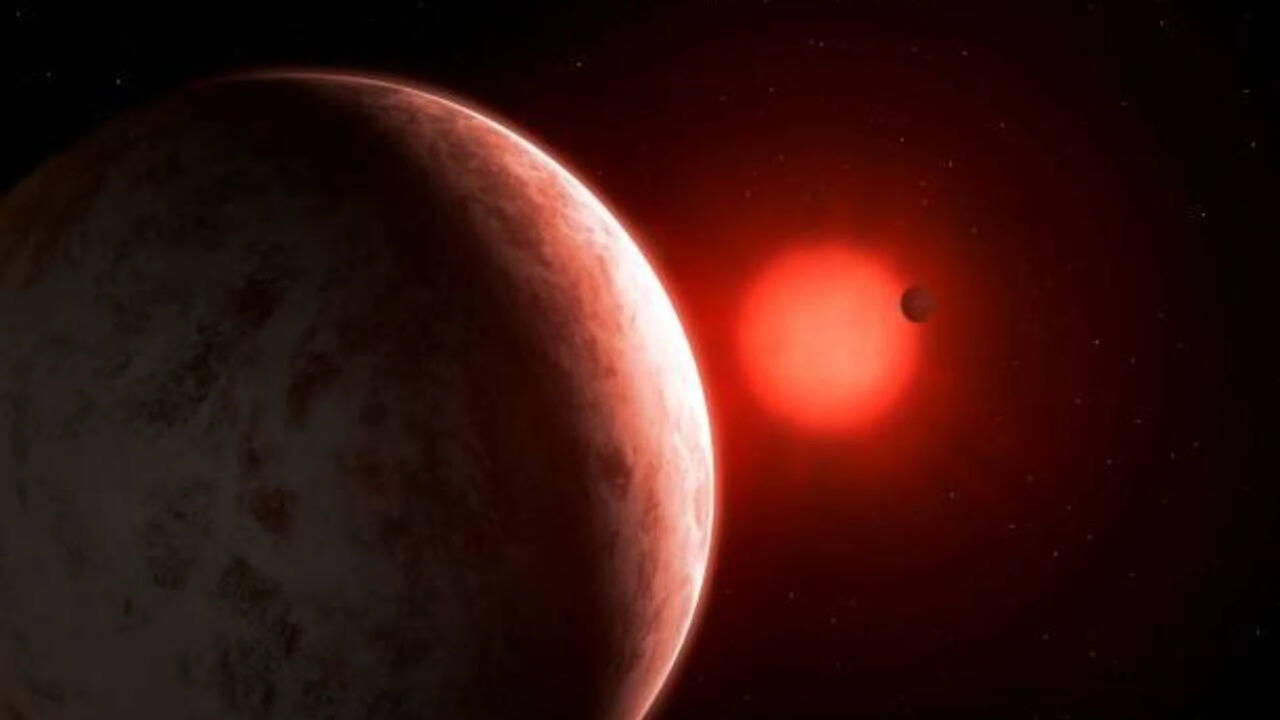

This might be the closest humans have come to finding another planet that can support life. In a shocking discovery, astronomers have detected an atmosphere around an Earth-like, rocky planet about 48 light-years away.The planet, called LHS 1140 b, is orbiting in the habitable zone around its star meaning that it is at the right distance away from its star for liquid water to potentially exist on the planet. According to the new research published in the journal Science, it has an atmosphere that contains helium and is also the first rocky planet to have an atmosphere detected directly.”We have actually detected directly the helium present in the atmosphere itself, and that’s the first direct detection for any rocky exoplanet, which is really exciting … and then there’s this added bonus that it’s in the habitable zone, which is super exciting for astrobiology and habitability and searching for life,” lead author Collin Cherubim, who recently earned his Ph.D. from Harvard University, told Space.com. “It feels kind of surreal.”
How is the planet like?

While a few rocky planets have been found in their star’s habitable zone, none have had an atmosphere like this one.
The discovery of the first exoplanet was confirmed just over 30 years ago. Since then, scientists have found over 6,000 exoplanets and more. While a few rocky planets have been found in their star’s habitable zone, none have had an atmosphere.To prove that this planet has an atmosphere, the team started with a prediction Cherubim made during graduate school, using a theoretical model and a suspicion that there must be rocky exoplanets with atmospheres other than Earth. “I went out and did a pretty unexpected, weird thing using this technique that’s typically reserved for observing giant planets, and I used it for a rocky planet, which nobody has done before. And lo and behold, I made this measurement that was actually consistent with my prediction. And it was really nice to kind of close the whole loop of the scientific method,” he said.One reason why scientists have had a hard time finding such planets with atmospheres is their stars. LHS 1140 b orbits the most common type of star, a red dwarf, which is about one-third the size of our sun. This type of star remains active for a lot longer than stars like our sun. This activity means it releases bursts of extreme radiation like solar flares and coronal mass ejections, which can totally strip the atmosphere from the planets orbiting them.”This discovery is a big deal because it’s showing that at least this rocky planet has retained an atmosphere over billions of years,” Cherubim said. It’s “a bona fide, robust way of saying yes, atmospheres can survive on rocky exoplanets.”There’s a possibility that other gases beyond helium are present in the planet’s atmosphere. But the red dwarf that this planet orbits is roughly 6 billion years old, a few billion years older than the age at which its extreme radiation activity begins calming down. So while some helium is still slowly escaping the planet’s atmosphere over time, the team expects the planet to retain an atmosphere, Dittman shared. After all, even Earth’s helium is slowly escaping our own atmosphere.
Are there alien inhabitants?

Currently, the researchers lack enough data to make that conjecture
When looking at a planet that is rocky, has an atmosphere and is in the habitable zone, the question of existing life comes up quickly. But currently, the researchers lack enough data to make that conjecture. “I’m not claiming this planet has life,” Cherubim made clear. Further observations might not be able to confirm habitability or identify any life on the planet, but they could at least help better understand planets like this.As scientists and astronomers continue to search for planets that can be considered “habitable”, this planet checks more boxes than anyone before. Go to Source